
DOWNLOAD THE APP


Customer Services
Copyright © 2025 Desertcart Holdings Limited
DOWNLOAD THE APP


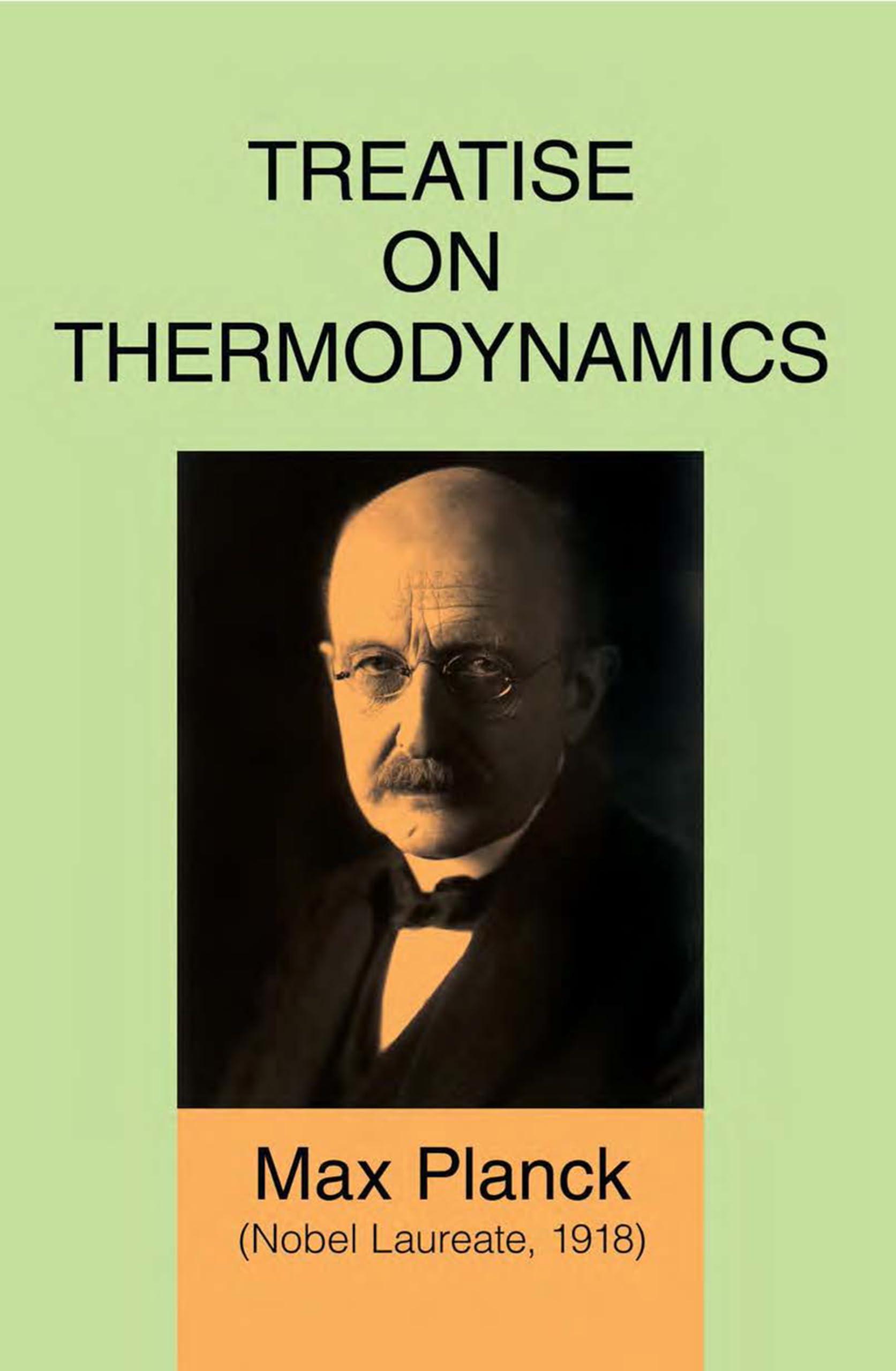

Buy Treatise on Thermodynamics (Dover Books on Physics) on desertcart.com ✓ FREE SHIPPING on qualified orders Review: Master's book - Max Planck teached Thermodynamics during 32 years and you notice that trough the well edited, clearly written, easy to understand numerical examples, near the expierience of your own senses... I realized that the examples presented by Einstein in his book: The evolution of Physics edited in 1938 were a copy of the 1897 edition in german of this book. Students of Chemical Engineering should read this book. It is necessary that the reader study Calculus... partial differential equations to better grasp the themes... This book is comparable to The Principia of Isaac Newton... both authors return more value for the dollar you spend... Both are authors that current teachers unjustly do not recommend to their students to read their books or they just mention them superficially... This book presses me to be a more serious and scientific professional... Dover did a great job making 3 editions in English of this book... the mathematical notation is clean and adequate... Review: Physical content - Physical concepts are accurate and clearly expressed. Remarkable is the presentation of energy, physical property that induced much debate among scientists.
| ASIN | 048666371X |
| Best Sellers Rank | #461,584 in Books ( See Top 100 in Books ) #16 in Physics of Entropy #64 in Thermodynamics (Books) #3,532 in Mathematics (Books) |
| Customer Reviews | 4.1 4.1 out of 5 stars (43) |
| Dimensions | 5.5 x 0.75 x 8 inches |
| Edition | Reprint |
| ISBN-10 | 9780486663715 |
| ISBN-13 | 978-0486663715 |
| Item Weight | 10.4 ounces |
| Language | English |
| Print length | 320 pages |
| Publication date | June 17, 2010 |
| Publisher | Dover Publications |
R**A
Master's book
Max Planck teached Thermodynamics during 32 years and you notice that trough the well edited, clearly written, easy to understand numerical examples, near the expierience of your own senses... I realized that the examples presented by Einstein in his book: The evolution of Physics edited in 1938 were a copy of the 1897 edition in german of this book. Students of Chemical Engineering should read this book. It is necessary that the reader study Calculus... partial differential equations to better grasp the themes... This book is comparable to The Principia of Isaac Newton... both authors return more value for the dollar you spend... Both are authors that current teachers unjustly do not recommend to their students to read their books or they just mention them superficially... This book presses me to be a more serious and scientific professional... Dover did a great job making 3 editions in English of this book... the mathematical notation is clean and adequate...
D**U
Physical content
Physical concepts are accurate and clearly expressed. Remarkable is the presentation of energy, physical property that induced much debate among scientists.
9**G
Three Stars
delivered as expected, classic book, hard to read
G**Y
Planck: "inductive treatment used exclusively in this book."
As with many a mature topic in physics, many textbooks from which to learn the material are extant. Classical thermodynamics is hardly an exception. There are textbooks, both modern and vintage (the tendency of those modern textbooks is to weave together micro- and-macroscopic aspects). The vintage material is more focused on developing classical thermodynamics, in so far as possible, without reliance on statistical foundations. Two textbooks adhere to that outlook: Enrico Fermi’s 1936 lecture notes (Dover edition published 1956) and Max Planck’s 1922 treatise (English edition 1926, Dover edition 1945). Fermi is 160 pages, Planck runs to 290 pages. Fermi and Planck complement each other and I suggest to first study Fermi, then turn to Planck. (1) Fermi and Planck are similar in pedagogic approach: Theory is developed at length, after which applications. Planck says this: “it is still very uncertain whether the molecules of liquid water are the same as those of ice.” (page 139). Remember, this is 1922 ! Time to read chapter one of Chaikin and Lubensky (1995, pages 1-25). Planck performs the feat of situating the “second law” squarely within confines of experiment. Planck utilizes the second law to determine the absolute temperature of a substance (page 134, thus, a reversal of the usual sequence of: equilibrium, to temperature, to entropy--see Reif, chapter three). Entropy maximum and relative maximums are elucidated and demarcated (pages 139-144). (2) The discussion of Carnot engine is a model of lucidity (pages 63-68). Fermi is terse (pages 31-34). Planck uses the notation I prefer (dU = Q + W, work “done on the substance” page 92). Fermi utilizes the opposite sign-convention, W is opposite in sign (work done “by the system on the environment” page 17). It is most helpful to read chapter three of Chaikin and Lubensky (especially, pages 108-117). (3) Complementary aspects of Fermi and Planck are evident in their respective discussions of dilute solutions (Fermi, pages 113-130; Planck, pages 229-271). Planck begins with a mathematical theorem. Then, he proceeds to another derivation of Carnot-Clapeyron equation (page 243). (4) Footnotes are informative: “the following discussion, of course, deals with the meaning of the second law only in so far as it can be surveyed from the points of view contained in this work avoiding all atomic hypothesis.” (page 105). Notation is explained in another footnote (page 57, for example, avoiding using dQ). (5) Mechanical equivalent of heat, described and encountered often (page: 55, 63), where Ryogo Kubo writes "equivalence of heat and work means essentially the first law..." (page 9). Planck presents rather few diagrams. (6) Read Planck: “presumably, the time will come when the principle of the increase in entropy will be presented without any connection with experiment.” (page 107). Caratheodory took a step in just that direction (Adkins, chapter six, pages 93-104). Chandrasekhar: “Caratheodory’s theory enables us to obtain all the mathematical consequences of the second law without further physical discussion.” (page 24, 1939, Introduction to the Study of Stellar Structure). (7) More from Planck: “the energy and entropy ‘of the world’ have no meaning because such quantities admit of no accurate definition.” (page 104). Read: “that a process be irreversible, it is not sufficient that it cannot be directly reversed.” (page 84). Finally: “the Law, once discovered, must receive recognition of its independence--at least in so far as Natural Law can be said to exist--independent of Mind.” (page 106). (8) Max Planck has provided his outlook on classical thermodynamics. Enrico Fermi has done the same. Both books should be part of your library. Two masterful physicists expounding one topic: classical thermodynamics. I suggest a possible route: Fermi, then Planck, then Adkins' delightful textbook. Then, statistical mechanics.
D**N
Excellent Dirk Cornelis
Excellent Dirk Cornelis Krispijn
Z**O
Reading unfortunate Planck
Planck submitted his doctoral dissertation in 1879, at the age of 21. According to Planck’s autobiography, his dissertation elaborated on Clausius's entropy and its role in distinguishing reversible and irreversible processes. His dissertation failed to interest his professors, Helmholtz and Kirchhoff among them. Planck subsequently, as a young academic, applied the principle of the increase of entropy to analyze phases and ideal-gas mixtures. "Unfortunately," he wrote in his autobiography, "as I was to learn only subsequently, the very same theorems had been obtained before me, in fact partly in an even more universal form, by the great American theoretical physicist Josiah Willard Gibbs, so that in this particular field no recognition was to be mine." Clausius named entropy in 1865, and Gibbs published his 300-page paper in 1878. Planck again: "Obviously, this battle, in which Boltzmann and Ostwald represented the opposing views, was fought rather heatedly, and produced also many a drastic effect, for the two antagonists were each other’s equals in quick repartee and natural wit. After all that I have related, in this duel of minds I could play only the part of a second to Boltzmann—a second whose services were evidently not appreciated, not even noticed, by him." Picture the young Planck struggling in the field of giants. It is fortunate for us that he kept working and publishing on thermodynamics, which led to this remarkable textbook, Treatise on Thermodynamics. In many ways his textbook marked the beginning of the teaching of thermodynamics in its finished form. The book itself is a phase transition in the pedagogy of thermodynamics, and is particularly significant to people who wish to see the evolution of various elements of what we teach today. His devotion to thermodynamics also prepared him for the discovery of quantum mechanics in 1900. The book, Treatise on Thermodynamics, has four parts: temperature, energy, entropy, and applications. The first 3 parts are perhaps confusing to today's students, but are full of interesting and significant ideas. The last part is superb. Here we have unusually clear treatments of phases, mixtures, reactions, and dilute solutions, all started from the principle of the increase of entropy. On these topics, the quality of Planck’s book surpasses Fermi’s book and perhaps all modern textbooks. For example, in chapter II of part 4, he developed the theory of phases of a pure substance. His theory is analytical and compliments Gibbs's graphic method. It is sad that both methods have been removed from most textbooks used today. Planck's book has less than 300 pages, and contains only 5 figures. Figure 4 is interesting and important. Planck drew a phase diagram of a pure substance in the plane with energy and volume as axes. He made an error: he drew a critical point for solid-liquid transition. The figure is analogous to that drawn by Gibbs, who used volume and entropy as independent variables, which was a complication. (Gibbs, however, did not draw a critical point for the solid-liquid transition.) Planck also avoided another complication introduced by Gibbs: the Gibbs function. Gibbs seemed to like to hide entropy, and dress entropy up into “free energy”. In Chapter III of Part 3, Planck considered a body in thermal contact with a reservoir of a fixed temperature, and subject to a constant pressure (say applied by a weight). The body, the reservoir and the weight together constitute an isolated system. The isolated system conserves energy and maximizes entropy. The Planck function (equation 75) is simply the entropy of this isolated system. The Planck function plays the same role as the Gibbs function, but removes the needless conversion from the basic principle of the increase of entropy. But Gibbs won. Modern textbooks use the Gibbs function. Reading old masters lets us relive their struggle in discovering ideas and putting them together.
L**S
O livro veio bem encapado, sem defeitos perceptíveis e folhas novas. Conforme a descrição, de fato trata-se de uma cópia fotográfica das páginas de um dos livros originais, o que significa que não foi redigido em fontes modernas. No geral é um livro bacana para quem quer entender melhor sobre termodinâmica.
D**.
Max Planck, seit 1889 Professor für Theoretische Physik in Berlin, begründete 1900 die Quantentheorie, für die ihm 1919 der Nobelpreis verliehen wurde. Die Entdeckung ist Teil von zahlreichen Erkenntnissen, die Planck auf dem Gebiet der Thermodynamik erzielt hat. Während seines Studiums in München hört Planck u.a. Kirchhoffs Vorlesungen über Wärmetheorie, die Schriften von Clausius beeindrucken ihn wegen ihrer beispielhaften Klarheit, schließlich promoviert er über den Clausiusschen Entropie Begriff. Diese Studien zur Entropie setzen sich mit Untersuchungen zu dissoziierten Gasen und verdünnten Lösungen fort, und bilden letztlich auch die Grundlage für die Behandlung der Hohlraumstrahlung. Wie der Autor im Vorwort zur ersten Auflagen (1897) betont, wurde er wiederholt darum gebeten seine Arbeiten zur Thermodynamik zusammen zufassen; eine Sammlung der entsprechenden Originalpublikationen wäre die einfachste, zeitsparendste Möglichkeit gewesen, Planck entschließt sich aber zu einer Überarbeitung des gesamten Stoffs, ergänzt die knappen Darstellungen mit ausführlichen und verständlichen Beweisen, denn er wollte die Gelegenheit wahrzunehmen, die Thermodynamik in einer einheitlichen Form zu einem Lehrbuch zusammenzufassen, das auch als Einführung in dieses Thema für Studierende dienen kann. Planck folgt damit Rudolf Clausius, der sein berühmtes Werk 'Die mechanische Wärmetheorie' mit der zweiten Auflage (1876) ebenfalls zu einem Textbuch umgearbeitet hat. Von den drei sehr verschiedene Methoden der Präsentation der Thermodynamik, erstens der von Joule, Clausius und Maxwell geschaffenen, und von Boltzmann wesentlich erweiterten, kinetischen Wärmetheorie, die bei den Vorstellungen über die Art der Wärmebewegung am weitesten geht und am tiefsten schürft, die aber bei der mathematischen Durchführung des komplizierten Programms auch auf Hindernisse stößt, zweitens die Methode von Helmholtz, die nur allgemeine Voraussetzungen über die mechanische Wärmebewegung verwendet, bevorzugt Planck eine dritte induktive Darstellung, diese beruft sich zwar auch auf die mechanische Natur der Wärme, beginnt aber mit einfachen, allgemeinen Erfahrungstatsachen – insbesondere den Hauptsätzen der Wärmelehre, aus denen sich eine Vielzahl von Sätzen über Phänomene aus Physik und Chemie ableiten lassen – das scheint ihm der fruchtbarste Weg zu sein. Folgerichtig beginnt das Werk mit der Erörterung von Erfahrungstatsachen über den Wärmeaustausch zwischen Körpern, die einem Gleichgewicht zustreben. Systematische Betrachtungen zeigen, dass die Eigenschaft von Körpern, im Wärmegleichgewicht zu stehen, transitiv ist, auf dieser Grundlage wird der Begriff der Temperatur eingeführt. Der zweite grundlegende Begriff, die Wärmemenge, spiegelt die Erfahrungstatsachen wider, dass Körper gleicher Temperatur aber unterschiedlicher Materialien, die mit einem Vergleichskörper in Kontakt gebracht werden, bei diesem unterschiedliche Temperaturänderungen verursachen. Temperatur und Wärmemenge, gemeinsam mit den mechanischen Eigenschaften von Körpern, bilden die begriffliche Basis von Plancks Wärmetheorie; entsprechend des induktiven Ansatzes, formulieren die beiden Hauptsätze fundamentalen Erfahrungstatsachen, aus denen die Theorie systematisch entwickelt wird. Der erste Hauptsatz konstatiert das Prinzip der Erhaltung der Energie unter Einbeziehung von Wärmemengen, mechanischer Arbeit und innerer Energie eines Systems. Hingegen postuliert der zweite Hauptsatz die Unmöglichkeit eines Prozesses, der nur Arbeit leistet und Wärme einem Reservoir entzieht, während er alle andern Körper unverändert lässt. Der letzte Teil des Buches ist Anwendungen der Theorie gewidmet. Es werden homogene Systeme, Systeme mit verschieden Aggregatzuständen, gasförmige Systeme und verdünnte Lösungen betrachtet. Abschließend wird Nerst's Theorem diskutiert, aus dem Absolutwerte für Entropien abgeleitet werden können. Plancks Buch ist meisterlich konstruiert, in klarer aber knapper Sprache, wird die Theorie entwickelt; der Text ist in 297 durchnummerierte Paragraphen gegliedert, diese Paragraphen enthalten in nicht zu geringer Zahl verbale Erläuterungen, die die Hintergründe und Zusammenhänge der entwickelten Theorie mit den physikalischen Phänomenen in Verbindung bringen. Diese Gestaltung entspricht ganz dem von Planck gewählten induktiven Ansatz. Planck verbindet die formale Entwicklung der Theorie der Wärme mit inhaltlichen Argumentationen, das mag den Leser zunächst gelegentlich Geduld abverlangen, gerade bei der Behandlung der 2. Hauptsatzes verwenden die Ableitungen Konstruktionen von thermodynamischen Prozessen, ggf. auch in Form eines Widerspruchsbeweises, aber gerade die Vorgehensweise ist bestens geeignet, den Leser auch für physikalischen Bedeutungen zu sensibilisieren. All das spricht für den Erfolg von Plancks Treatise, um so mehr verdient dem Dover Verlag Dank und Anerkennung, dass dieser Meilenstein der Theorie der Wärme in diese schönen Edition wieder verfügbar ist.
S**L
Best book for thermodynamics
P**N
The reprint edition is of good quality, better than the low price suggested. I has made a valuable addition to my personal library.
F**O
Extraviou nos EUA
Trustpilot
3 weeks ago
2 months ago