We remain fully operational. Our teams are working around the clock to ensure your deliveries continue safely.

DOWNLOAD THE APP


Customer Services
Copyright © 2025 Desertcart Holdings Limited
DOWNLOAD THE APP
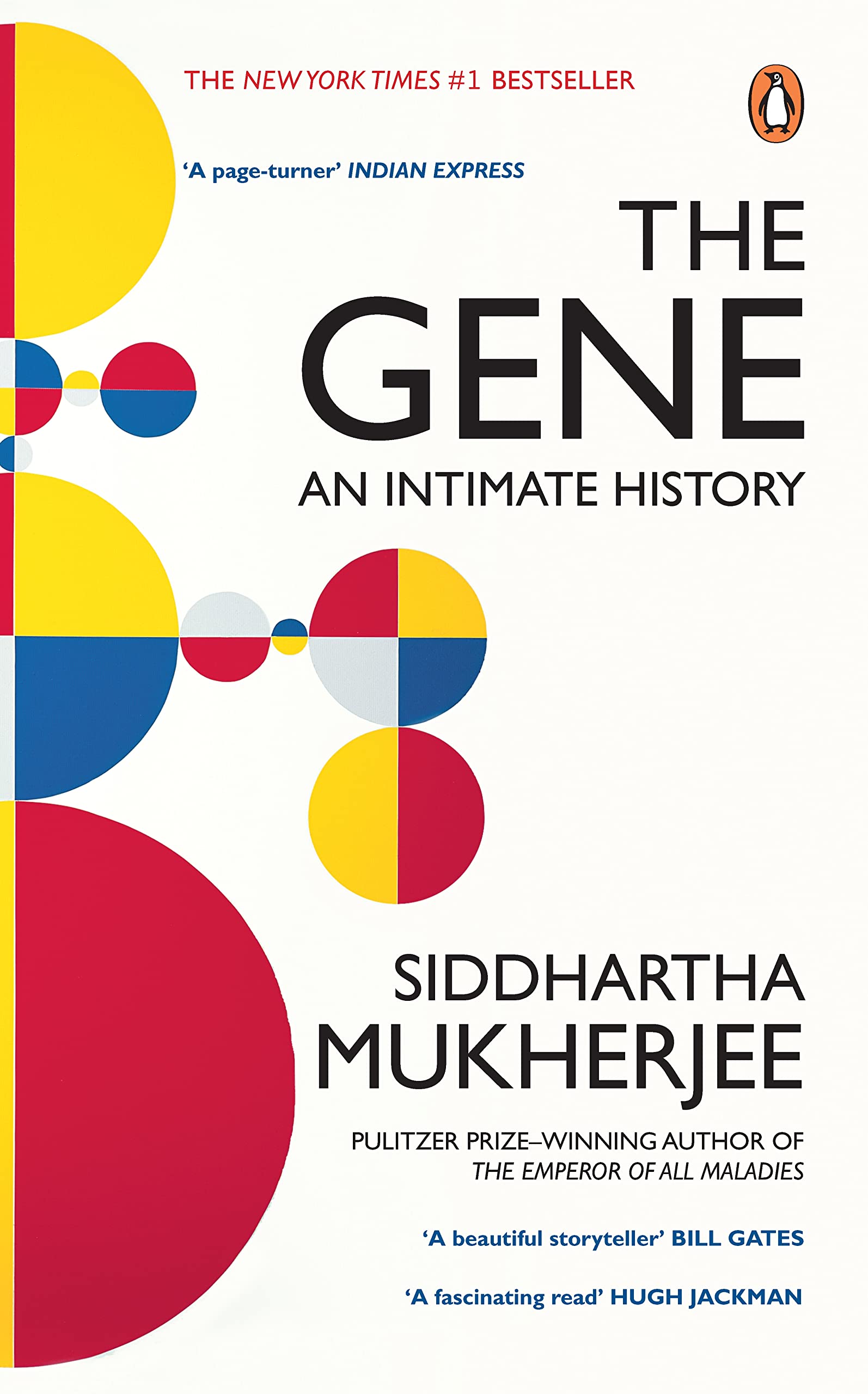
🧬 Unlock the secrets of your DNA — before everyone else does!
‘The Gene: An Intimate History’ by Siddhartha Mukherjee is a bestselling, critically acclaimed exploration of genetics, tracing its evolution from ancient philosophy to modern gene editing. Spanning over 600 pages, it combines rigorous science with vivid storytelling, making complex concepts accessible to professionals and enthusiasts alike. With a 4.6-star rating from over 7,400 readers, this book offers a panoramic view of genetics’ past, present, and future, including ethical considerations and groundbreaking therapies.
| Best Sellers Rank | #6,054 in Books ( See Top 100 in Books ) #33 in Biology Books #206 in Biographies & Autobiographies (Books) #311 in Reference (Books) |
| Customer Reviews | 4.6 out of 5 stars 7,459 Reviews |
A**R
An exquisite read!
I finished reading ‘The Gene’ by Siddhartha Mukherjee last month. It has been a fascinating voyage in the world of biology- genetics to be precise. As I wrote before too, it has been written with great erudition and is richly laced with metaphor and similes to make it comprehensible even for a non-biologist. It staggers my mind to think how must an ocean of research material have been mined for it, grasped, and then put to masterly use by the doctor-writer. Only a man of SM’s calibre who gave us a wonderful book on cancer ‘The emperor of all maladies’ before, could have done it. The gene book tells us in gripping detail the whole story of the gene right from early meanderings before the Christian era by the Greek Philosophers like Pythagoras (530 BC), Anaxagoras (400 BC), Aristotle (350 BC) and many others to unravel the mystery of inheritance. (Incidentally, Anaxagoras thought that the essence of heredity was carried by the male sperm, while the female only “shaped’ male semen in the womb to produce the foetus! And Aristotle argued that hereditary information is transmitted in the form of messages.) Nothing is in fact left out by the author in this long journey of man’s search for answers to the intriguing gene puzzle: Mendel’s experiments on pea to unravel the mystery of inheritance of characters, Darwin’s great voyage, how Watson and Crick cracked the DNA code, the human genome, how the new findings have helped mankind in understanding and curing genetic disorders by gene therapy, gene edting and gene surgery and the future scenario in regard to genomics and humankind. A lot has been done but a lot more still needs to be discovered. So many tricky genetic ailments such as Haemophilia, sickle cell anaemia etc which have afflicted mankind causing huge suffering, are now being cured thanks to new insights into the subtle working of the gene. Many more are on the threshold of being tamed and treated through gene therapy. The quest is on. Needless to say, the coming decades will see man (or a geneticist) playing God with gene editing and cloning technologies in his kitty. It will be for the humankind though to see and decide where to draw the line. What makes the book so outstanding is the interesting manner and the arresting narrative with which the whole story of the gene is laid bare before the mesmerized reader with fascinating details about the personal lives of Mendel, Darwin and all other luminaries who have been involved in their scientific endeavours in unravelling the mystery of the gene right from the beginning till date, their obsessions, devotion, dedication, foibles, failures, jealousies, the politics and so on. Having been a zoologist myself – though not a great one! – I could strike an instant chord with the book and had it fill many gaping voids in my understanding of the gene. Subhash Sharma, Palampur, Kangra HP
D**H
A book that broadens your vision...
I liked the book-The Gene: An Intimate History by Siddhartha Mukherjee. Being a former teacher of Human Anatomy including Genetics, I am aware of the vastness of the subject and its branches but this book covers all the important aspects in less than 600 pages. The book has been divided into Parts and in each Part, there are several chapters; this makes convenient reading. All the parts and chapters have been thought provokingly titled. The author has meticulously avoided technical terms as the book is intended to be for the lay readers. If you are interested in the development and evolution of the subject, this is a book for you; it makes interesting reading. The author’s background has lent authenticity to the contents. He has tried to give justice to every character who contributed significantly: Aristotle, Darwin, Mendel, Morgan, Bateson, Johannsen, Galton, Garrod, Beadle and Tatum, Jacob and Monod, Watson and Crick, Khorana, McKusick, Sanger, Berg, Venter, Gurdon and Yamanaka; it is actually ‘Who is who’ of Genetics. Some new terms like previvors have been introduced and Human Genome project has been discussed in details. The narrative is so detailed and vivid that we feel that the author was personally present when and where the history (and the future) happened! I enjoyed reading accounts pertaining to Eugenics, BRCA1, Indian counter part of Nazism, sexual identity, Gay gene etc. I tend to agree with the author’s prediction- “The discontinuity of genes-the discreteness and autonomy of each individual unit of heredity-will turn out to be an illusion: genes may yet be more interconnected than we think.” That would be the end of the prevalent reductionist view of the word-Gene. A clinician is mainly concerned with what can be applied on patients in the clinic. In spite of the tremendous strides that Genetics has taken in recent years, there is not much that can be offered to the needy patients as far as the curative treatment is concerned; this is particularly true for the mental ailments (the author with several members of his family suffering from such disorders knows about this more intimately than anyone else) and the cancers. Some of the advancements are rightly facing political, social and ethical hurdles. If researches on the stem cell and gene therapy are approved wholeheartedly in due course of time, we may see more practically beneficial genetics which not only satisfy curiosity but also cures. Human Genome project has been rightly proved to be just the beginning in this direction; we are now eagerly awaiting the outcomes of Human Epigenome project and Encode. This is a book that broadens your vision whatever your background may be.
K**R
A different genetics book
Not written from a medical viewpoint alone. That tends to put off some people including doctors (I am one). Covers a lot of interesting ground in history - the american eugenics program and the German T4. The pre-war ideological problem the soviet communists had with modern genetics and its consequences - very interesting. Got little bogged down in the Human genome project. The author`s attempts to intertwine the story with the story of mental illness in his own family feels little strained at times. A valiant attempt all the same. Great writing and research. Dr Mukherjee explains complex ideas very `patiently` in simple words. Must come from his experience in teaching medical students at the bedside. IMO medical students and subsequently doctors are simple minded ! Does not soar like the Emperor however. But then a lot of ground past present future has already been covered by other writers and so Dr Mukherjee`s job is to put all that in one place with emphasis on the overall sociopolitical context and its relevance to clinical practice. Like he has said in an interview, this is one book he wanted off his chest. Good read. Will appeal to all those popular science fans, doctors, biologist and anyone interested in science and history of the 20th century. Shouldn't let the Emperor of all maladies to cloud your assessment of this book !
S**R
Product was in great condition
A Page turner book for reader, Must readable book.
A**N
A good blend of history, science and personal narratives
The context for the “intimate” part of the title is the incidence of bipolarity and schizophrenia in the male members of Mukherjee’s family — two of his uncles and a cousin were diagnosed with the disease - which would be a constant threat hovering over the family. And this sets the tone for Mukherjee’s fascinating and detailed exploration into the subject of genes. He divides the book into six parts, starting from 1865 until the present day, covering the history of genetics ranging from Mendel’s first experiments with peas to genome mapping. He combines significant academic rigour with writing flair while covering the 160-year journey that shaped human understanding of genetics. While parts of the book make heavy reading, Mukherjee keeps most of it interesting and sometimes even manages to convert potentially academic and mundane topics into racy narratives. The section on the race to discover the DNA structure by multiple scientists is one example. Or the race to map the human genome between a private company, Celera and the Human Genome Project. The Book of Man chapter, somewhere in the middle of the book, is particularly interesting with several factoids about human genes. The most fascinating parts of the book, as to be expected, cover the debate around eugenics, contrasting the benefits of manipulating genetics to avoid serious disabilities in humans, with the potential violation of individual rights and the marginalisation of certain sections that it could ultimately engender. There have been several instances in recent human history that foretell the significant negative implications of eugenics, such as the eugenics movement of the early 20th century, Nazi Germany’s policies and prenatal genetic testing, we need to tread along this path with extreme caution. While Mukherjee does not provide any concrete solutions, the book does make one pause and think. Ultimately, The Gene turns out to be a great combination of history, science, personal narratives and some guide rails for the future of genetics! Pros: Rigorous research and a fascinating look at the history of the gene Cons: Heavy reading in parts
R**M
Read this book after you have read emperor of all maladies
From origin of species to the fundamental breakthroughs by Mendel, from gene as an abstract idea to the discovery of the structure of DNA, from horrifying episodes of eugenics to the technological marvel of modern day genetics, this book gives us both historical and scientific perspective that is thoroughly enjoyable and enlightening. And his command over the language is as inspiring as the journey he narrates.
N**H
This book is a must read to know the plight of scientists and their emotional account like Mendele, how they overcome criticism
After reading a formidable book The Emperor of All Maladies from the same author i was interested in this book. This book is enjoyable and informative.S Mukherjee has managed to explain scientific concepts without over simplifying them. Besides science this book is a personal account of an interesting familial disease, which unfolds as the book progresses and is totally linked with the book's subject. Mendel's story was heart wrenching. This book is a must read to know the plight of scientists like Mendel and their emotional account, how they overcome criticism and continue their work without ever getting noticed in their life time. The only problem which i felt was there were few parts stretched out and monotonous for example breast cancer details , otherwise this book is a gem.
S**Y
Master Story teller : Read it like a thriller and enjoy every moment
The book arrived on time and packaging was great thanks to seller and Amazon. When I first picked up this book, I was skeptical about it. Genetics as a topic, at best looked academic to me. This was so, until I read this book. It is hard to fathom that a medical doctor can write such a beautiful book, which weaves together several years gene evolution, from it's genisis to the modern era. He starts the story with a poignant portrayal of his family history of mental illness. Beginning at pre-independence era meandering it way' via three generations, to the present. From there on he starts to put together an enthralling account of Charles Darwin's discovery of "natural selection" and Mendel's seminal work on genes. Though both discoveries, i.e. the process of selection and code of selection, complement each other, sadly in-spite of living in the same era both the geniuses fail to meet each other or even connect each others works. Mendel's work, is lost to obscurity, as he fails to get recognised for his work on "gene" and he gets sucked into the administrative tasks at the monestary. Finally, his work is rediscovered (after 40 years) in 1900's and from then on the race begins. I haven't seen better story telling experience, as there isn't any dull moment in this book. Read it like a thriller and enjoy every moment of callisthenics as Sid takes you through past present and future of genealogy.
Trustpilot
3 weeks ago
1 week ago