
DOWNLOAD THE APP


Customer Services
Copyright © 2025 Desertcart Holdings Limited
DOWNLOAD THE APP
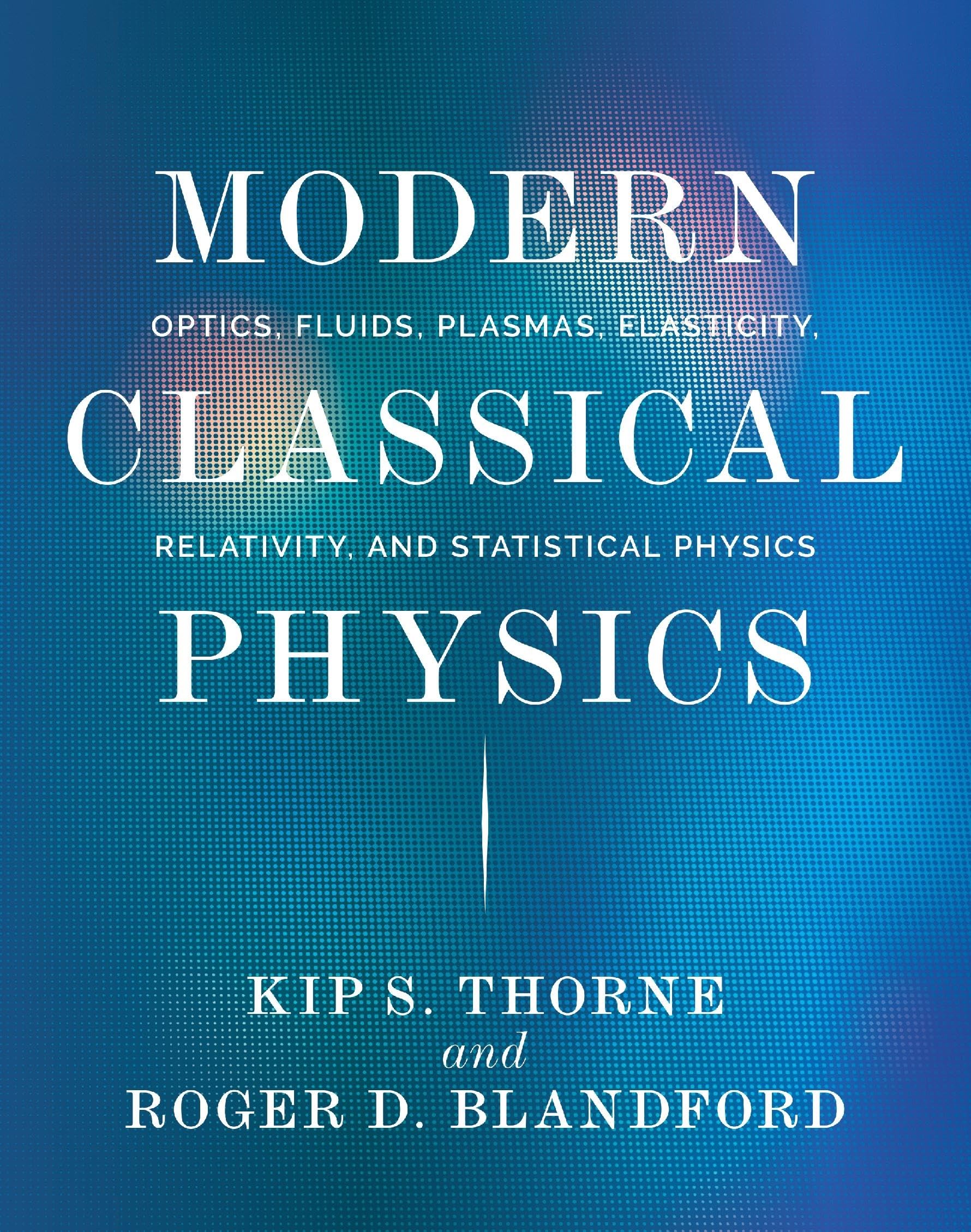
Buy Modern Classical Physics: Optics, Fluids, Plasmas, Elasticity, Relativity, and Statistical Physics by Kip S. Thorne, Roger D. Blandford (ISBN: 9780691159027) from desertcart's Book Store. Everyday low prices and free delivery on eligible orders. Review: An invaluable graduate student companion! - One of the best books of its kind! Wish I had this when I was in graduate school! Review: Exceptionally poor quality. - This item came a full year after i ordered it and now it has arrived, its a mess. The cover is on backwards and the pages are all stuck together (because they haven't been cut properly) and not even bound correctly. Also the pages that are cut are really jagged and its just such a poorly made book. Seriously I expected a decent quality text book, this looks like it has been put together by 3 year old's. I'm getting a refund. Have no idea if the content is any good, I'm so appalled by the quality of the book its not worth reading. I'm really disappointed, i'm not a student this was (meant to be) a book of pleasure for me.
| Best Sellers Rank | 828,656 in Books ( See Top 100 in Books ) 1,585 in Electronics & Communications Engineering 2,834 in Popular Science Physics 18,431 in Science & Nature References |
| Customer reviews | 4.8 4.8 out of 5 stars (162) |
| Dimensions | 20.32 x 6.35 x 26.67 cm |
| ISBN-10 | 0691159025 |
| ISBN-13 | 978-0691159027 |
| Item weight | 3.4 kg |
| Language | English |
| Print length | 1216 pages |
| Publication date | 15 Aug. 2017 |
| Publisher | Princeton University Press |
C**S
An invaluable graduate student companion!
One of the best books of its kind! Wish I had this when I was in graduate school!
M**D
Exceptionally poor quality.
This item came a full year after i ordered it and now it has arrived, its a mess. The cover is on backwards and the pages are all stuck together (because they haven't been cut properly) and not even bound correctly. Also the pages that are cut are really jagged and its just such a poorly made book. Seriously I expected a decent quality text book, this looks like it has been put together by 3 year old's. I'm getting a refund. Have no idea if the content is any good, I'm so appalled by the quality of the book its not worth reading. I'm really disappointed, i'm not a student this was (meant to be) a book of pleasure for me.
S**I
Very satisfied
Great academic view about the modern physics and up-to-date
M**N
Soy profesor y me hablaron de este libro, que me ha parecido MUCHO MEJOR de lo que imagiba: lo mas importante, el contenido FANTASTICO, muy sencillo y didactico, a lo que hay que añadir muy buena calidad de encuadernado y papel. Muy buena edicion, merece la pena¡
G**Y
Having recently acquired this text, I can add little to the extant reviews, except to say: Study the book ! For more, read the Princeton University Press Blog, including an interview with 2017 Nobel Prize winner Kip Thorne and Roger Blandford. Regarding this book, read: "LIGO’s gravitational wave detectors rely on an amazingly wide range of classical physics concepts and tools, so time and again we draw on LIGO for illustrations. The theory of random processes, spectral densities, the fluctuation-dissipation theorem, the Fokker-Planck equation; shot noise, thermal noise, thermoelastic noise, optimal filters for extracting weak signals from noise; paraxial optics, Gaussian beams, the theory of coherence, squeezed light, interferometry, laser physics; the interaction of gravitational waves with light and with matter; the subtle issue of the conservation or non conservation of energy in general relativity— all these and more are illustrated by LIGO in our book." (10/12/2017, Kip Thorne, Princeton University Press Interview). Addendum (August 2019): An engineering student lamented about his academic performance in a recent course of fluid dynamics. Happily, Thorne and Blandford can be recommended as an excellent guide on this topic. Having read Feynman (volume two, chapters 38 through 41) and having viewed videos relevant to the topic (referenced here pages 731 and 790; films from the Committee for Fluid Mechanics, now available Youtube), you are prepared to tackle Thorne and Blandford, their chapter 12, 13 and 14. These chapters are replete with insight. I enjoyed, and highlight: “analysis of fluid flow based on some general ideas that ought to be familiar from other areas of physics.” (pages 750-752). The analysis is a crash-course in “how to think like a physicist."
M**U
Recently retired from paid work I thought it useful to delve again into the "advanced basics" of theoretical physics. Educated an astrophysicist I knew part of the work of Roger Blandford from the seventies / eighties. My "prejudice" was, partly for that reason, that the book might be worthwhile. And indeed, the book is a true cathedral of knowledge. Of course I haven't digested it all by now, but I have studied the statistical physics part. It may sound over the top, but I thought it a miracle. I used Landau / Lifshitz for studies in statistical physics way back in the seventies, but the presentation by Thorne and Blandford is much clearer. Whereas in L/L the treatment of the subject is obviously good, it is more difficult to follow than the Thorne /Blandford treatment. The autors make use of concise tables, and they treat the ensembles (canonical, microcanonical &) more systematically than L/L. I really got the feeling that I got it sorted out really well. The exercises offered in the book are usually part of the theory, and certainly demand serious work from the reader. The book is written by physicists, and one notices that especially in the chapter on Random Processes. Rigorous enough, but perhaps less so than in a mathematician's treatment. Of course there is always room for criticism. The explanation of the Second Law by coarse graining fails to convince, because it looks as if the physicist with his limited powers is "guilty". This is a criticism on the explanation as such, and has nothing to do with their - again excellent - presentation. There might be better ways to explain the law (Penrose?). After I have worked my way through the chapter I will happily jump on other parts of the book. All in all, the authors have done a great service to the (astro)physics community by writing this book, for which we can only be most grate ful! Manuel Nepveu
S**R
Già dall’aggettivo “Modern” si intuisce che questo testo affronta argomenti di fisica “classica” (nel limite in cui h~0) in modo non convenzionale. Gli autori enfatizzano il fatto che la fisica classica è tutt’ora una disciplina indispensabile per la comprensione e le applicazioni tecnologiche attuali ma che necessita di un linguaggio matematico diverso da quello utilizzato nell’800 se si vuole affrontare la connessione tra i fenomeni macroscopici e quelli quantistici. Il testo si sofferma sui principi fondamentali della fisica classica in se stessa ed in relazione alla fisica quantistica. Il linguaggio matematico utilizzato sin dal primo capitolo è quello geometrico (ovvero che le leggi fisiche debbano esprimersi indipendentemente da coordinate e sistemi di riferimento). Il testo consta di circa 1500 pagine e tratta unicamente argomenti di ottica, fluidi, plasmi, elasticità, relatività (anche generale) e fisica statistica. Gli esercizi proposti sono molto numerosi ed illuminanti. Così come nella “bibbia” Gravitation, anche qui abbiamo argomenti suddivisi in due tracce, di cui la T2 contenente argomenti che si possono tralasciare in una prima lettura.
B**H
J' ai acheté ce livre pour offrir à un physicien qui ne l'avait pas trouvé. Après un livre abîmé et une action efficace d'Amazon, un volume parfait est parvenu à son destinataire physicien théoricien qui l’attendait impatiemment car c' est parait-il un must dans la physique actuelle... Pour spécialistes bien sûr.
Trustpilot
2 months ago
2 weeks ago