
DOWNLOAD THE APP


Customer Services
Copyright © 2025 Desertcart Holdings Limited
DOWNLOAD THE APP

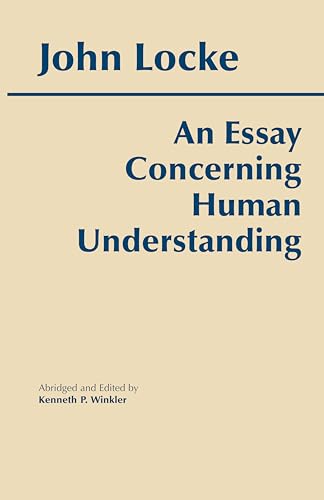
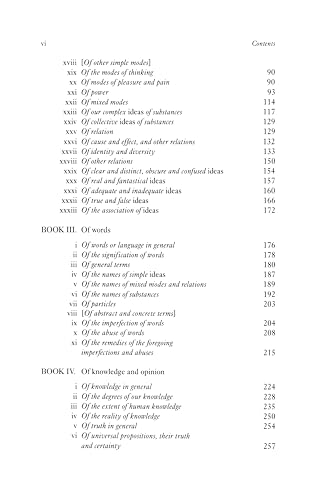

NA : Locke, John, Wrinkler, Kenneth P.: desertcart.in: Books Review: classic Locke empiricism book which provide modern psychological concept for literature Review: Book was in better condition than described
| Best Sellers Rank | #817,122 in Books ( See Top 100 in Books ) |
| Country of Origin | United Kingdom |
| Customer Reviews | 4.6 4.6 out of 5 stars (156) |
| Dimensions | 13.97 x 2.54 x 22.23 cm |
| ISBN-10 | 087220216X |
| ISBN-13 | 978-0872202160 |
| Item Weight | 476 g |
| Language | English |
| Paperback | 416 pages |
| Publisher | Hackett Pub Co Inc (1 September 1996) |
A**Z
classic Locke empiricism book which provide modern psychological concept for literature
C**D
Book was in better condition than described
P**.
This review concerns the Hackett edition (abridged and edited by Kenneth P. Winkler). Unfortunately, this edition has some major typographical issues. One issue concerns the use of commas. Take this sentence for example (as it appears in this edition): “What censure, doubting thus of innate principles, may deserve from men, who will be apt to call it, pulling up the old foundations of knowledge and certainty, I cannot tell:” ...and contrast it with how it appears both on Wikisource and on johnlocke.net: “What censure doubting thus of innate principles may deserve from men, who will be apt to call it pulling up the old foundations of knowledge and certainty, I cannot tell;” I think it is evident that the former version is much harder to parse. This is not an isolated case; it happens constantly throughout the book. Also, apart from punctuation issues, this edition also has some straightforward typographical errors. For example, I just came across this sentence: “Whatsoever positive ideas we have in our minds of any space, duration, or number, let them be never so great, they are still finite;” I had to spend some time/effort trying to understand the meaning of this sentence, but, in the context, the word “never” just made no sense to me. Once again, here is how that same sentence appears on Wikisource: “Whatsoever positive ideas we have in our minds of any space, duration, or number, let them be ever so great, they are still finite;” This is on page 87 (out of 357) and I’ve already encountered several errors of this kind. Unfortunately, this being a philosophical text (where linguistic precision is very important), these types of issues can make it much harder to follow (when you are having trouble understanding a sentence there is always a bit of doubt whether it’s on you or on the edition) and significantly detracts from the overall reading experience.
J**.
I love this book. It will last for many, many years for what is written inside, what it is all about, is timeless.
W**Y
Bought as a gift
Trustpilot
3 weeks ago
2 weeks ago