
DOWNLOAD THE APP


Customer Services
Copyright © 2025 Desertcart Holdings Limited
DOWNLOAD THE APP


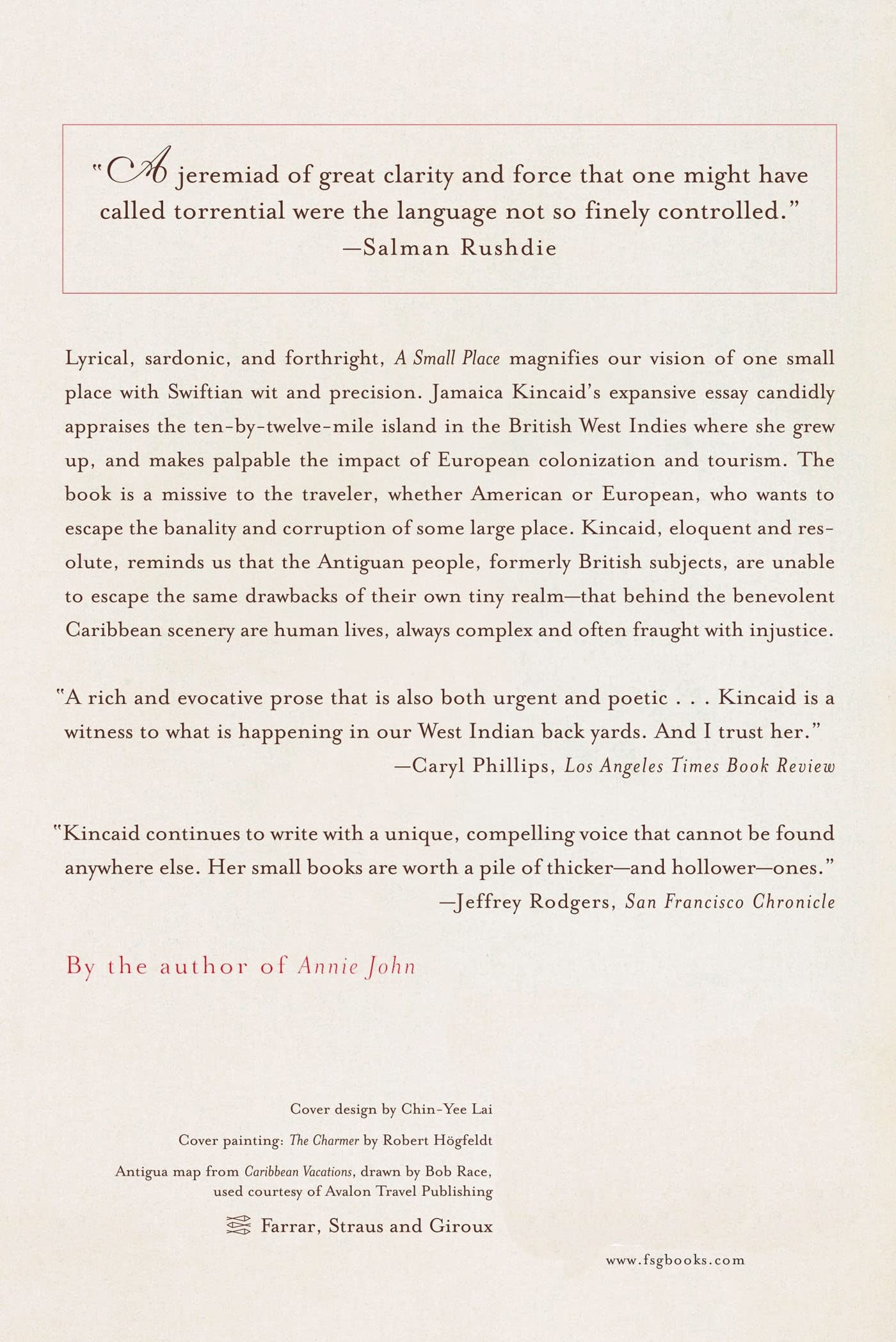

A Small Place [Kincaid, Jamaica] on desertcart.com. *FREE* shipping on qualifying offers. A Small Place Review: Amazing book - Amazing book! Review: Short, Precise and Honest! - In her book A Small Place the author Jamaica Kincaid reflects on the debilitating impacts of colonialism and slavery on her people, Antiguans. The narrator does not tell her audience, which are tourists, about the beauty of Antigua, the warm and beautiful weather of the country, or the magnificent even about beaches. She straightforwardly confronts her audience as tourists and informs them about their lack of awareness of the corrupt political system in the place they are visiting and the people who suffering consequently from outcomes. She is telling them if they were intelligent enough, they would not travel the long journey from their land to the place of Antigua in order to build up the corrupt political system. In this book, the most important themes that the author deals with are slavery, colonialism, corruption. The country is naturally beautiful and has thriving tourism industry, however, the underlining problems of corrupt system that was inherited from the slavery and colonialism, oppresses its citizens. The deep-rooted negative effects of these two brutal and inhumane systems are still visible in the political and socio economic situations of Antigua. The leaders are corrupt and work based on nepotism and political affiliations (Kincaid, 72). An irrefutable example, which the narrator uses, is the presence of Japanese made cars for taxi drivers. She states the reason why these luxurious and expensive cars are available for the drivers are because the government mandates their purchases and operations (5-6). These cars benefit the members of the government, not the people of Antigua. Her second example for the political corruption is the assignment of the Minister of Culture (46). The irony is that this minister is also the Minister of Education and Sports who controls all these offices for his advantage. She believes these offices exist for the purpose of exploitation and abuse, and not for the benefit of the country. The people of Antigua came out of slavery and colonialism, they still are suffering and are being abused and exploited by their own government.
| Best Sellers Rank | #84,943 in Books ( See Top 100 in Books ) #26 in General Caribbean Travel Guides #78 in Travel Writing Reference #98 in Traveler & Explorer Biographies |
| Customer Reviews | 4.5 4.5 out of 5 stars (1,257) |
| Dimensions | 5.45 x 0.3 x 8.2 inches |
| Edition | First Edition |
| ISBN-10 | 0374527075 |
| ISBN-13 | 978-0374527075 |
| Item Weight | 2.31 pounds |
| Language | English |
| Print length | 81 pages |
| Publication date | April 28, 2000 |
| Publisher | Farrar, Straus and Giroux |
N**E
Amazing book
Amazing book!
A**W
Short, Precise and Honest!
In her book A Small Place the author Jamaica Kincaid reflects on the debilitating impacts of colonialism and slavery on her people, Antiguans. The narrator does not tell her audience, which are tourists, about the beauty of Antigua, the warm and beautiful weather of the country, or the magnificent even about beaches. She straightforwardly confronts her audience as tourists and informs them about their lack of awareness of the corrupt political system in the place they are visiting and the people who suffering consequently from outcomes. She is telling them if they were intelligent enough, they would not travel the long journey from their land to the place of Antigua in order to build up the corrupt political system. In this book, the most important themes that the author deals with are slavery, colonialism, corruption. The country is naturally beautiful and has thriving tourism industry, however, the underlining problems of corrupt system that was inherited from the slavery and colonialism, oppresses its citizens. The deep-rooted negative effects of these two brutal and inhumane systems are still visible in the political and socio economic situations of Antigua. The leaders are corrupt and work based on nepotism and political affiliations (Kincaid, 72). An irrefutable example, which the narrator uses, is the presence of Japanese made cars for taxi drivers. She states the reason why these luxurious and expensive cars are available for the drivers are because the government mandates their purchases and operations (5-6). These cars benefit the members of the government, not the people of Antigua. Her second example for the political corruption is the assignment of the Minister of Culture (46). The irony is that this minister is also the Minister of Education and Sports who controls all these offices for his advantage. She believes these offices exist for the purpose of exploitation and abuse, and not for the benefit of the country. The people of Antigua came out of slavery and colonialism, they still are suffering and are being abused and exploited by their own government.
J**N
Kinc-Aid: The Metaphorical Tropical Punch!
A Small Place tells the story of the island of Antigua through the eyes of its author, Jamaica Kincaid, an Antiguan now living in the United States. It was originally an essay for The New Yorker, but was rejected, which I guess was good for Kincaid. We start in second person, with Kincaid narrating the arrival of "you," the tourist, on the island of Antigua, and all of the wonderful activities - the beach, the food, the hotel - that you will experience. She then takes a turn towards with the pragmatic, detailing the island's faults that are unseen to the tourist eye, including but not limited to: the island's lack of proper sanitation and health care; the collapse of banking and local food production; hotels enforcing neo-colonialism by training native Antiguans to serve tourists; the corruption of the government, mostly of Syrian descent... If you liked this review, come read more at my blog: http://wp.me/p3Aqzs-hz
D**R
Reading this book is necessary to understand the effects of colonialism
An experience written from a viewpoint most tourists have surely never considered. Honest and deep; written concisely and eloquently. The reader gets an eye opener that should permanently change their view. This book was required reading for my child’s Sophmore class in a private girls high school. Thank you to Jamaica Kincaid for giving this perspective to young girls who are future leaders.
W**W
If you go to resorts or cruises, this book is for you
I feel like most readers choosing to pick up this book aren't who need to hear what Kincaid has to say but you’ll just have to pass it around to family and friends. Its a short and easy read.
K**I
Beautifully Written, Regardless of Your Politics
I love this book because it is beautifully written- lyrical, poetic, smart. I think she captures her complicated opinions on the culture and history of Antigua wonderfully. It's a brutally honest book, which I think is refreshing. As far as I know, and I may be wrong, she doesn't really represent this as anything other than her opinion. So by "brutally honest," I don't mean everything in it is true, in a textbook kind of way. I just mean that she expresses an eloquent, honest, complicated, contradictory portrait of how she feels. And the writing is beautiful. It's best described as a "poetic essay." If you're looking for a travel guide or a straight non-fiction history book, this isn't it and it shouldn't be marketed that way. I don't feel strongly about the politics of this book, nor did I feel particularly hated (I'm a white American), but I guess I could see how you might feel that way if you are the sort of person who takes everything personally.
K**R
Refreshing
Kincaid offers an honest and more complete view of Antigua than most people are willing to admit. In beautiful logical language, she describes the impossible beauty that was the destruction of Antigua. Open an honest, you walk beside her as she tells you her story. A delight to Read, a small boon filled with enormous ideas and stories.
A**A
Such a fantastic book, I loved every part of it. Would definitely recommend. It also highlights how important it is to be literate, because education is the true key to emancipation.
M**L
good book. the text is very readable
T**N
This book didn't stop me from visiting Antigua at all, in fact, Jamaica Kincaid's observations in 'A Small Place' were spot on. When I visited the island before I read her book, I always had my 'tourist hat on', and was oblivious to the struggles of the indigenous population; the corruption that still haunts their politicians; and the failed legacies that the British had left behind some time ago. It was only after I had read her book, that everything she had written, fell into place when I went back to visit again. The majority of cars were still in a much better state than the homes where people lived, and many of the islanders that I spoke to were always complaining about the influx of the Guyanese & the Syrians who were hindering their own job prospects, also, the politicians were still 'ducking & diving' to avoid the smears of corruption; and not forgetting the influence of the long departed British is still much in evidence to this day (you only have to look at the decaying statues & monuments, and the over reliance on a judicial system that still prolongs many a murder trial on this island). An evocative read, but a very accurate one ...
V**A
So, this is my first Kincaid read, and all thanks to the 2020 Reading Women Challenge. Their first prompt is an author from Caribbean or India. Since I’ve read a lot of women from India, I thought let’s give the Caribbean a shot and started with A Small Place by Jamaica Kincaid – a rather short, but extremely powerful and engaging book about colonialism and its effects in Antigua. There were so many things I wasn’t aware about Antigua till I read A Small Place, and like I said I was only too happy to read something out of my comfort zone and thereby discover the writing of an author I had intended to read for a while. A Small Place is a memoir, it is also a history of Antigua in a way, it is also an essay of anger against the people who colonised Antigua, it is also a voice of great empathy that Kincaid has for her country and people. The book begins with an attack on tourists who visit Antigua – what they expect and choose to see versus what the place is. A Small Place is a short book – but extremely powerful and angry. Kincaid writes about home – about what it meant to her, and what has become of it. Of how the English ruled them, and how their independence has only worsened the situation because of corruption and bureaucracy. Jamaica Kincaid speaks candidly – almost to the point of being brutal – there are no holds barred. The prose comes from an extremely personal space and therefore the writing shines the way it does. For instance, when she speaks of lack of clean water in the country or even about the beloved old library that was destroyed in an earthquake and how nothing was done to build the new one. And now that there is a new one that has been built (way after the book was published), but there is still doubt if it is open to public or not. Kincaid’s book is large – very large not only in its scope but also in what it has to say – and how she manages to say it in all in less than hundred pages is nothing short of a feat. That explains the writer she is – succinct, bare-boned, and yet so deeply emotional that every emotion is reflected on paper, and in turn is felt by the reader.
L**O
hermosa prosa de las cosas sencillas. pocas veces me releo un libro. este seguro que lo volveré a leer.
Trustpilot
2 months ago
3 weeks ago