Some deliveries may take a little longer than usual due to regional shipping conditions.

DOWNLOAD THE APP


Customer Services
Copyright © 2025 Desertcart Holdings Limited
DOWNLOAD THE APP
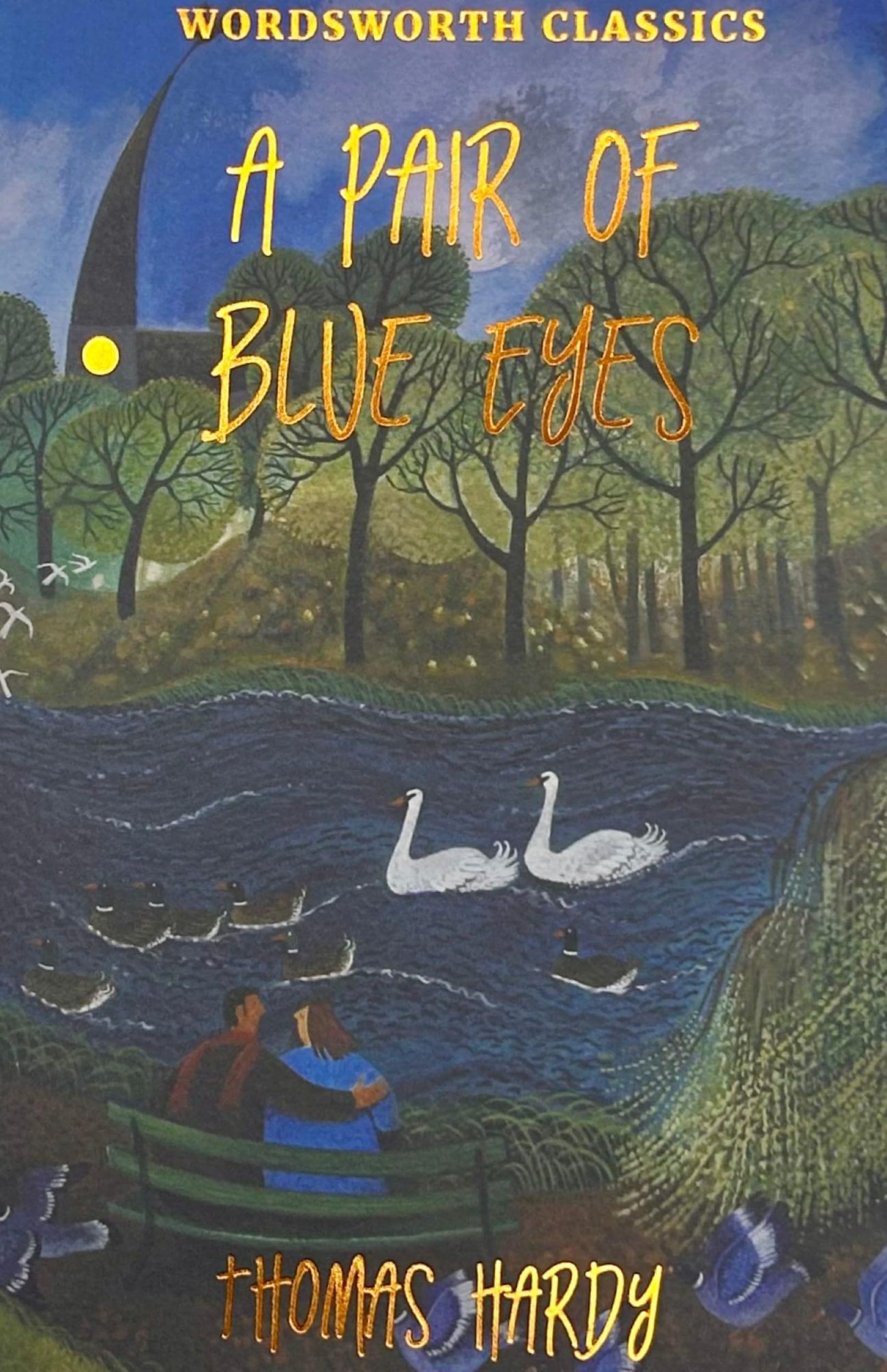
A Pair of Blue Eyes (Wordsworth Classics) [Thomas Hardy] on desertcart.com. *FREE* shipping on qualifying offers. A Pair of Blue Eyes (Wordsworth Classics) Review: One of Thomas Hardy's neglected novels - *A Pair of Blue Eyes* is often called one of Hardy's minor novels -- which means it's usually passed over and ignored, in favor of his monumental successes, *Tess of the d'Urbervilles*, *Jude the Obscure*, or *Far From the Madding Crowd*. *Blue Eyes* is an enigmatic work, because it's not always clear who the protagonist is: Elfride Swancourt, the central female figure; Stephen Smith, who may be a stand-in for a youthful (and charmingly naive) Hardy himself; or Henry Knight, who resembles Hardy's mentor and friend Horace Moule, an older man more worldly, experienced, and intellectually sophisticated than the author in his early twenties. Then there's Elfride's father, the ironically-named Christopher Swancourt, the socially ambitious and self-promoting Anglican country vicar, who hovers over the others' lives like a dark cloud. The novel develops like a romance, with attractive (though flawed) male characters competing for the affection of a sweet, naive, but fetching female. The novel's progress is anything but conventionally romantic, however; its conclusion leads the reader far off the romantic path to an ending that explodes all the characters' hopes and expectations, and likely the reader's as well. *A Pair of Blue Eyes* was written before Hardy began *Tess of the d'Urbervilles*, and it's a worthy competitor to that more recognized novel. Elfride's life and Tess's warrant equally close scrutiny, and both characters reveal Hardy's developing sympathetic envisioning of the lives of young women, their choices concerning lovers and marital partners, and the ways in which their circumstances as women deprive them of the choices they deserve. The far-western English landscape -- Cornwall -- in which Elfride Swancourt lives her life is beautiful, harsh, and ruthless, not unlike the patriarchal social order that governs her being. This novel is more than a good read; it's gripping and mind-bending, for luke-warm Hardy readers or even for his most passionate fans. Give it a go. The final pages will grab you like a hand you didn't know was hovering over your shoulder. Review: I love the Victorian period and have just *rediscovered* Hardy - I love the Victorian period and have just *rediscovered* Hardy. I read what I imagine were his standard fare in college. Now, I am enjoying his stories that I missed. Although I am only 1/2 through this one, it has not disappointed.








| Best Sellers Rank | #657,297 in Books ( See Top 100 in Books ) #5,407 in Contemporary Literature & Fiction #11,729 in Classic Literature & Fiction |
| Customer Reviews | 4.6 out of 5 stars 166 Reviews |
F**L
One of Thomas Hardy's neglected novels
*A Pair of Blue Eyes* is often called one of Hardy's minor novels -- which means it's usually passed over and ignored, in favor of his monumental successes, *Tess of the d'Urbervilles*, *Jude the Obscure*, or *Far From the Madding Crowd*. *Blue Eyes* is an enigmatic work, because it's not always clear who the protagonist is: Elfride Swancourt, the central female figure; Stephen Smith, who may be a stand-in for a youthful (and charmingly naive) Hardy himself; or Henry Knight, who resembles Hardy's mentor and friend Horace Moule, an older man more worldly, experienced, and intellectually sophisticated than the author in his early twenties. Then there's Elfride's father, the ironically-named Christopher Swancourt, the socially ambitious and self-promoting Anglican country vicar, who hovers over the others' lives like a dark cloud. The novel develops like a romance, with attractive (though flawed) male characters competing for the affection of a sweet, naive, but fetching female. The novel's progress is anything but conventionally romantic, however; its conclusion leads the reader far off the romantic path to an ending that explodes all the characters' hopes and expectations, and likely the reader's as well. *A Pair of Blue Eyes* was written before Hardy began *Tess of the d'Urbervilles*, and it's a worthy competitor to that more recognized novel. Elfride's life and Tess's warrant equally close scrutiny, and both characters reveal Hardy's developing sympathetic envisioning of the lives of young women, their choices concerning lovers and marital partners, and the ways in which their circumstances as women deprive them of the choices they deserve. The far-western English landscape -- Cornwall -- in which Elfride Swancourt lives her life is beautiful, harsh, and ruthless, not unlike the patriarchal social order that governs her being. This novel is more than a good read; it's gripping and mind-bending, for luke-warm Hardy readers or even for his most passionate fans. Give it a go. The final pages will grab you like a hand you didn't know was hovering over your shoulder.
M**T
I love the Victorian period and have just *rediscovered* Hardy
I love the Victorian period and have just *rediscovered* Hardy. I read what I imagine were his standard fare in college. Now, I am enjoying his stories that I missed. Although I am only 1/2 through this one, it has not disappointed.
D**2
If you like Hardy novels, you'll like this one
One of Thomas Hardy's earlier novels it has all the hallmarks of his writing style. His character development and descriptions of the English countryside and living are on full display. The story moves quickly at the beginning and at the end but does have a lull in the middle. I am a big fan of his work and this novel, although not his best work, is an enjoyable read.
M**R
Five Stars
Wonderful book!!
B**R
Another great by Thomas Hardy
This is another of Thomas Hardy's romantic novels. I was not disappointed but was surprised by how he ended the story. As an author, I know we write from our experiences. Thomas Hardy is a man I would have liked to know.
D**S
Through A Proustian Eye
I do like and admire Hardy very much as a novelist - Jude the Obscure being my favourite - but I must fully admit to having an ulterior motive in reading this earlier, less masterful novel in Hardy's oeuvre - Proust's admiration for it. Proust said that, of all Hardy's works, it was the one he would himself most gladly have written. For many reasons, it now seems to me after reading it, Proust must have found the work a goad to his own genius. There is a particular passage in Proust where he visits the cathedral at Chartres and goes into great detail - as Proust is wont to do - in making a connexion between the soaring cliffs and Gothic architecture. Hardy doesn't make the connexion so explicit here, but, all the same, the juxtaposition is manifest and may be said to dominate the backdrop of more than half the book. But, what I think Proust probably found most resonant with his own artistic sensibility in the book is the dissolution of the notion of "character" in the personage of Knight. One rather expects - indeed, Hardy describes them so - Elfride and Stephen to have mercurial temperaments, easily swayed by circumstance. But the slow disintegration of Knight's Victorian "character" is truly something to behold. When introduced to him, he seems every inch the paragon of the stolid, cerebral homme de lettres; and watching the slow, inevitable crumbling of this factitious edifice under the influence of love and jealousy has all the mesmeric quality of watching, say, a train slowly going off the rails and plunging into some deep, unfathomable gulf, and one is reminded, of course, of connoisseur Swann's obsessive love for Odette in Proust's lengthier opus. This review only covers one aspect of the book and may be disregarded by those not interested in Proust, though it seems to me that lovers of Hardy are grand candidates to see the themes running through this book developed to their fullest extent in the magnum opus of the 20th Century master stylist par excellence.
Z**E
A hidden early gem
A Pair of Blue Eyes contains obvious prototypes for later novels like The Return of the Native (Stephen Smith being similar to Clym Yeobright) and Tess of the d'Urbervilles (Henry Knight, a most dislikeable character on a par with the hypocritical Angel Clare). However, it has a charm all of its own, with possibly the most ingenious ending of any of Hardy's books. Like much of Hardy's work, some of the characters' prejudices and attitudes are barely credible in the modern world, and this is probably its biggest flaw, although not Hardy's fault given that he wrote it in the 19th century. If you can suspend disbelief, this is a meticulously-plotted story with a real emotional pull.
Trustpilot
2 months ago
1 day ago