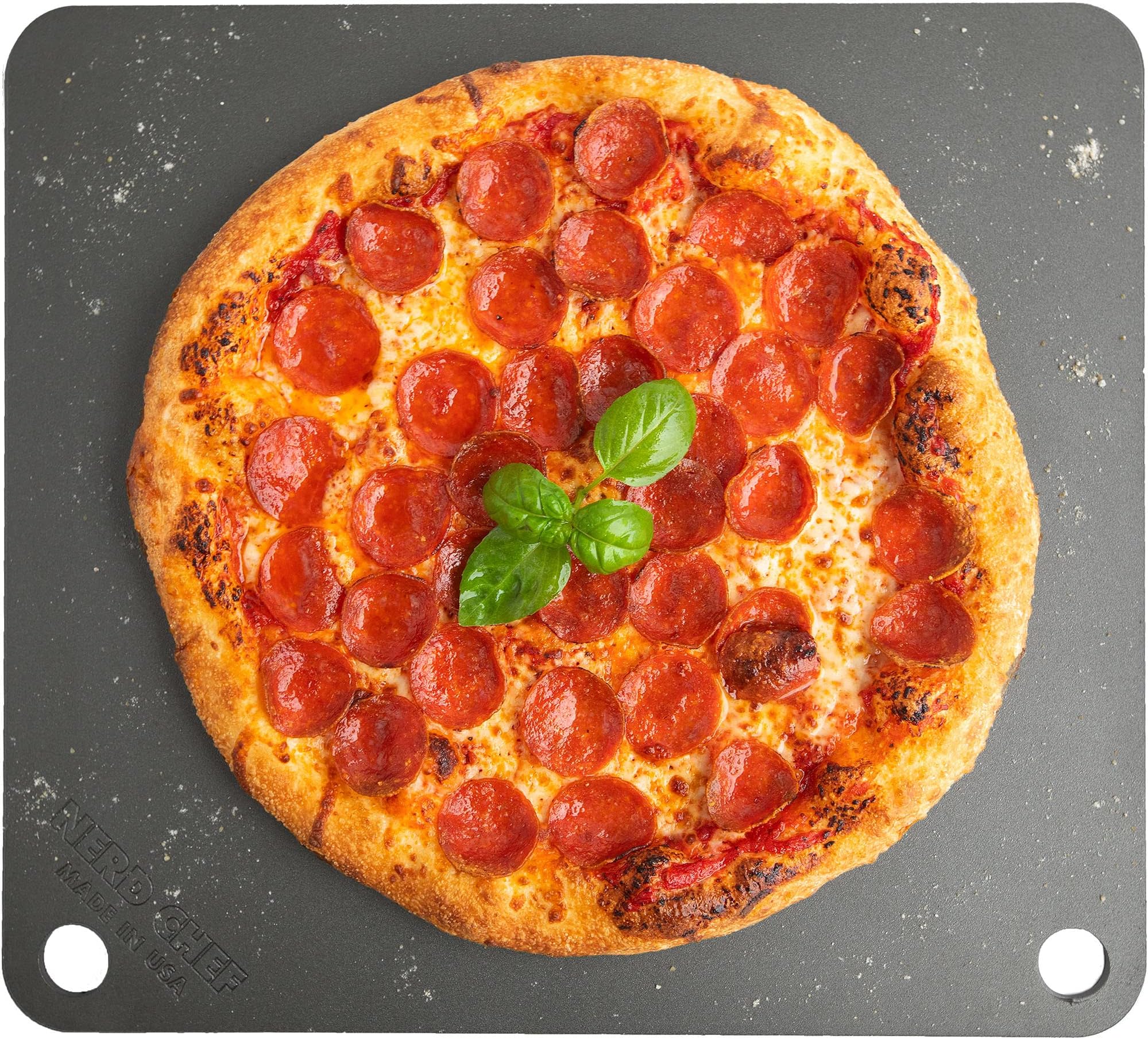


🍕 Elevate your pizza game with steel-cold precision and crust that commands attention!
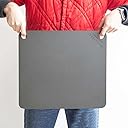
The Nerd Chef Steel Stone 1/4" is a professional-grade pizza steel boasting 20 times the heat conductivity of ceramic and double the heat capacity, enabling home ovens to mimic 1000°F commercial performance at just 450°F. Its low-friction, flaxseed-oil-seasoned surface ensures perfect blistering and crispy crusts, while its solid steel build guarantees lifetime durability. Measuring 16"x14.25"x0.25" and weighing 16 lbs, this USA-made powerhouse also doubles as a griddle for induction cooktops, making it a versatile must-have for serious home chefs.


| Best Sellers Rank | #29,267 in Kitchen & Dining ( See Top 100 in Kitchen & Dining ) #63 in Pizza Pans & Stones |
| Customer Reviews | 4.6 out of 5 stars 2,208 Reviews |
S**.
Amazing! But, buy with care, the .5" is HEAVY. (But amazing!)
So I'm giving 5-stars for the results. It's just so much better than a ceramic stone in my oven. As others have pointed out, it is heavy. Really heavy. I rarely move it from my oven but when I do, I have to be very careful. But the results are totally worth it. I've never made pizza with a better crust. I also don't have to put the oven up to 500, where things start to smoke and my smoke detector goes of (no matter how much I clean my oven). 450 works well because the steel transfers so much heat to the bottom of the crust. I use the broiler trick to crisp up the toppings and the pizza is done in just a few minutes. Middle rack. Another thing to try. I've also been making Detroit-style pizzas in those rectangular metal pans. Pan-pizzas are great because you can get that melted cheese/crust thing going on the edges. But to kick it up a notch, when my Detroit pizza is done, I take it out of the pan, and just drop it on the steel for 30 seconds. It makes the bottom of the crust crispy in a way that the thin-steel pan just doesn't. Pizza snobs love it. Finally, and this does mean that I move the steel around more than I thought I would. It makes a great griddle for an induction range-top. Our induction range has two burners that can be bridged together, but I never really used them because my cast iron griddle still would heat too unevenly (really just tow circular hot spots on the griddle). With the thicker steel I get a big, flat uniformly heated griddle surface for cooking pancakes, diner omelets , patty melts, etc. Reminds my of my younger days cooking at the diner. It takes a little while to get the heat spread out, but it stays at temperature once you do, just like a commercial griddle. That was a fun surprise. If you don't have strong hands, I'd say get the thinner versions, but if you want the full experience, this is the one.
C**R
LOVE IT !!!!!
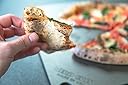
🔥 Game-Changer for Pizza Night! 🔥 Just tried out my new Nerd Chef Pizza Steel from Amazon, and it’s the real deal. Crisp crust, perfect blistering, and an even bake from edge to edge. This thing holds serious heat and turned my kitchen oven into a full-blown pizza oven 🍕💪 The crust came out light, airy, and crispy — no soggy bottoms here. Used it with homemade dough and the results were better than some wood-fired places I’ve been to. Cleanup was easy, and it feels like it’ll last forever. Super heavy-duty! 💯 Worth every penny if you’re serious about pizza. ⭐️⭐️⭐️⭐️⭐️ 📸 (Just look at that crust 👇)
V**E
Upgrade to steel you cave person.
NerdChef Steel Stone - High-Performance Baking Surface for Pizza (.375" Thick - Pro) I seem to be incapable of successfully caring for a pizza stone. Do not ask me to care for your pet rock. You may be sorry. I also do not yet have the motivation to construct a backyard wood fired pizza oven but have an insatiable lust for pizza at home. Enter the pizza steel. After a quick inquiry with NerdChef (they were super responsive and friendly!) about the proper rack height (I used the third setting from the top, but may go one higher next time @ 500F) I was set to try this baby out by making one of my trademark delicious, but homely, pies. I also decided to try a Naan recipe out that previously did not impress much on cooked on a normal stone (prior to me killing it). Long story short. This was the tool I've been looking for. The bottoms and the top of both crust and bread cooked at an even rate. Patience and keeping a close eye (as well as a peel) are key here. I was a tad impatient on my first ugly pie pictured here, subsequent tries were cooked a bit more and were considerably more homely. No material could help me in that department. Pictures are on various baking sheets I put the items on after coming out of the oven, not the steel. The Naan worked out wonderfully and I have been eating delicious sandwiches all weekend. After all was said and done the stone had darkened noticeably, but this is to be expected. It will take quite a long time to cool down so if you have other need of your oven keep that in mind. It is heavy and safety is key if you are going to start moving this piece around. To wrap this up: It's steel. It enhances your oven. It will hurt me long before I am able to hurt it. It is made locally and the company is quite lovely. You are paying quite a bit for the finish, and decorative bits, but I'm not really interested in hunting down a piece of steel and getting it kitchen ready so there you go. Making GOOD pizza at home is both fun and good for your soul! A+, would buy again.
S**S
Better than any stone -- buy this!
I've bought a number of pizza stones in my time, and have never really had great luck with them. Not exactly sure why. People talk about how the porous nature of the stone makes a better pizza crust, but I haven't found that to be true. Honestly I think the porous nature of the stone means that more of the stone is actually air, and the air doesn't really get hot and doesn't really make the pizza crunchy enough. I've made decent pizza on a stone but never great. Also, every stone I've ever had has broken eventually. I've gotten to the point where I use them even though they're broken, I just put the 2 halves together, and leave them in the oven. Just getting tired of broken stones. Advantage number 1, and not even the best advantage, this steel will never break. Advantage number 2, this thing gets hotter than any stone. Usually a stone is cool within an hour after you turn off the oven. After an hour, this metal pizza stone is still smoking hot. In my mind overall this is the best pizza making tool I have ever bought. Here's the pizza dough recipe that I used, 3 1/2 cups of flour, 1 cup water, 1/4 cup half-and-half or butter, and a tablespoon of salt. I like my pizza dough salty, you might want to use a little less. Some other things to add are diastatic malt maybe a half tablespoon, and/or a teaspoon of white sugar . Use about three quarters of a teaspoon of dry yeast. Mix all together in a stand mixer for about 10 minutes. Then let it sit for a few minutes, and add about 2 tablespoons of oil, and mix it again. Leave that at room temperature for at least 3 hours, 6 hours better, overnight even better, punching it down once or twice if you feel like it, but honestly it doesn't matter. This is enough for 2 nice thin pizzas. If youre good at stretching it, you can stretch it with your hands, otherwise use a rolling pin to press it out (dust it with flour to keep it from sticking to the cutting board and to the rolling pin). I like to make my pizzas oval or rectangular to match the rectangular stone. I cooked them 2 different ways, but I like the manufacturer's instructions better. Manufacturer's instructions are put the pizza stone in the oven on the second from the top shelf, and turn the oven on to full broil. Leave it there for an hour. Manufacturer says 45 minutes but I don't think that's long enough. Then, put the completely assembled pizza onto the stone. At this point the manufacturer says to cook for 4 to 6 minutes, but I like to cook for 2-3 minutes, until I start to see some burnt parts on the pizza. Then I use a pizza peel to move the pizza a little, either turning it 180° or just moving it a little bit on the stone. Once the toppings look done (when they're done you will know it, they are boiling), I turn off the broiler and leave the pizza in there for another 2 or so minutes. At that point use the pizza peel to pick up an edge of the pizza and make sure that the crust is done to your liking. This makes a pizza as good as anything I've ever had in any pizzeria. Especially if you use the butter instead of the half-and-half, but the half-and-half works well too. The second way is to put the stone in the same place and put the oven up to maximum temperature, my oven goes to 525. Preheat it for 45 minutes and do the same thing. The topping won't cook as fast, and doing it this way usually requires more like 8 to 10 minutes of cook time. You're also going to have to turn the pizza if you want it to cook evenly. I think the latter way makes a slightly better crust, but doesn't cook the toppings as interestingly. As you use the stone it turns darker, which I think is very cool. Also, unlike a baking stone, nothing will ever stick to this.
S**E
Great pizzas
Made our first pizzas on it and turned out great. We had been using a stone, with oven set to highest temp, etc...but this made the pizzas even better. It is very heavy so it's great that you don't have to worry about it breaking or cracking. Just need to figure out where to store it.
S**N
Damaged in transit - Successfully exchanged
Yes, these are heavy. That doesn’t mean they should be dropped off the truck onto the pavement. Two of the corners were dog-eared. Solid steel, remember. If you drop it onto concrete it will still be damaged. I don’t want to clog up the postal system, but if the Amazon delivery personnel had not damaged the item in transit, then we wouldn’t have to go through all this again. UPDATE: I was indeed able to return the damaged unit to the UPS store. I got the 0.5" version. The replacement arrived intact and undamaged. It functions wonderfully so far. I have not made pizza yet, but my artisan sourdough loaves have turned out great so far. The crust is nice and crispy and crunchy on the bottom. I have seasoned the steel several times since receiving it, and it has a good patina now. My oven is a Frigidaire Gallery, and it does bend the racks down in the middle (so it only contacts the rack on the left and right sides). However, one of the racks is made of a heavier gauge wire (offset shelf), and while it still exhibits the same bending phenomenon, it is only around 1 mm depressed in the center. Also, while it might become slightly bent over time, it should only be an aesthetic change as the overall shelf structure is very sturdy. OEM shelf replacements are available (Around $100 for the thicker offset one), so if it ends up becoming bent more than I would like, I can always buy another shelf. However I doubt this will ever be truly necessary. At this rate, I wouldn't need one for several years at least, if at all.
M**D
it will do as fine of a job as any other steel the same ...
I have the .5" version. I feel the quality is more than sufficient, it will do as fine of a job as any other steel the same thickness, regardless of price. The only improvements I could think of to be made (necessitating higher prices) would be to round all of the outside profile edges over. The edges aren't sharp like a knife, but since this is a fairly heavy piece of metal it is capable of doing some serious damage to whatever it hits if it is dropped or banged against something. The best best, whether the edges are rounded or 90 degrees is to be very careful when handling it. For most fit men and many women, the weight should not be a problem. Since the open oven door requires one to stoop over and reach to put it in the oven, the weight become a little more unwieldy though. If you have help available and question your own ability then two people should make it manageable. If you desire to make pizzas that have puffed up crusts with a thin crispy outside and soft chewy inside, and do it in your home oven, a baking steel or a conventional pizza/baking stone is absolutely essential to get the best possible results. Both types of material have their place, in some ways steel is best, and in other ways the stones are as good or better. To explain the need for baking steels and stones: the faster you can heat the dough in the oven, the more it puffs up before taking a set. Air bubbles in the dough are expanded by heated air and moisture, and "pump" up the crust. This is often called "oven spring". It is like a race and it needs to happen quickly because as the dough begins to cook it will not expand any more. Like most tools, you need to use it properly or it won't perform to it's full potential. The steel and various stone type materials transfer heat to the dough faster than air can, that is the principle of operation. It takes longer to preheat the steel or stone than normal, it needs to be saturated with heat to perform best, think of it as having to cook your stone until it's done, before it can cook your pizza of other bread item. So planning ahead and using patience is a virtue here, but the reward is well worth it. There are certain techniques that can employed, such as placing it on one the higher rack positions and using the top broiler to get the steel or stone to 600 degrees F or higher, measured with a IR temperature gun. If you do not let a baking steel or stone reach the optimum temperature range it will do little or no good at best or even slow down the cooking and make it worse. Until you get the hang of it, and perhaps even afterward, it's best to confirm temperatures of the steel or stone. If you don't have a temperature gun and are not able to get one, allow plenty of preheating time. If you plan to use this to cook frozen pizza on, are impatient, or aren't willing to take the time to make good dough and fiddle around with techniques this item probably will not be very useful to you. Otherwise, I believe you would be very pleased with it. While steel is superior to stone (or fire brick, and etc) in transferring heat faster, it has one draw back. It doesn't absorb moisture like natural porous materials, and while the crust might puff up more and cook faster, the very outside layer will usually not be as crisp as a stone and a little longer cook time. The longer cook time will also give a little more even browning because being a little more crisp. So, there are instances where each material has pros and cons. If you are serious about pizza you might want one made from each material, otherwise choose according to what kind of crust you like the best.
K**Y
The only way to make pizza at home
I notice the YouTube chefs recommend a pizza steel for home pizza preparation Gets really hot. Produces great results. You season it just like a cast iron skillet. Water and steel wool gets the crusty junk off of it. Reapply oil for the next time. Also produces great pita and flat bread
Trustpilot
1 week ago
1 month ago