
DOWNLOAD THE APP


Customer Services
Copyright © 2025 Desertcart Holdings Limited
DOWNLOAD THE APP
Full description not available
R**D
Much to 'Chu' On
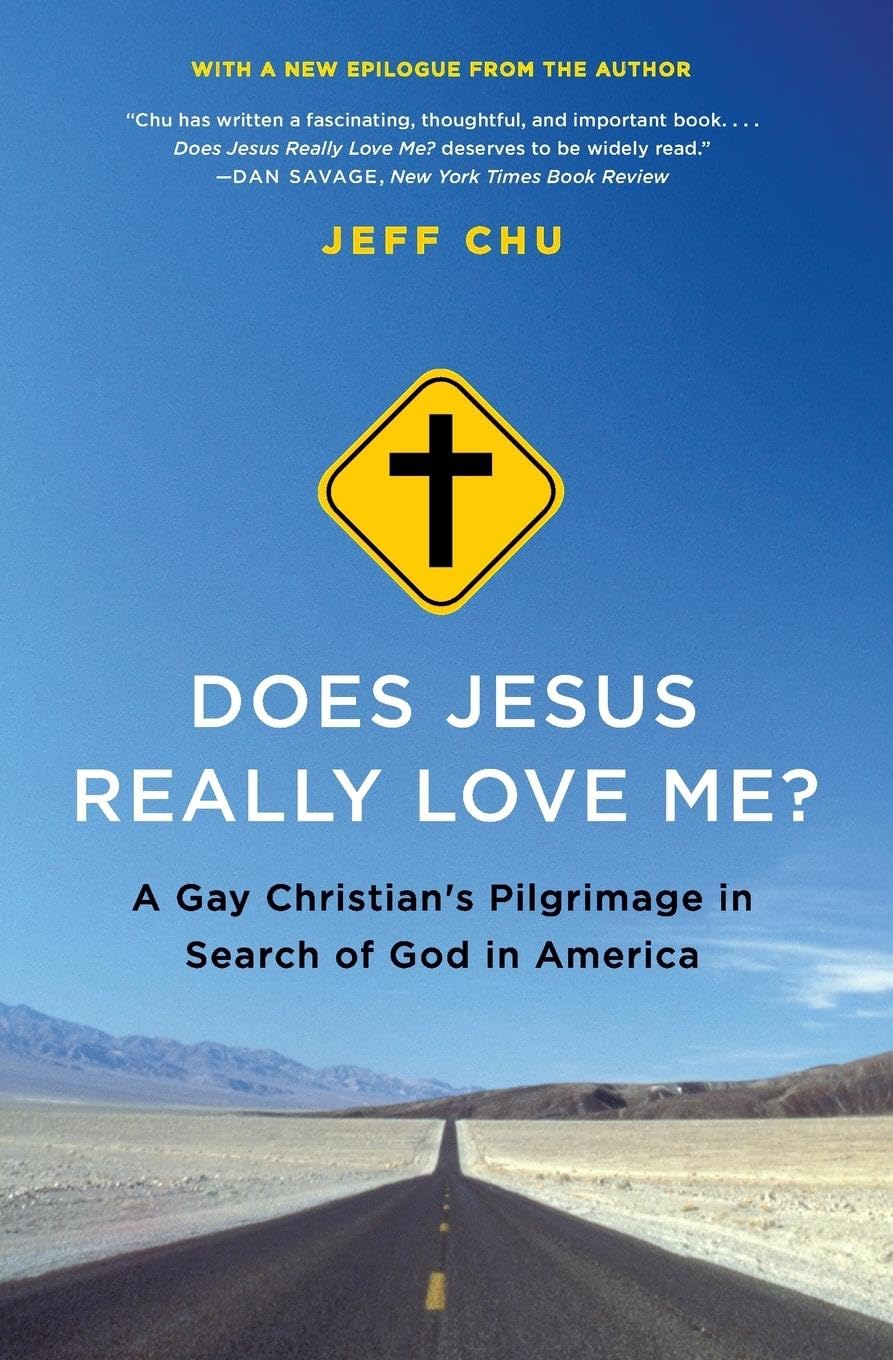
There is much to ‘chu’ on in this book, especially for a UK-based outsider like myself who has never visited America nor has any intention to do so. However being an ‘outsider’ can confer a degree of objectivity that enables the reviewer to offer an impartial criticism that pays little heed to the various factions engaged in America’s bitter Culture Wars. (A conflict any sensible Englishman would be wise to stay out of!) Culturally, I’m European and much of what I’d read in Chu’s work seemed like an explorers travelogue of a strange planet. At times, I’d felt as if Doctor Who’s Tardis had whisked me off to a parallel universe.In essence, ‘Does Jesus Really Love Me?’ is best read as a ‘road book’ in which the author is on an interior pilgrimage trying to reconcile his own sexuality with the Christian Faith. This complements an exterior pilgrimage in which he seeks out those engaged in the same struggle. As a ‘road book’ it succeeds very well and justifies its five star rating. What it does not claim to be is a work of theology. Indeed, Chu has the honesty to admit on p.7 “I’m no theologian.” As will be seen later in this review some of the subsequent contents of that book do support that statement. Consequently, any attempt to read his ‘Does Jesus Really Love Me?’ as a work of theology is to miss its central purpose. It does not claim to be a work of theology.Certainly Chu’s work made a fascinating read – so gripping in fact that I read the last part of whilst walking across some Pennine Moorland with my wife and two of her friends who seemed glad that my ‘anti-social book’ kept me out of mischief and left them free to ‘natter’ among themselves. Viewed purely as a work of journalism, it’s apparent that this book possesses many merits. The author had Louis Theroux ability draw people out whilst remaining discreetly in the background. He also managed to get a people from a variety of backgrounds to talk about themselves and their sexuality. These ranged from ‘big names’ like Ted Haggard and Bishop Mary Glasspool through to obscure figures like Gideon Eads. A few of those he interviewed like Fred Phelps were utterly repellent whilst others like the mixed orientation couple The Buechners, were highly endearing. (I found their testimony to be especially heart warming.) However, some like the tormented celibate Kevin Olson came across as being rather sad – although in the end he did appear to be on the way to fulfilling his dream of working in China. As an outsider ‘Does Jesus Really Love Me?’ main use was the insight it gave on America’s fractious culture wars and the extent to which ‘the Same Sex Issue’ had divided churches and families alike. This was highlighted by Chu’s account of ‘First United Lutheran Church.’ It reinforced my impression that this was a mess to keep out of. However, as a source for future historians exploring this conflict Chu’s book will have much to offer.The one part that provoked a feeling of anger, was the account given by Gideon Eads (on pp.312-321) of an utterly disastrous counselling session with a party who clearly had no calling at all to engage with the LGBT sector. The party concerned came across as rude, arrogant, prejudiced and lacking any degree of empathy. Listening skills were conspicuous by their absence. Indeed, he reminded me of the character in poem ‘The Wonderful Counsellor’ and like that character he had no interest in people as people. He had no ability to treat LGBT’s as human beings. Even basic courtesy and common sense was lacking. From this episode, it’s clear that no one should begin to tackle the LGBT issue unless they have a clear and unmistakeable call to do so and even if such a call does emerge it should be subject to the most rigorous form of scrutiny. The disastrous counselling session involving Gideon Eads shows the harm that can be inflicted when this is not the case.Also creating a sense of unease was the interview with Bishop Mary Glasspool who seemed willing to pontificate about love while occupying a senior position in an organization whose leader’s endless legal campaign against traditionalist dissenters gives me the impression of someone aspiring to be the Madam Whiplash of Traditionalists. (Their yelps of pain have been heard in England.) On offer appears to be a highly conditional love which says ‘we love you so long as you don’t question our authority or depart from our party line.’ Hmmm! One should always be wary when Senior Prelates make a point of saying how much they love people. Their embrace can all too easily be that of a Boa Constrictor.Chu’s considerable skills as a journalist and thought provoking narrator are partly offset by what appears to be a rather flabby theology. As was mentioned earlier Chu is not a theologian but even so one would have expected him to have had a better grasp of what the Christian Faith was about. It was in this area that he almost had me pulling what remained of my hair out in exasperation. On pp.146-7, he cited the Existential Theologian Soren Kierkegaard while appearing to be in a muddle about the nature of faith – unwisely equating it with absurdity rather than reason To quote his own words on p. 147 “Faith is not about reason – in fact reason obstructs faith, and it’s not until we set aside the former that the latte’s possibility becomes clear.” No, no, no, this is not the case! Faith is never more dangerous than when it’s separated from reason. This is a point that the American LGBT should have learnt from their unhappy experiences of Christian Fundamentalism. It was surprising that Chu shared a view of faith that has inflicted so much hurt on people sharing his same-sex orientation. During the mid-1990s I myself saw this form of faith lead to people laughing like lunatics in an asylum, double up as if they were having a fit, roar like animals and have a spurious word of knowledge that mocked some studies I was doing on Christ’s atonement. (This was the movement the anti-Gay activist Michael Brown endorsed at Pensecola.) Even in its milder forms it can entice practitioners into following the kind of “hippie-dippie mumbo jumbo” Chu described on pp.257-258. It’s a good job that Chu’s book was not being assessed on the basis of its theology because the score would have been minus 5. He didn’t see that committing yourself to Jesus through an act of faith is the most sane and rational step anyone can take regardless of their sexual orientation.However toward the end he does partly redeem himself by making (on pp. 295-7) some perceptively critical comments concerning the Metro-Community Church which appeared to offer a soup of syncretism (mixed religious beliefs and practices). Things improve still further in his conclusion when he offers some highly perceptive comments about church unity, the cowardice among pastors, the linguistic breakdown in churches and the reason why “the word Christian has taken on such negative connotations in our society” (p.344). Especially insightful was the comment made (on p.346) about the Hinduization of Christianity. Here he agrees with fundamentalist commentators who often make the same point. Truly, “we have taken a God of many names and hand-selected our favourite few.” I couldn’t have put it better myself. All these comments confirm that Chu had been actively learning from the encounters he had with people. He didn’t just accept things at face value.Chu’s observation that pastors were more sheep then shepherd, (p.343) especially resonated. Across the United Kingdom I’d seen them fall like ninepins before a ludicrous deception, that even in common sense terms, was obviously wrong and highly damaging. They became the fawning courtiers of evil. Hence, nowadays when I came across a decent pastor my attitude is one of considerable surprise. My initial reaction is usually one of mistrust. I usually assume them to be the carriers of bubonic plague unless proven otherwise.It’s on p.346 that Chu tries to answer the question “does Jesus love me?” On a positive note it’s clear that he’s grown beyond the immature security blanket view of God that he’d hitherto indulged in. He rightly discerned that love was something to be shared and that to grow in love it’s necessary to shed many “illusions and dreams and wishful thoughts,” (p.347) All very well and good, but what he still needs to see more clearly how our love is a result of what Jesus did for us at Calvary. It was there that our Lord hacked through the many barriers created by the world, the flesh and the devil and it was there that he gave us the freedom to begin to love others as he loved us. However such blessings need to be received through faith. They don’t come automatically. It really is a case of applying Paul’s words in Romans 10:9. Over this question one has the impression that Chu’s thinking is going in the right direction but is in need of more development. In particular, he needs to sort out what he means by the word ‘faith.’I began this review as an outsider to the American Christian Scene and despite learning many things I still remain one. I appreciated its liveliness and willingness to grapple with very difficult issues. However, there were aspects that caused me to raise my eyebrows in disbelief. As a Northern Englishman and member of the ‘no sex please, we’re British’ generation I found the high voltage emotionalism and willingness to disclose the intimate personal details rather strange. On occasion, I was tempted to exclaim, ‘why make such a blooming fuss?’ When I came across the sillier aspects of American Faith, I couldn’t help thinking, ‘what a load of cobblers’ (as we say in my part of the world). The effect of Chu’s work was to make me feel more European not less. However it would provide an invaluable guide for those wishing to visit the American Christian scene either electronically or in person. I was also left hoping the author will provide his readers with more to ‘chu’ on in the future.
G**S
An Honest and Thorough Investigation
Jeff Chu has gone on a pilgrimage. He quotes Pilgrim’s Progress at the beginning of each chapter. On his journey, he interviews and encounters many people of Christian faith, some of whom are disillusioned and some have left. Each interview provides a glimpse into the issue of how the Protestant church in the United States deals with gays. The book is enlightening and well worth the read.
M**R
Very Sad Stories, I Don't Think The Average Gay Christian Remains This Conflicted
This book is full of a lot of interesting and controversial ideas. While I was fascinated to learn about other people's journeys as gay Christians, I found this book over-all to be very sad. I accepted myself as a gay Christian long ago. I came to terms with my sexual orientation as a teenager. I never doubted my Christian faith or my relationship with God, so for me there was no conflict. I found it to be tragic that most of the people (clergy included) that were interviewed or featured in this book seemed to remain so full of doubt and conflict. They seem to still be struggling to find away to believe that God still loves them, even as actively gay people. Also, sad was the devastating need for approval these people seemed to have. In many cases they seemed to be desperate for their minister or anyone with some assumed religious authority to accept them and give them permission to be the gay person God made them without sacrificing their position as children of God. I don't think I ever had that need for approval from fellow humans. Everyone wants to be loved and accepted, but it is another thing to so need validation from others that you can't be happy and self-loving without it. I hope all those people find peace eventually, and somehow find the truth. God made them, and He doesn't make mistakes. He loves them completely exactly as they are. And if God is with you, who can stand against you? As a final note, I don't think those asking this question will find comfort in this book, unless they just want the validation of knowing that many other people share their fears. My answer to them would be to consider this: Since Jesus never said a word against homosexuality, why would they ever doubt that He would not love them because of it. It seems very probably that if He had a problem with it, He would have said so. He seemed to prefer those people that most of society shunned. He's kind of amazing that way.Michael Travis Jasper, Author of the Novel "To Be Chosen"
A**N
A thought provoking review of the state of the Christian church's approach to people who are gay.
Jeff does an amazing job of communicating his "pilgrimage" across the American church landscape as he discovers how a cross section of churches and people respond to people who are gay. It is very telling how the inconsistencies between the gospel and the church's practice create hardship and break relationships.I learned a lot from reading this and recommend it to those who are also interested in learning.
L**A
Excellent book.
It gives great insight into other gay Christian’s experiences around the world. Thank you Jeff Chu for sharing your story of stories!
L**E
Good, but heavy
A very good and very interesting read about many folks different stories about being queer & Christian. I highly recommend it; however if you are LGBTQA+ yourself it may be a heavy read, so please be aware of that & take care of yourself as needed ❤
P**H
Gay? Godly?
An honest search to reconcile faith and sexual identity.
Trustpilot
4 days ago
2 months ago