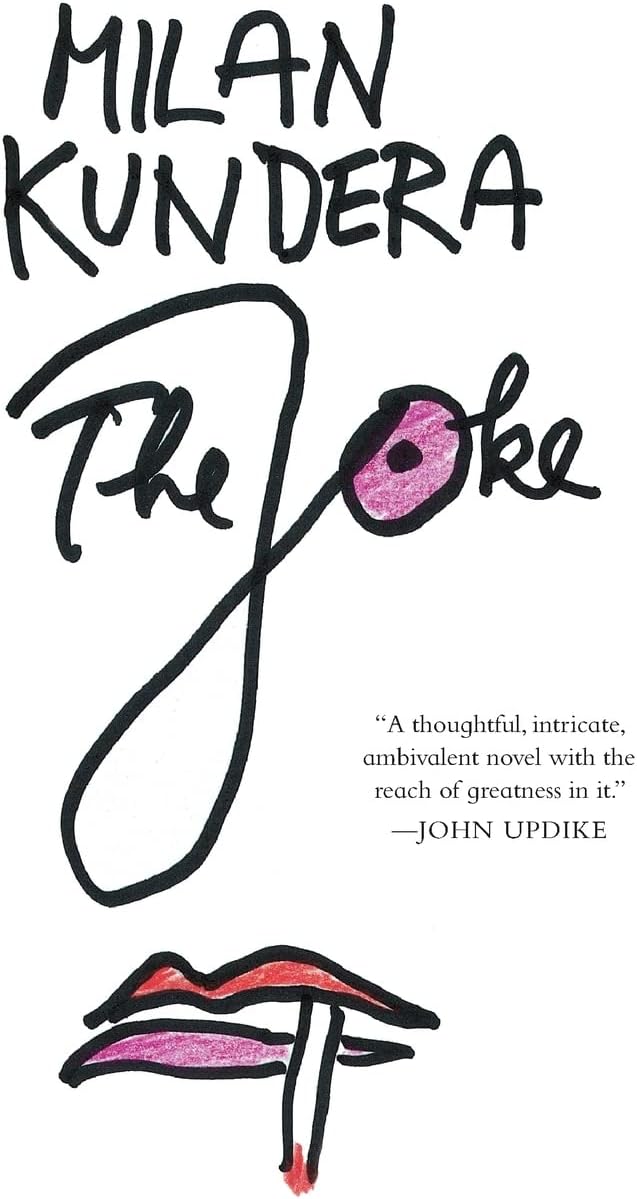
The Joke (Definitive Version)
Product ID: 9764931
Buy anything from 5,000+ international stores. One checkout price. No surprise fees. Join 2M+ shoppers on Desertcart.
Desertcart purchases this item on your behalf and handles shipping, customs, and support to GERMANY.
desertcart.com: The Joke (Definitive Version): 9780060995058: Kundera, Milan: Books Review: A contemporary Dostoevsky - This book is brilliant. Kundera is of course a fine writer. What I find distinctively wonderful about this book is the intensity of both thought and feeling throughout, reminiscent of Dostoevksy's "The Brothers Karamazov." Both characters and plot are secondary. The book switches from one narrator to another and back again. Here it is not so convincing to me as truly different characters. Different stereotypes and voices, yes. And the book therefore maintains its intellectual drive. But the overall perspective seems to be that of the protagonist Ludvik. Also, the male characters seem to be better developed than the female characters. A high (or low!) point is the almost unbearably exquisite depiction of Ludvik's experience of unrequited young love. The title of the book is itself interesting to contemplate. There is an explicit joke early in the book that sets the plot (or more like a series of episodes) in motion. But clearly the notion of a joke is meant to apply more broadly in the book. I'm not quite sure the book has a "moral," but if it does, one candidate for that moral would surely be that life -- romantic, political, religious -- is a joke. (And it's on us.) Review: Bittersweet, relevant and brilliant - I believe this to be a much more brilliant novel by Kundera than his more famous The Unbearable Lightness of Being, which to me seems all the more impressive considering it was his first book. The author has a fantastic ability to pull the story together from the different perspectives of the characters, and the story takes a more mature direction instead of becoming too ironic. Throughout the book I’m reminded of the silliness of youth and of strong, puritanical views of the world, political views of naive people with “good intentions” and lofty ideals, eager to sacrifice the world for their newfound solutions.


| Best Sellers Rank | #760,673 in Books ( See Top 100 in Books ) #1,894 in Fiction Satire #11,529 in Literary Fiction (Books) #12,932 in Classic Literature & Fiction |
| Customer Reviews | 4.4 4.4 out of 5 stars (366) |
| Dimensions | 8.01 x 5.32 x 0.84 inches |
| Edition | Reprint |
| ISBN-10 | 006099505X |
| ISBN-13 | 978-0060995058 |
| Item Weight | 2.31 pounds |
| Language | English |
| Print length | 336 pages |
| Publication date | January 1, 1993 |
| Publisher | Harper Perennial |
J**S
A contemporary Dostoevsky
This book is brilliant. Kundera is of course a fine writer. What I find distinctively wonderful about this book is the intensity of both thought and feeling throughout, reminiscent of Dostoevksy's "The Brothers Karamazov." Both characters and plot are secondary. The book switches from one narrator to another and back again. Here it is not so convincing to me as truly different characters. Different stereotypes and voices, yes. And the book therefore maintains its intellectual drive. But the overall perspective seems to be that of the protagonist Ludvik. Also, the male characters seem to be better developed than the female characters. A high (or low!) point is the almost unbearably exquisite depiction of Ludvik's experience of unrequited young love. The title of the book is itself interesting to contemplate. There is an explicit joke early in the book that sets the plot (or more like a series of episodes) in motion. But clearly the notion of a joke is meant to apply more broadly in the book. I'm not quite sure the book has a "moral," but if it does, one candidate for that moral would surely be that life -- romantic, political, religious -- is a joke. (And it's on us.)
R**A
Bittersweet, relevant and brilliant
I believe this to be a much more brilliant novel by Kundera than his more famous The Unbearable Lightness of Being, which to me seems all the more impressive considering it was his first book. The author has a fantastic ability to pull the story together from the different perspectives of the characters, and the story takes a more mature direction instead of becoming too ironic. Throughout the book I’m reminded of the silliness of youth and of strong, puritanical views of the world, political views of naive people with “good intentions” and lofty ideals, eager to sacrifice the world for their newfound solutions.
R**E
The Political Deforms the Personal as the Self Wavers
"Optimism is the opium of the people A healthy atmosphere stinks of stupidity. Long live Trotsky!" This is the joke, sent on a postcard for all the nosy official world to see, made by Ludvik Jahn when he was a promising student and a leader of the University's Communist youth group. Its flippancy is a product of his desire to amuse himself by discomfiting Marketa, a serious and gullible young woman on whom he has set his romantic and erotic sights; the postcard is part of his strategy as a would-be lover. The powers that be do not see the humor in his joke, but rather a fatal character flaw with treacherous implications. (Perhaps they were more insightful than they knew - their response recalls Nietzsche's observation that a "joke is an epitaph on the death of a feeling", in this case an emotional commitment to an ideal that can never be a joking matter to its adherents.) This results in a judgment which brings him so low that it takes him years to recover from its aftermath: expulsion from the university and the Party, forced service in an army "work battalion" in the mines, followed by three additional years as a civilian miner - which adds up to half a dozen years of self-doubt and psychological isolation, its pain made more acute by a consciousness of his lost privileges and debased social status. He comes to see his sentencing by a gathering of fellow students as emblematic of humanity's failings as a whole -- people in groups act as a compliant and sometimes violent herd out of envy, fear, or an unfounded moral superiority based on misunderstandings of their own personal myths or the myths of a society that is deceiving itself; and, needless to say, many of the upholders of public morality are merely careerists and opportunists. In any event humans are untrustworthy in situations that demand honest thought and fair judgment, implying to Ludvik that he would have raised his own hand to condemn another man had the tables been turned. While Ludvik eventually recovers a decent position in society and a kind of toughened mental equilibrium, he struggles with his misanthropy and a desire for retribution (but he retains his ironical sense of humor, which takes a dark, absurdist twist that matches the events in his life). In its structure "The Joke" is a polyphonic song of lament, recited by people about events from their shared pasts -- the national, collective past of the undiscriminating enthusiasm of youthful ideologues for the new Communist state of 1948; and the particular pasts of Ludvik, two of his old friends (Jaroslav and Kostka), the wife (Helena) of his youthful persecutor (Zemanek), and a strange, damaged woman from his period of societal punishment (Lucie). In the "musicological chapter" we hear Jaroslav's observations about the nature of Moravian folk music, accompanied by bars of musical notation. These illustrate an ancient mode of singing, in which each voice "personalizes" a song by singing in odd keys and awkward, shifting rhythms, as do the voices of lament in "The Joke" (the reader who knows little or nothing of the technical side of music and its notation still gets an interesting historical survey of a millennium's worth of folk-music and its relationship to both older and newer styles of music). Each voice tells part of the story of interlocking lives. The forlorn Lucie is the one person who is not a subject and remains an object throughout, so two versions of her story are told by Ludvik and by Kostka as part of their own stories. Each voice has a different purchase on reality and is driven by a different myth of the self and of things larger than the self, constructs by which individuals justify their actions. In Ludvik's and Helena's cases this exterior justification is their early allegiance to the ideals of socialism, in Jaroslav's his idolization of folk-art as a panacea for all of the woes of modern life, and in Kostka's a commitment to a highly personal Christian God. In each case there are moments when the individual despairs and believes that his "cause" may be nothing but a delusion or a means of avoiding personal responsibility for his own life. Based on a chance encounter, Ludvik targets Helena in order to revenge himself against her husband, considering her sexual conquest and the cynical manipulation of her emotions to be an exquisite (and, in its details, sadistic) "joke" which will finally satisfy his cravings for revenge. But he sadly discovers that he wounds the wrong person and that even his real target, Zemanek, is no longer the man he once was; now the joke is on Ludvik, and it leaves a bitter taste in his mouth. The "polyphonic" fragments of three voices accelerate their tempo in the last chapter, and there is a harmonic resolution of sorts - Ludvik "returns home", as it were, and reconciles with the friend of his youth, Jaroslav, whom he has hitherto identified with the stupidity and smugness of small home-town virtues which he fled long ago. (One of the many ironies in the book is that it was Ludvik who convinced the resistant Jaroslav to become an ardent Communist, and Jaroslav does so because the new State is a sponsor of all the folk arts. A parallel irony is that Kostka, the pious Christian, approves of the Party's expulsion of Ludvik, because he understands the Party as a faith, and no faith can tolerate corrosive skepticism.) In the end it is not clear how or if any of the damaged characters will move forward in their lives; much of the damage has been self-inflicted and based on illusions, which only makes it worse. There are elements of an authorial self-portrait here, as one might expect from a first novel. To begin with the obvious, Ludvik is Kundera's age and has passed through the same national history and a similar personal history (as a student Kundera was expelled from the Party in 1950 for six years; readmitted, he was expelled again in 1970). Furthermore, Ludvik's and Jaroslav's characters contain something of Kundera's own early musical training. More autobiographically telling are the oblique references to Kundera's long poem celebrating Julius Fucik, a work which fit well with the regime's peculiar and intense cult of Fucik as an exemplary national hero of the resistance against the Germans during the Protectorate and a model for Communist youth, who are to be elevated and instructed by Fucik's "Reportage: Notes from the Gallows". On this note (poetry and Kundera's evaluation of it), the highlighted term "the lyrical age", a recurring idea in his work, makes its appearance. This phrase, which Kundera uses critically and almost with contempt or perhaps contempt mixed with regret, is meant to stand for each man's period of immaturity, in which he assumes postures and attitudes to impress the world, while all the time he is in a state of inner confusion and uncertainty about how to behave as an adult. The lyrical age is the age of imposture and narcissism. And the term has a double meaning, referring not only to individual psychology, but to the psychology of an era, specifically the years following the Communist take-over of the state in 1948. This was the lyrical age of Czechoslovakian Communism, which happened to coincide with the last vicious burst of Stalinism; it should be remembered that the participants in the Stalinist drama were motivated as much by a "collective joy" associated with the "construction of socialism and the new man and the new woman" as they were by fear of political trials and the penal system. In Kundera's case this was a period when he wrote lyrical poetry imbued with these political attitudes, especially his poem idealizing Fucik. Kundera obviously rues this phase of his own youth and, now a master of prose, gives us an unflattering alternative reading of Fucik's life. In this sense "The Joke" is an attempt to redress the excesses and impostures of Kundera's own youth. (If the reader wishes to explore what Kundera means by "the lyrical age" -- and he means a great deal by it; it is something like a ramifying leitmotif in his work -- he can find more details in the author's own words in Kundera's "The Art of the Novel" and in an interview published in Antonin J. Liehm's "The Politics of Culture". The idea is also examined by Peter Steiner in his book "The Deserts of Bohemia". In his essay on the Slansky show-trial Steiner also supplies information that, for non-Czech readers, illuminates the pathetic character Alexej in "The Joke", who could well be based on Ludvik Frejka's son. Frejka was a former high-ranking economics official who was condemned to death for espionage and sabotage in this parody of a trial in 1952. And Frejka's son Tomas vilified him in the pages of the Party paper, "Rude Pravo" -- like Alexej, who bears a burden of socialist shame over his deposed father and writes a public letter denouncing him.) Although it contains satirical elements (its portraits of Zemanek and Helena, its depiction of authority figures in the army), it would be a mistake to call "The Joke" a work of satire. Kundera considers his novels to be primarily what might be called "existential meditations". Much of the meditation is on people in a situation which is characterized by the inevitability of extreme politics as a background condition which permeates everything, including all human relations. This particular situation appears almost inescapable to Czechs (and Slovaks), especially to Czech writers during the period from 1938 to 1990. The dates of the book's composition and publication (1967) are very important in assessing Kundera's relationship with other writers and intellectuals who participated in the Prague Spring (1968) and were hammered down in various ways after the failure of the movement to establish "socialism with a human face." Kundera, like Ludvik, was still arguing for the maintenance of a reformed Communist state which would rationally carry out social and economic programs while allowing individuals civil liberties - this proved to be a pipe-dream. His recognition of the unviability of this idea is indicated by his self-exile to France in 1975. Another disturbing meditation, central to Kundera's way of thinking, is on the fluidity and "lightness" of the self, represented here by the masked alterations of identity that take place in the Moravian ritual "Ride of the Kings". The dissolving self is a subject fit for its own essay; and a subject notably treated by Karel Capek in his trilogy "Three Novels". Now to the most important matter, the literary qualities of the work. Kundera is a thoroughly professional writer with literary goals and standards that he has set for himself (again, these are explicitly stated in "The Art of the Novel"). Since he has chosen to tell his story - or construct his existential meditation -- through the minds and words of four different characters, how well has he established the individuality of their voices? It can be said that three of the voices - Helen's, Jaroslav's and Kostka's - have something in common. Each of these characters is arguing with himself or herself within a system of ideas that is almost axiomatic, and they take their arguments to a logical extreme. At the same time they are questioning their relationship with their most cherished idea in order to evaluate the worthiness of their own lives (i.e., "Have I chosen to live a certain way correctly, or even wisely?"). Helen's choice is for the Party and its notion of society, even to the extent that her first love and marriage were based on their acceptability within this framework. Jaroslav's is for folk-art, based on a belief that it will save him (and others) by reconnecting them with a long and diffuse group identity (the village; the nation; the culture). Kostka's commitment is to God, apprehended through a highly personalized form of Christianity. Each believes he or she will be saved by his adherence to the chosen ideal. Ludvik, however, has fallen from grace, and, with that, from certainty; he no longer believes in belief, in the notion that such broader commitments are necessary or desirable, because they are a reservoir of self-deceit and self-justification rather than ideas which can withstand rigorous criticism. And so his voice stands out from each of the others, although it can be pointed out that he too becomes obsessive in the pursuit of revenge - his "myth" is purely personal, and it has been thoroughly formed and deformed by politics. On a final note, the present reviewer's reading is based on the Faber and Faber edition of 2000, which is the only English edition that is "fully authorized and approved" by Kundera. In this edition's "Afterword" Kundera explains both the sources of the work's translation (Michael Henry Heim, other translators, and one key editor are involved) and the reasons why he felt the earlier four translations were unworthy or absolutely misleading. Don't skip the Afterword, since it is a miniature essay on the art of translation itself (and, in an oddly ironical way, a commentary on the "bad joke" which Kundera feels the English-language publishing industry has played on him, especially with this work). While in comparison to numerous other good novels this book merits five stars, I give it four because there are other novels by Kundera which I esteem more highly.
A**T
a brilliant portrait of the tragicomedy called 'human existence'
This is Kundera's first major success, finished in 1965 and eventually published 1967 in the original Czech version ("Zert"), after managing to slip by the censors that had become a little relaxed as part of the beginning of the famous "Prague Spring." Earlier English (and French) translations were not very good; be sure to get the "definitive version, fully revised by the author" (for the English version, that generally means published in1992 or later). I read it in French (La plaisanterie) and English side by side - a wonderful way to compare the effect and "feeling" of the two languages, by the way. Later in his life, Kundera, who had managed to emigrate to France after falling out of favor with the post-1968 authorities in his native Czechoslovakia, started to write in French - so that version may even be a little closer to the original author's intent (he personally revised that translation also). This novel is an absolute masterpiece. With both surgical precision and a painter's eye for all shades of human frailty, Kundera exposes human confusion in the hapless pursuit of happiness, and many of the built-in traps that thwart success in that endeavor. He manages to be kind, wise, and simply honest, in the face of utter baseness and hopelessness. It is an intense exposure of the human predicament, and at the same time it makes you smile. Reading this book was a very incisive experience. If you read French, I would recommend reading that version side by side, and to also study Alain Finkielkraut's review and analysis of this novel (a chapter in his "Un coeur intelligent").
M**C
Heavy slog
I'm an avid reader. Thought it was finally time I read Kundera's work, since he is so famous, but I just couldn't get through this. I know it's a great story, but looooong paragraphs, buried conversations put me off.
N**M
it's just beautiful. an insight into a different era, a different political system, the mind of young men, and even the musical heritage of Moravia. impossibly for me to describe. so in short: beautiful.
A**R
I am a fan of Milan Kundera and this book is one of his bests.
M**A
I came to this very late: 'The joke' was Kundera's first novel, published in (what was then) Czechoslovakia in 1967, and having gone through 4 or 5 English translations before settling on this, the definitive English translation (according to Kundera's own note at the end of the book). I feel it's a good introduction to Kundera's work for those who haven't read any of his other books; and after all, this is where it all started... The Joke alternates between the perspectives of different characters: Ludvik (who feels the central figure); Helena, Jaroslav and Kostka. And I would also add: Lucie, although it is through the voice of others that we hear her voice, but it is a very distinctive voice indeed. The joke in question occurs at the beginning; it has to do with Ludvik's playful and meant-to-be-funny remarks on Trotskyism on a postcard sent to a girlfriend. Within the tight, repressive, paranoid and (of course) humourless restraints of the Czechoslovakia communist regime, this postcard is taken as proof that Ludvik has strayed from the party's orthodoxy; he is seen as a 'cynic' and a 'skeptic', thus potentially dangerous for the party that needs pure, unthinking followers. So his studies are forcefully interrupted & he is sent to the army which then leads to prison. Once in isolation and having lost everything that meant anything to him, Ludvik is led through a journey which comes to doubt meaning itself and where he comes to doubt his own intentions and underlying beliefs when 'joking'. Was what he had written, after all, funny? Funny to whose ears? This leads to some interesting thinking regarding the seriousness of jokes- let's not forget Freud's own book on Jokes- and also regarding, ultimately, the absurdity of life's turns, the sense of inevitability but also of randomness that comes to penetrate Ludvik's life to the point where he almost completely loses sight of what (if anything) matters to him. What comes to matter, eventually, is revenge. But in the process of his (failed) effort to get revenge against those who seemed to believe they had all the answers but who, as he sees it, destroyed his life, Ludvik comes to realise that it is here, in the process of revenge, where the greatest absurdity and meaninglessness occurs. Crucially, the greatest humiliation can occur too just because revenge can force us to face the true meaning of forgetting, of time passing. But in the process of Ludvik's efforts at revenge the reader has the pleasure to finally laugh with some relief at what is a real (if tragic and grotesque) joke. I leave you to discover that one yourselves... A beautiful book, well worth returning to. It's particularly good to read this from a distance, now that life in the 50s and 60s Eastern European Communist regimes feels so far behind us (although it was not that long ago). Made me think about the passage of time and the crushing role of forgetting within it. What once seemed, at the time Kundera writes about, essential and true, seems so very distant now that we almost forget the whys and hows of that time. We can also easily forget the reality and inevitability that everything at the time meant to the people living through that period. And I suppose that's a thought to hold on to about our own lives too.
M**N
Awesome
米**弁
クンデラを読むのはこれが2冊目である。1冊目はもちろん “The Unbearable Lightness of Being” で、これを読んだのは10年以上前。とても緊迫感のある良い小説だったが、20代の時に読んだ、同じく共産主義政権下における知識人の苦悩を描いた小説、ソルジェニーツィンの『ガン病棟』『煉獄の中で』と比べると、そのスケールの大きさにおいて見劣りするような気がして、その後クンデラには手を出していなかった。 最近、あることが切っ掛けで、もう一度クンデラを読んでみようと思い、どれにしようか迷ったすえ、”The Joke” にした。理由は2つ。 1つはこれがクンデラの最初の長編小説であること。よく言われることだが、「処女作にはその作家の全てが詰まっている」のではないか。 もう1つは、この Harper Perennial の版が “Definitive Version Fully Revised by the Author” となっていることであった。そこに至る経緯はこの本の最後に Author’s Note として詳しく書かれているのでそちらを御覧頂きたいが、”The Joke” がチェコ語で出版されたのは1967年、この “Definitive Version” は1992年、その間25年である。それほどに英語の翻訳に拘った作品であるなら、作者の思い入れもさぞかし深い作品だろう。(最初の英語版が出版されたのは1969年。その後訳者が替わったり改訳されたりと計4回の英語版が出版されたそうだが、クンデラはどの翻訳にも満足できず、最終的には Michael Henry Heim の翻訳を基に、HarperCollins 社の編集者 Aaron Asher と協議し、自ら筆を入れて現在の版を作ったとのこと。Author’s Note の最後にクンデラは ‘To my readers, a promise: there will not be a sixth English-language version of The Joke.’ と冗談交じりに記している。) 筆者自らが英語版の翻訳に手を入れただけあって、この翻訳は明晰で読みやすく、美しい英語になっている。(浅学の者の言うことゆえ当てにはなりませんが。) しかし書かれている内容は重く、決して気楽に読めるものではない。読んでいる間中、常に読者は、登場人物の生き方・考え方を自分のそれと比較し、現在の自分の在り方を再考せずにはおれない。そんな真摯さと力強さとをこの作品はもっている。だから、読後の印象は爽やかでもないし、ほのぼのとしたものでもない。(大衆小説と純文学の違いと言っても良いだろう。) この作品の主題は何だろう。私には、人はひとを真に理解できるのか、ということのような気がした。たとえ親子であっても、友人同士であっても、恋人同士であっても、人がひとを真に理解すること、もっと言えば、自分自身をさえ真に理解することは不可能なのではあるまいか、取り分け言葉のレベルにおいて、肉体のレベルにおいて。しかし、音楽は時にそれを可能にする。最後の場面で Ludvik は嘗ての音楽仲間 Jaroslav 率いるシンバロンの楽団で10数年ぶりにクラリネットを吹き、チェコの民族音楽を奏でる。その時彼は、この10数年敬遠し嫌悪していた Jaroslav に人間としての親近感を憶え、同時に自分がチェコ人以外の何ものでもないことを納得する。それが音楽の持つ力だ、音楽には言葉や肉体を超えた親和力がある――そうクンデラは言っているかのようだ。(因みにクンデラはプラハの音楽芸術大学を卒業している。また130ページ、131ページには楽譜も登場する。) もちろん複雑・微妙に織りなされたこの小説の主題がこの1つだけでないことは当然であろうし、他に様々な読み方があってよい。(クンデラ自身はこの小説はラブストーリーだと言っているそうだ。) 文学とはそういうものだ。 結論: 明晰な英文で書かれた実存主義的純文学を味わってみたい方にはお勧めの一冊である。ただし、これだけを読んで “The Unbearable Lightness of Being” をお読みにならないとしたら、それは勿体ない。
Trustpilot
2 weeks ago
5 days ago