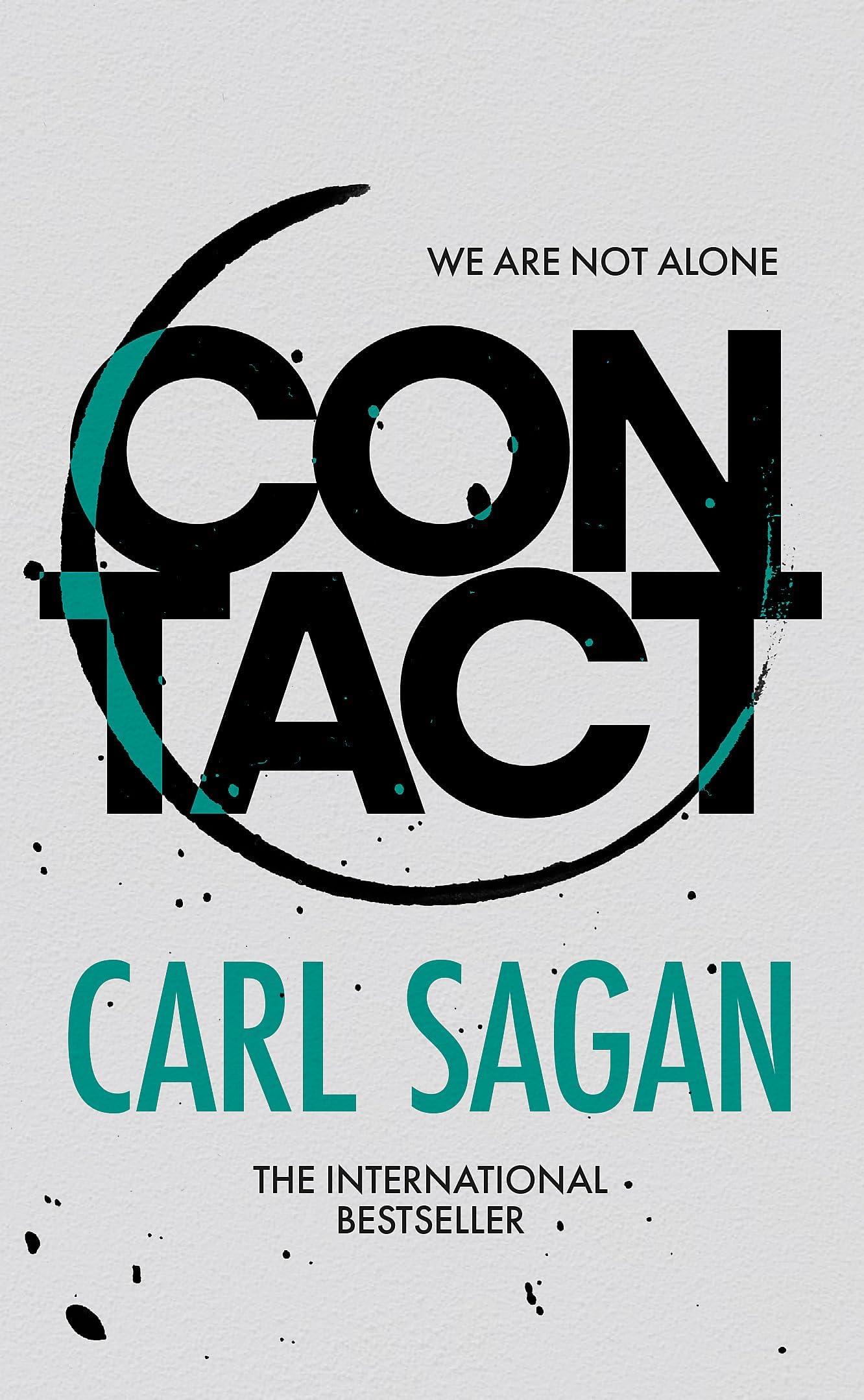
Contact
Product ID: 479846769
⭐4.4/5 from 6,677 reviews
📚44,693 Best Seller Rank
🚀Thought-provoking first contact sci-fi
Buy anything from 5,000+ international stores. One checkout price. No surprise fees. Join 2M+ shoppers on Desertcart.
Desertcart purchases this item on your behalf and handles shipping, customs, and support to GERMANY.
🚀 Unlock the universe’s secrets—don’t just read about the stars, rethink your place among them!
Contact by Carl Sagan is a bestselling, critically acclaimed science fiction novel ranked #44,693 in books and #178 in First Contact genre. With a 4.4-star rating from over 6,600 readers, it blends rigorous science, philosophy, and narrative to explore humanity’s response to extraterrestrial communication. Ideal for intellectually curious professionals seeking a thoughtful, mind-expanding read.
| Best Sellers Rank | 44,693 in Books ( See Top 100 in Books ) 178 in First Contact |
| Customer Reviews | 4.4 out of 5 stars 6,677 Reviews |
J**J
Will you look differently at the stars after reading this book?
I really enjoyed the film and to the best of my memory it seems the film was true to the book but missed out the more complicated science. I love reading about space, engineering, physics, any science really. I don't claim to always understand what I'm reading but this is where a Kindle e-book trumps a real book, as a dictionary and Wikipedia are at your fingertips. I was really surprised to find all the words I was unfamilar with were actually in the dictionary, as some of the words seemed quite obscure. The Kindle didn't let me down and even though I had to pause to look words up it didn't detract from the story because I felt I was also learning something. Beyond the science, the story encourages you to condider what first contact would mean. What about our safety, our future, our beliefs? Would the world unite? Would the populace want trillions to be spent on a machine specified by a voice from space, when they don't know what it will do or if it will even work and when millions of people are in need? Carl Sagan looks at these questions. I don't know if his answers are realistic, that's up to you to decide but hopefully you will enjoy the journey that helps you get to that point and if you weren't before, perhaps you will also be captivated by the resplendence of the stars. Overall, a great read that opens minds to science and out of this world possibilities. Definitely a journey to enjoy.
L**N
Intelligent, gripping and thought provoking
This is a proper book. It tackles massive issues and questions and it does out in a sensible, non excitable way. The book itself is detailed, it's narrative told through the detail of science and maths rather than characters. That's not to say there is not character development as there is but the development is based on the science and what is occurring and how this affects the players, but there are not long conversations or plot developments through talk. Sagan raises many issues and whilst the ending might be surprising from an author that is a man of science it's also refreshing that he is willing to raise the questions and spark the debate amongst readers that he has. Highly recommended that like their science fiction thoughtful and questioning rather than exciting and faced paced.
D**N
Superb
I am a long-time fan of the movie, but hadn't quite gotten around to reading the book. When I started it, I was - as I often am - a little put out of countenance by the differences. However, what emerges from the book is an even richer, even deeper story. The scientific concepts thrown around at first seemed like window-dressing, but eventually emerge as absolutely core to understanding the message, both in and out of text. Carl Sagan was a wonderful communicator, as his Cosmos series, his books and his lectures clearly show. What Contact shows is that he was also a tremendous story-teller - in retrospect, that's not much of a revelation as all his work is inherently the act of telling stories about the universe. His fiction is infused with fact, but his ability to do that with such seamless elegance is a rare talent. I was also deeply impressed by Sagan's explorations of the issue of faith. I consider Carl Sagan to have been one of the pre-eminent atheistic philosophers of the age, and as such I wouldn't have expected his discussion of faith to be so rounded and so inclusive. He always did have the ability, far beyond those of raving loons like Dawkins, to offer a cogent and respectful deconstruction of theism without being spiteful or dismissive - I'd say Contact though shows that he did have a spiritual side that was more, not less, inspiring with the removal of God from the equation. I won't go so far as to say that, despite my initial suspicion, the book is better than the movie. I will say though that they tell two very different stories - connected in some key players and events, but otherwise radically different in both tone and implication. You can enjoy one without the other, but as with the lessons of scientific co-operation across the world in the book it's better to consider the tale from two perspectives.
D**Y
Great ideas, boring book
Carl Sagan is one of those people whose legacy seems untouchable. From the Pale Blue Dot and his work with NASA to the groundbreaking and essential TV series Cosmos you'll never hear a bad word spoken about him. He's one of those people who just makes you damn proud to be human. I cracked through the box set of Cosmos in under a week and was eager for more. I was excited by the prospect of Sagan having a whole novel to stretch out his ideas and was curious about how the passion and intelligence he displayed on screen would translate to the page. What a shame then that this book is such a crushing bore! Massive theme's, breathtaking consequences. A protagonist vindicated before the whole world and realising a life's dream; contact with beings from another world! Do we sense any of this? I'm sorry but I didn't. The enthusiasm evident in Sagan's TV programs is all but absent from his prose. The writing is so dry, academic and thuddingly dull. There's just no personality or style to it. I wasn't expecting loads of laughs or anything but this book is as close to being amusing as we are to a faint star in a distant galaxy. Characters still need to be human, not machines for the pursuit of science or puppets to espouse the authors theories on Religion and politics. Dr Arroway, our protagonist, is given an injection of excitement and personality when she reveals that she is pretty liberated sexually. Not that she is given a chance to persue her penchant for experimentation; it forms no part of the plot and her only love interest is a lukewarm affair which peters out weakly. Really, her liking sex has more to do with Sagan's ideas on Feminism than it does to her character. Similarly we are presented with two religious characters, one closed minded and fundamentalist, the other open minded, giving Arroway (an Atheist) a chance to argue with both faces of religious intuitionalism. Can you guess who comes out on top? The shame is that as a respected scientist and thinker Sagan does have great idea's on a wide range of subjects but the whole book smacks more of a thought experiment than it does a novel. I have to say if it wasn't for the strength of the ideas and my respect for the man I'd have given up a long way before the finish. My curiosity did win out, and I really wanted to read Sagan's vision for first contact between Humans and an Alien race. The result is believable and fairly spectacular, or at least it would be if, like the rest of the book, the life wasn't drained out of it by the dull characters and duller writing.
E**3
An excellent novel on many levels
I don't generally buy books this old these days, but it was on offer, by one of my favourite, childhood science figures, had good reviews and I had seen the film, so I thought I would find out what the original was like and I am very glad I did. This is a beautifully written book, with good science (as you would expect), well developed characters (including a strong, female scientist lead, in the days when these were rare) and a believable plot which keeps you reading. It has also aged well: no novel can predict the future but it did not read like a book written more than 30 years ago, more like an alternative history novel written recently. My respect for Professor Sagan was renewed and increased by reading this work. For others who have seen the film but not yet read the book I will not reveal any of the differences, but they were numerous and large enough to make yet another good reason for reading it.
C**T
A science fiction yarn, but unconvincing.
This story started extremely well - it is gripping - a message from space rooted in prime numbers. Unfortunately, for my taste, it slowly but surely gets bogged down in a debate between religious faith and scientific experimentation, in search for the “truth “. Talk of the Advent and the Rapture do not enhance the central theme of the book - is there extraterrestrial intelligence in the universe? That said, Sagan’s story is interesting but spoiled by various dogmas. To be honest I enjoyed the film by the same name “Contact” more.
J**R
Worthy of the Epithet, Classic
Throughout his life, Carl Sagan's proclivity for speculation made many of his colleagues uncomfortable and some of his peers even considered his propensity for indulging his imagination to be irresponsible. In spite of this hostility (or perhaps because of it), Sagan used Contact to give full reign to his imagination. However, whilst Contact is undoubtedly a remarkable work of fiction, it is far from being an example of fantasy run amok and Sagan never betrays the principles and constraints of his discipline, producing an intelligent and compelling discourse on the role of science in society. It is this self-restraint that is so appealing and marks this book as something very special. Throughout, Sagan never eschews an opportunity to educate his readers or promote science generally and those familiar with his work will be struck by the similarities to his factual writing: remarkably, all that seems to differentiate Sagan's fiction from his non-fiction is a subtle shift in emphasis between speculation and science. Of course, Contact was not only a vehicle for popularizing science but also an opportunity for Sagan to explore his own attitudes and prejudices through a thinly disguised alter-ego. The book revisits many of his favourite themes: the search for (and discovery of) extraterrestrial intelligence provides the central motif of the novel but Sagan also discusses sexual inequality, the politics of space travel, the dichotomy between religious and scientific outlooks, and the dangers nuclear proliferation. We are also given a fascinating glimpse of Sagan's relationship with his parents and an insight into how hurtful he found some of the criticism of his approach to science. For Sagan, Contact was not simply a work of science fiction, it was a very personal odyssey. Contact has aged gracefully since its publication in 1985 even if some of its metaphors seem anachronistic to modern readers (for instance, the American/Soviet relationship) and its message remains relevant to this day. Whilst it may lack the excitement of inter-species battles and inter-planetary wars, it is a hopeful and thoughtful novel deserving of the epithet, classic.
N**O
A must buy!
One of the best novels that everyone should have in their collection!
Trustpilot
2 months ago
4 days ago