
Buy anything from 5,000+ international stores. One checkout price. No surprise fees. Join 2M+ shoppers on Desertcart.
Desertcart purchases this item on your behalf and handles shipping, customs, and support to GERMANY.
Reader Favorites Visit the Store Reader Favorites Visit the Store Bestselling Beartown Series Visit the Store Bestselling Beartown Series Notable Novellas Visit the Store Notable Novellas Review: I lOVED this endearing novel - I am a huge fan of this author ever since reading Beartown. It amazes me how young he is yet has his finger on the pulse of humanity so astutely. This was, for me, a thoroughly charming, engrossing novel about someone who clearly has 'issues'. She has left her former life (husband who cheated on her) to embark on being on her own. You will grow to 'understand' her. As the author occasionally tosses in information about where Britt-Marie has come from, you get a glimpse into her entire life leading up to now, you will question whether her experienced issues contributed to how she is now, or did they accelerate issues she already had embedded in her. You will form your own opinions about all the other characters. You have to remember this takes place in a tiny 'town' in Norway - things are not anything like any of us have experienced. This novel needs to be digested for exactly what it is: The journey of a very 'challenged' woman. It took my heart into another whole dimension. Bachman's incredible insight into others' 'idiosyncracies' is amazing. I think the main message for me, aside from loving the story, the interplay of the characters, the wanting to know where it all leads, is how the players 'accept' Britt-Marie's personality. I am a huge 'highlighter' of passages and though I have too many to put forth here, I shall share what I can to hopefully give you a true 'feel' of what this author portrays in his wondrous story: "Once he used to hold her hand when they slept, and she dreamed his dreams. Not that Britt-Marie didn't have any dreams of her own; it was just that his were bigger, and the one with the biggest dreams always wins in this world." "Kent said that Britt-Marie was socially incompetent, so she stayed home for another few years so he could be social on behalf of the both of them. It's not that she chose not to have any expectations, she just woke up one morning and realized they were past their sell-by date." "In the end, all she dreamed of was a balcony and a husband who did not walk on the parquet in his golf shoes, who occasionally put his shirt in the laundry basket without her having to ask him to do it, and who now and then said he liked the food without her having to ask. A home. Children who, although they weren't her own, came for Christmas in spite of everything. Or at least tried to pretend they had a decent reason not to. A correctly organized cutlery drawer. An evening at the theater every now and again. Windows you could see the world through, someone who noticed that she had taken special care with her hair. Or at least pretended to notice. Or at least let her go on pretending. Someone who came home to a newly mopped floor and a hot dinner on the table and, on the odd occasion, noticed that she had made an effort. " "She misses her balcony more than anything. You're never quite alone when you can stand on a balcony - you have all the cars and houses and the people in the streets. You're among them, but also not. That's the best thing about balconies." "It may be that a heart only finally breaks after leaving a hospital room in which a shirt smells of pizza and perfume, but it will break more readily if it has burst a few times before." "She wasn't upset about what Kent had said, because most likely he didn't even understand it himself. On the other hand she was offended that he hadn't even checked to see if she was standing close enough to hear." "Ingrid (Britt's deceased sister) was never negative. As always with people like this, it's difficult to know whether everyone loved Ingrid because she was so positive, or if she was so positive because everyone loved her. Ingrid also loved to play. As with all people like that, it's difficult to know if she was the best because she loved the games, or if she loved them because she was the best." "It's the silence that she struggles most of all to live with, because while immersed in silence you don't know if anyone knows you are there, and Winter is also the quiet season because the cold insulates people. Makes the world soundless. It was the silence that paralyzed her when Ingrid died." "All marriages have their bad sides, because all people have weaknesses. If you live with another human being you learn to handle these weaknesses in a variety of ways. For instance, you might take the view that weaknesses are a bit like heavy pieces of furniture, and based on this you must learn to clean around them. To maintain the illusion. Of course the dust is building up unseen, but you learn to repress this for as long as it goes unnoticed by guests. And then one day someone moves a piece of furniture without your say-so, and everything comes into plain view. Dirt an scratch marks. Permanent damage to the parquet floor. By then it's too late." "Societies are like people in that way. If you don't ask too many questions and don't shift any heavy furniture around, there's no need to notice their worst sides." There are two parts of the novel whereby the title of the book will come to your mind (I always enjoy finding out where titles come from) - one of which is when Britt is looking at a map of Borg on the wall - she looks at the red dot that first made her fall in love with the picture. The reason for her love of maps. It's half worn away, the dot, and the red color is bleached. Yet it's there, flung down there on the map halfway between the lower left corner and its center, and next to it is written "You are here." "Sometimes it's easier to go on living, not even knowing who you are, when at lest you know precisely where you are while you go on not knowing." "Human beings are the only animals that smile as a gesture of peace, whereas other animals show their teeth as a threat. This is perfectly understandable now; she can see the animal inside the human being." "They got married because Kant's accountant said it made sense from a 'tax-planning perspective'. She never had a plan, she hoped it would be enough if you were faithful and in love. Until the day came when it wasn't enough." "Then she rubbed the white mark on her ring finger. People who have not worn a wedding ring for almost their entire lives are unaware of how a mark like that looks. Some people take theirs off from time to time - while doing the washing-up, for instance - but she had never once taken off her ring until the day she took it off once and for all. So the white mark is permanent, as if her skin had another color when she was married. As if this is what is left of her, underneath, if your scrape off everything she turned into." "A few moments. A human being, any human being at all, has so perishingly few chances to stay right there, to let go of time and fall into the moment. And to love someone without measure." "All passion is childish. It's banal and naïve. It's nothing we learn; it's instinctive, and so it overwhelms us. Overturns us. It bears us away in a flood. All other emotions belong to the earth, but passion inhabits the universe. That is the reason why passion is worth something, not for what it gives us but for what it demands that we risk. Our dignity The puzzlement of others and their condescending, shaking heads." "She asks herself if choices or circumstances make us the sort of people we become. She wonders what takes the most out of a person: to be the kind that jumps, or the kind that doesn't? she wonders how much space a person has left in her soul to change herself, once she gets older. What people does she still have to meet, what will they see in her, and what will they make her see in herself?" "One remarkable thing about communities built along roads is that you can find just as many reasons for leaving them as excuses to stay. Some people never quite stop devoting themselves to one or the other." "Morning comes to Borg with a sun that controls itself and waits respectfully on the horizon, as if wanting to give her enough time to make a last choice, and then to choose for herself for the first time." The scenes with Britt-Marie and Sven brought me to my knees - the first being when he produces a bamboo screen in order to calm her before riding in his patrol car going by townspeople. He was beyond an incredible human being. When she rides in his patrol car she reflects 'He talks all the way, just as Kent used to do when they were in the car. But it was different, because Kent always told her things, whereas the policeman asks her questions. It irritates her. You do get irritated by someone taking an interest in you when you're not used to it." Pay attention to how the author planted just one little drawing at the start of each paragraph - one that encapsulated what the most important point of that chapter was. I am still reeling from the ending. I cannot comment one bit on it. I would dearly love to know how others feel about it. Review: Backman does it again. - 📖 Book Review: Britt-Marie Was Here by Fredrik Backman 📖 Rating: 🥃 4 Stars - Smooth & Satisfying: A solid, enjoyable read with great flow. After the dark intensity of Phantasma, this was a refreshing change. Britt-Marie Was Here is a heartwarming story about second chances, finding purpose, and stepping outside your comfort zone—whether you want to or not. Britt-Marie, a woman set in her ways, suddenly finds herself in the struggling town of Borg, coaching a youth soccer team and discovering the power of community. Watching her transformation from an overlooked, rigid housewife to someone truly seen was both touching and inspiring. ✨ What I Loved: ✔️ Britt-Marie’s unexpected growth ✔️ The quirky, lovable townspeople ✔️ Backman’s signature mix of humor & heart ⚠️ Trigger Warnings: Infidelity, depression, neglect. 📚 Tropes: Fish Out of Water, Found Family, Starting Over, Small Town Dynamics. 💬 Have you ever stepped out of your comfort zone and found something unexpected? 🔖 Hashtags: #BookReview #BookLovers #Bibliophile #Bookstagram #ContemporaryFiction #BookRecommendations #ReadingCommunity #FredrikBackman #BrittMarieWasHere #SmallTownStories


| Best Sellers Rank | #13,894 in Books ( See Top 100 in Books ) #68 in Humorous Fiction #75 in Small Town & Rural Fiction (Books) #542 in Literary Fiction (Books) |
| Customer Reviews | 4.4 out of 5 stars 27,408 Reviews |
B**C
I lOVED this endearing novel
I am a huge fan of this author ever since reading Beartown. It amazes me how young he is yet has his finger on the pulse of humanity so astutely. This was, for me, a thoroughly charming, engrossing novel about someone who clearly has 'issues'. She has left her former life (husband who cheated on her) to embark on being on her own. You will grow to 'understand' her. As the author occasionally tosses in information about where Britt-Marie has come from, you get a glimpse into her entire life leading up to now, you will question whether her experienced issues contributed to how she is now, or did they accelerate issues she already had embedded in her. You will form your own opinions about all the other characters. You have to remember this takes place in a tiny 'town' in Norway - things are not anything like any of us have experienced. This novel needs to be digested for exactly what it is: The journey of a very 'challenged' woman. It took my heart into another whole dimension. Bachman's incredible insight into others' 'idiosyncracies' is amazing. I think the main message for me, aside from loving the story, the interplay of the characters, the wanting to know where it all leads, is how the players 'accept' Britt-Marie's personality. I am a huge 'highlighter' of passages and though I have too many to put forth here, I shall share what I can to hopefully give you a true 'feel' of what this author portrays in his wondrous story: "Once he used to hold her hand when they slept, and she dreamed his dreams. Not that Britt-Marie didn't have any dreams of her own; it was just that his were bigger, and the one with the biggest dreams always wins in this world." "Kent said that Britt-Marie was socially incompetent, so she stayed home for another few years so he could be social on behalf of the both of them. It's not that she chose not to have any expectations, she just woke up one morning and realized they were past their sell-by date." "In the end, all she dreamed of was a balcony and a husband who did not walk on the parquet in his golf shoes, who occasionally put his shirt in the laundry basket without her having to ask him to do it, and who now and then said he liked the food without her having to ask. A home. Children who, although they weren't her own, came for Christmas in spite of everything. Or at least tried to pretend they had a decent reason not to. A correctly organized cutlery drawer. An evening at the theater every now and again. Windows you could see the world through, someone who noticed that she had taken special care with her hair. Or at least pretended to notice. Or at least let her go on pretending. Someone who came home to a newly mopped floor and a hot dinner on the table and, on the odd occasion, noticed that she had made an effort. " "She misses her balcony more than anything. You're never quite alone when you can stand on a balcony - you have all the cars and houses and the people in the streets. You're among them, but also not. That's the best thing about balconies." "It may be that a heart only finally breaks after leaving a hospital room in which a shirt smells of pizza and perfume, but it will break more readily if it has burst a few times before." "She wasn't upset about what Kent had said, because most likely he didn't even understand it himself. On the other hand she was offended that he hadn't even checked to see if she was standing close enough to hear." "Ingrid (Britt's deceased sister) was never negative. As always with people like this, it's difficult to know whether everyone loved Ingrid because she was so positive, or if she was so positive because everyone loved her. Ingrid also loved to play. As with all people like that, it's difficult to know if she was the best because she loved the games, or if she loved them because she was the best." "It's the silence that she struggles most of all to live with, because while immersed in silence you don't know if anyone knows you are there, and Winter is also the quiet season because the cold insulates people. Makes the world soundless. It was the silence that paralyzed her when Ingrid died." "All marriages have their bad sides, because all people have weaknesses. If you live with another human being you learn to handle these weaknesses in a variety of ways. For instance, you might take the view that weaknesses are a bit like heavy pieces of furniture, and based on this you must learn to clean around them. To maintain the illusion. Of course the dust is building up unseen, but you learn to repress this for as long as it goes unnoticed by guests. And then one day someone moves a piece of furniture without your say-so, and everything comes into plain view. Dirt an scratch marks. Permanent damage to the parquet floor. By then it's too late." "Societies are like people in that way. If you don't ask too many questions and don't shift any heavy furniture around, there's no need to notice their worst sides." There are two parts of the novel whereby the title of the book will come to your mind (I always enjoy finding out where titles come from) - one of which is when Britt is looking at a map of Borg on the wall - she looks at the red dot that first made her fall in love with the picture. The reason for her love of maps. It's half worn away, the dot, and the red color is bleached. Yet it's there, flung down there on the map halfway between the lower left corner and its center, and next to it is written "You are here." "Sometimes it's easier to go on living, not even knowing who you are, when at lest you know precisely where you are while you go on not knowing." "Human beings are the only animals that smile as a gesture of peace, whereas other animals show their teeth as a threat. This is perfectly understandable now; she can see the animal inside the human being." "They got married because Kant's accountant said it made sense from a 'tax-planning perspective'. She never had a plan, she hoped it would be enough if you were faithful and in love. Until the day came when it wasn't enough." "Then she rubbed the white mark on her ring finger. People who have not worn a wedding ring for almost their entire lives are unaware of how a mark like that looks. Some people take theirs off from time to time - while doing the washing-up, for instance - but she had never once taken off her ring until the day she took it off once and for all. So the white mark is permanent, as if her skin had another color when she was married. As if this is what is left of her, underneath, if your scrape off everything she turned into." "A few moments. A human being, any human being at all, has so perishingly few chances to stay right there, to let go of time and fall into the moment. And to love someone without measure." "All passion is childish. It's banal and naïve. It's nothing we learn; it's instinctive, and so it overwhelms us. Overturns us. It bears us away in a flood. All other emotions belong to the earth, but passion inhabits the universe. That is the reason why passion is worth something, not for what it gives us but for what it demands that we risk. Our dignity The puzzlement of others and their condescending, shaking heads." "She asks herself if choices or circumstances make us the sort of people we become. She wonders what takes the most out of a person: to be the kind that jumps, or the kind that doesn't? she wonders how much space a person has left in her soul to change herself, once she gets older. What people does she still have to meet, what will they see in her, and what will they make her see in herself?" "One remarkable thing about communities built along roads is that you can find just as many reasons for leaving them as excuses to stay. Some people never quite stop devoting themselves to one or the other." "Morning comes to Borg with a sun that controls itself and waits respectfully on the horizon, as if wanting to give her enough time to make a last choice, and then to choose for herself for the first time." The scenes with Britt-Marie and Sven brought me to my knees - the first being when he produces a bamboo screen in order to calm her before riding in his patrol car going by townspeople. He was beyond an incredible human being. When she rides in his patrol car she reflects 'He talks all the way, just as Kent used to do when they were in the car. But it was different, because Kent always told her things, whereas the policeman asks her questions. It irritates her. You do get irritated by someone taking an interest in you when you're not used to it." Pay attention to how the author planted just one little drawing at the start of each paragraph - one that encapsulated what the most important point of that chapter was. I am still reeling from the ending. I cannot comment one bit on it. I would dearly love to know how others feel about it.
T**E
Backman does it again.
📖 Book Review: Britt-Marie Was Here by Fredrik Backman 📖 Rating: 🥃 4 Stars - Smooth & Satisfying: A solid, enjoyable read with great flow. After the dark intensity of Phantasma, this was a refreshing change. Britt-Marie Was Here is a heartwarming story about second chances, finding purpose, and stepping outside your comfort zone—whether you want to or not. Britt-Marie, a woman set in her ways, suddenly finds herself in the struggling town of Borg, coaching a youth soccer team and discovering the power of community. Watching her transformation from an overlooked, rigid housewife to someone truly seen was both touching and inspiring. ✨ What I Loved: ✔️ Britt-Marie’s unexpected growth ✔️ The quirky, lovable townspeople ✔️ Backman’s signature mix of humor & heart ⚠️ Trigger Warnings: Infidelity, depression, neglect. 📚 Tropes: Fish Out of Water, Found Family, Starting Over, Small Town Dynamics. 💬 Have you ever stepped out of your comfort zone and found something unexpected? 🔖 Hashtags: #BookReview #BookLovers #Bibliophile #Bookstagram #ContemporaryFiction #BookRecommendations #ReadingCommunity #FredrikBackman #BrittMarieWasHere #SmallTownStories
J**S
SHE WHO LOVES TO CLEAN
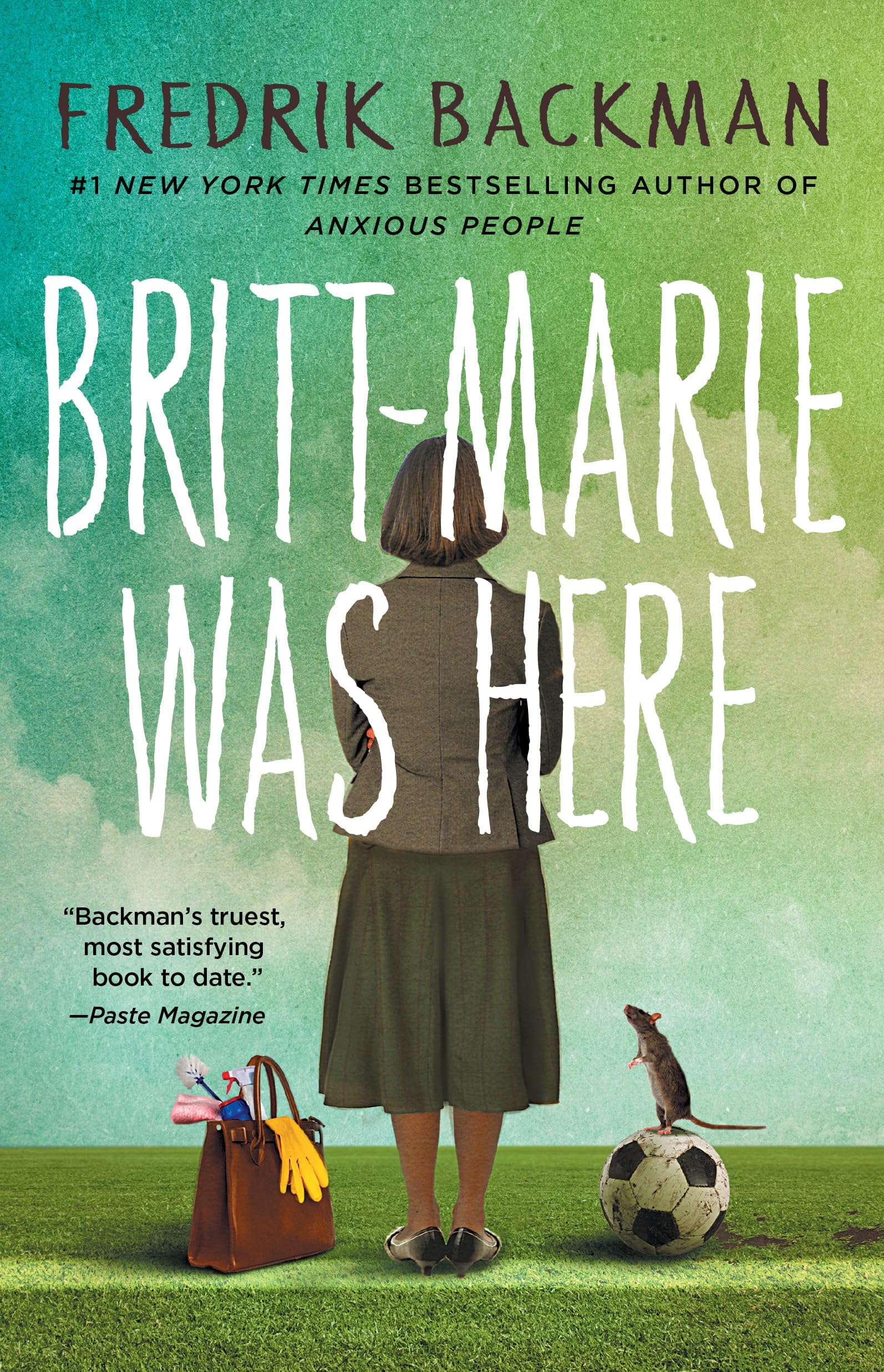
This is the first book I have read by Backman. I checked it out at the library. The story is so good i ordered the book. I like the character of Britt-Marie. She is obsessive, compulsive and the story tells much of a person with this particular personality. But I laughed. Britt-Marie is hilarious with her demands, outspoken, People today are so careless about what they do, how they dress, their hairstyles. She is quite opinionated. The lady hates dirt, a compulsive cleaner. As for drinks of any kind, coasters must be used. She keeps lists about tasks she must do, jobs she has finished and everything else. Coasters must be used, the table will be messed up. Cutlery drawers must always be neat and organized. Baking soda is excellent for cleaning. Britt-Marie sprinkles baking soda to absorb dirt and humidity. She has a special cleaner for windows. No other will do. This lady is sixty three years old, has never worked a job, took care of her mother, then was married for forty years, no children, step kids part time. Her husband cheated so she left. She goes to the unemployment office and demands that the young woman find her a job. But at her age and lack of experience, where is there a job? Her husband is gone on a trip on business. When he comes back she will be missed. She kept his clothes clean, cooked a good meal, the apartment was always immaculate. Fredrik travels on business, Britt-Marie will not go, she hates changes in her life. She will have a rude awakening. The young lady, after Britt-Marie's constant calling, finds her a job, a small village, run down, in the middle of nowhere. The book is set in Sweden, in a period of about three weeks. The village has many for sale signs in its building. The job Britt-Marie gets is working in the closed down town recreation center, the job only lasting three weeks. There is a pizzeria, the only place of business. A few businesses are conducted from this pizzeria. Britt-Marie's car is at the pizzeria waiting to be fixed. A big town is twelve miles away. The children of Borg play soccer, the only game they can afford to play. Borg is a poor out of the way village, but kids are full of life and mean to enjoy playing this game. Soccer is important in this story. The town cop, Sven, is taken with Britt-Marie and finds her a place to stay, a room where she can have a balcony and potted plants. This makes her happy. The landlady is crusty, rude and outspoken as is Britt-Marie. Bank has a dog and will rent to Britt-Marie until it sells. She's anxious to get rid of her home and get as far away from Borg as soon as she can. Britt-Marie gets a pet, a rat, that she treats with Snickers and talks to him like he is her psychiatrist. He lives in the rec center. Britt-Marie cleans the pizzeria, the recreation center and her renter house. Owners tell her she doesn't have to, she does, the ladies don't stop her. The owner of the pizzeria is named Somebody and is in a wheelchair. The lady gets to know characters, many of them not Swedish, down and out and becomes a more sympathetic, compassionate person who relates well to the kids and others. She loses many of her quirky ways and is not as laugh out loud. The characters around her are quirky. A fun read, but in a way sad. Everybody eats dinner at six o'clock as they should believes Britt-Marie. No excuses.
S**S
A fantastic book by a fantastic writer. Seven stars out of five.
I have read a number of books by Frederick Beckmann. Negotiate the first word that people say when they finish one of his books is “wow!“. And then they might say it again, because it really is that simple. Very few authors I have read have the ability that this one does to teach you to see beyond the superficial and understand the beautiful depth of what is possible inside people. His stories you feeling like your heart is swelling with gratification, and you are reassured in whatever lingering optimism you may have about the goodness of people. In a world where so many people look dark and impossible to believe, Bachman teaches us how to really see if only we care enough to do so. I urge everyone to read his books. They may very well make you a better person. What more could you ask for?
F**K
It was a great story and I wish I could have fallen in love with it.
I am so torn between giving this book a 3-star vs. a 4-star. I wish we could do quarter and half stars. It is more like a 3.5 star. The ONLY reason I bought and read this book is because of Backman's real (and at the moment in my view, ONLY) masterpiece, "A Man Called Ove", which was exceptional on all levels. "Britt-Marie was Here" was .... well many things that A Man Called Ove wasn't, even though you could see that it really tried to be. It starts off really slow and the author's reference to the characters - Somebody, Someone (???) WHAT? Just tell me who the character is, PLEASE! - was annoying. I admit, I was starting to warm up to Britt-Marie and her literal translation of the world around her, her awkwardness in social situations, the sad story that you could feel would come untangling sooner or later, and yet there just wasn't enough .... intrigue or momentum or reason to love or care for Britt-Marie. I feel almost heartless writing this but I'm not, I assure you. I have a lot of heart. I cried an ocean for Ove, and I desperately wanted to love and care for Britt-Marie and I did to some extent but the story-telling style around Borg, the devastated town and all its broken characters, its angry teenagers and druggie citizens and closed shops, it just didn't do it for me. The characters were not well described and so they were these hazy shades of people, and it was impossible to care about them. I cared most of all for the nameless girl at the unemployment office, and that's not saying much. I suppose, as I am writing this review, I can see that it is a 3-star in my heart, even though I love this author's other book, his masterpiece, "A Man Called Ove". I hope that this book speaks to you because it is a good story, and one that I am very glad I read, even if it did not inspire me to love it. Some of my favorite passages: There was a deluge of blood and glass, and three children sat waiting two thousand miles away for the sound of a key in the front door. At a certain age almost all the questions a person asks him or herself are really just about one thing: how should you live your life? Death is the ultimate state of powerlessness. Powerlessness is the ultimate despair.
K**G
Another Great Book From Fredrik Backman
Britt-Marie is originally a character from Fredrik Backman’s book ‘ My Grandmother Asked Me To Tell You She’s Sorry’. When Britt-Marie leaves her cheating husband to strike out on her own, she learns it’s hard to start a new lief as a sixty-something woman. Fredrik Backman writes the most amazing characters and Britt-Marie is one of his best. She is passive aggressive, judgmental, and set in her ways. She sees everyone around her as obstacles to keeping her OCD world clean and tidy. I loved, ‘My Grandmother Asked Me To Tell She’s Sorry.’ In that book it is so easy to dislike Britt-Marie. In ‘Britt-Marie Was Here’ we learn more of her back story and her life struggles and she becomes much more of a relatable character. Britt-Marie demonstrates amazing growth in this story. Even though she is older and set in her ways, Britt-Marie really learns what it means to get outside her comfort zone and challenge her beliefs and ideals. It was extremely interesting to me that as part of Britt-Marie’s growth in this story she begins to realize that many of her judgements and prejudices are not her own but her husband’s. This is interesting commentary on how many woman in male dominated relationships lose themselves and their own opinions. I loved the character of ‘Somebody’ in this story. I would love to learn more of her back story and could read a whole book about her. This story really held a lot of potential for me. It has amazing characters, a great plot and good set of secondary storylines. I loved ninety percent of the book but the ending just didn’t do it for me. This would have been a five star read for me otherwise. I still would highly recommend this book based on the rest of the story and Backman is still one of my favorite authors. P.S. One of my favorite things in this story:Britt-Marie’s lists.
C**S
How to Live a Life
Britt-Marie is the sort of person who likes things just so. She can’t abide a disorganized cutlery drawer, being offered “milk” in tiny disposable cartons, plastic mugs, plastic teaspoons. She is, if nothing else, fastidious. “’Milk and Sugar?’ the girl asks, pouring some coffee into a plastic mug. Britt-Marie doesn’t judge anyone. Far from it. But who would behave like that? A plastic mug! Are we at war?” Britt-Marie begins this journey as a 63-year old woman who has just moved out of her flat with her husband, Kent, and begins a new life working in a village that has very little, in terms of modern conveniences, to offer. It’s a community on the verge of non-existence in a place her mother would have described as “the back of beyond.” The few people and shops left are taking on additional responsibilities, the pizzeria serving multiple roles as other places close. In her new role as caretaker of the recreation center, Britt-Marie finds herself slowing finding herself warming up to the residents of Borg, The young people have little to do except play soccer, and as she warms up to a few select residents (including a rat), the residents begin to involve her in their lives, their worries, as they begin to open themselves to her, she begins to feel more “at home.” Still, there is Kent in the back of her mind, her philandering husband who she has spent most of her life taking care of. Now, she must take care of herself, she must be in charge of herself and her life. Her new life. “The reason for her love of maps. It’s half worn away, the dot, and the red color is bleached. Yet it’s there, flung down there on the map halfway between the lower left corner and its center, and next to it is written, 'You are here.' Sometimes it’s easier to go on living, not even knowing who you are, when at least you know precisely where you are while you go on not knowing.” With so many years of life with Kent behind her, she is still often torn between her old life, its comforts and routines, and this new life where virtually everything is new for Britt-Marie, new friends, new routines, new feelings. She has a new purpose, a newfound joy in herself, and her new friends, in this new community where she has made her home. She feels needed, she no longer feels invisible. “At a certain age almost all the questions a person asks him or herself are really just about one thing: How should you live your life?” Fredrik Backman has written yet another captivating story with terrific characters that are easy to give your heart to. If you read “A Man Called Ove” and / or “My Grandmother Asked Me to Tell You She’s Sorry” and enjoyed them, this is a must read. If you haven’t read his former novels, “Britt-Marie Was Here” can be enjoyed for its own merits.
J**S
Wonderful Book. Well Worth Reading.
After I read A Man Called Ove, I decided to find another book by Fredrik Backman. Reading the reviews of his latest works, I selected Britt-Marie Was Here with trepidation. Some of the reviewers complained that it didn't match Ove; Others liked it even more. Being a savvy buyer, I decided to take the risk and I'm glad I did. Backman is an extremely skilled writer. He puts you in the mind of his quirky characters, and he doesn't leave. You might think of one response in your head, but he character does or says something entirely different. And what he or she says and does makes you laugh out loud because it is so genuine. This is a story about a very lonely, lost woman. She spent the majority of her life living for her husband, washing his shirts, fixing his meals, cleaning his house, raising his (not hers) children. I was reminded of a robot, something without feelings or emotions that carried out the duties of life without complaint. Until the day of her husband's betrayal. On that day, she walks out without a word, and her life begins for the first time. She's sixty-three years old and about the bravest person you'll ever meet. Britt-Marie ends up in a very sad, depressed community. She brings something new and fresh into that community without really meaning to. Everyone touches her and she them. Changes start. Slowly and gradually. Not to give too much away, I'll just say that she finds that life can be fulfilling and her final decision to finally live, captures our hearts. As a reader, I felt satisfied at the end. At the end of Ove, I felt sad. Nonetheless, both ended as they should have, as Britt-Marie would want it to end and as Ove might have predicted. Here are some examples of the talent of Fredrik Backman. And, by the way, he says he loves getting feedback from readers, even negative feedback. I can only say in the negative light, that some parts dragged a bit longer than I would have liked, but after all, he was dealing with Britt-Marie and years to overcome. It had to be realistic. A few years turned into more years, and more years turned into all years. Years have a habit of behaving like that. The man smiles jeeringly at the men in the corner, and they look back at him as if hoping that by doing so they'll eventually set him on fire. She looks at him as if she just bought a new bag and he vomited in it. She has never met a gangster with a correctly organized cutlery drawer. Sami gives a deep breath, which is not at all a sigh. Sven's neck doesn't seem capable of holding up all his thoughts any longer. These are just a smattering of the amazing writing you'll encounter in this remarkable book. Enjoy it!
Trustpilot
3 weeks ago
1 month ago