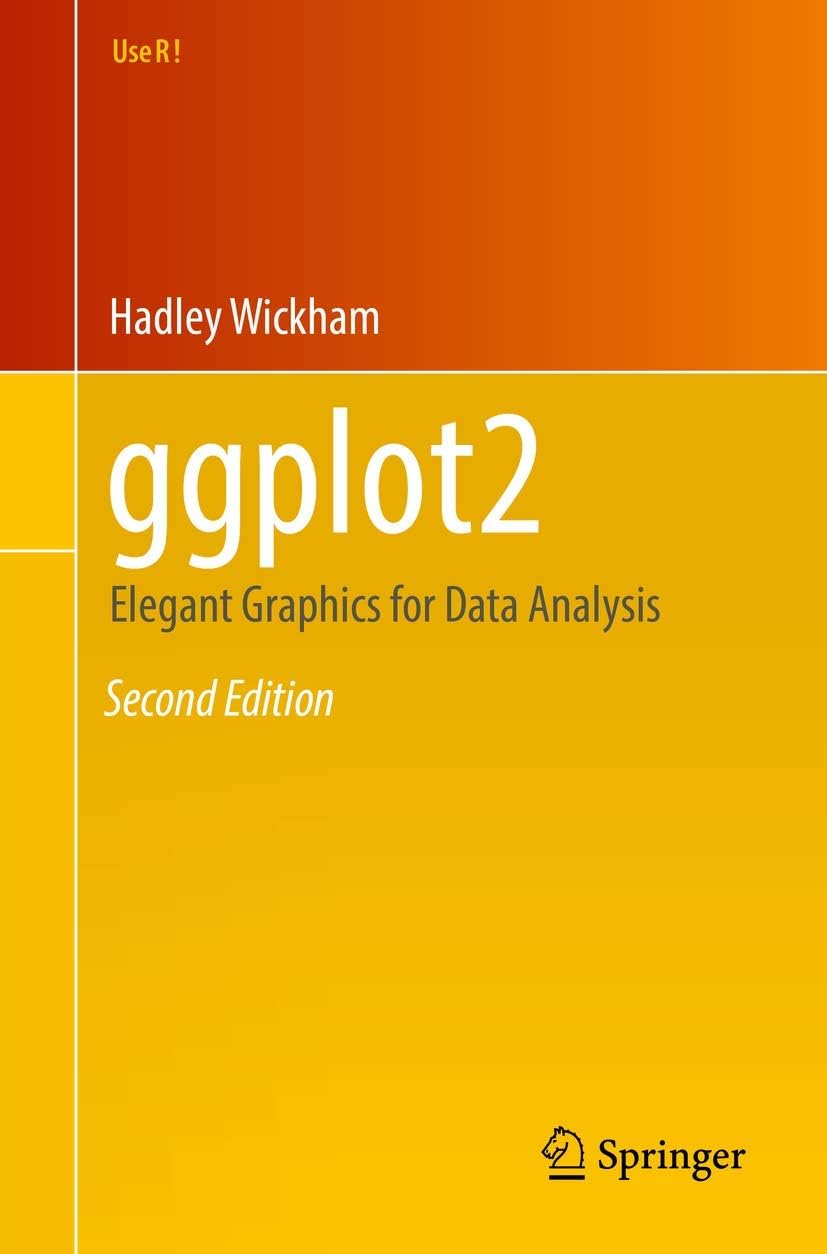
ggplot2: Elegant Graphics for Data Analysis (Use R)
Product ID: 33509203
Buy anything from 5,000+ international stores. One checkout price. No surprise fees. Join 2M+ shoppers on Desertcart.
Desertcart purchases this item on your behalf and handles shipping, customs, and support to GERMANY.
Buy ggplot2: Elegant Graphics for Data Analysis (Use R) on desertcart.com ✓ FREE SHIPPING on qualified orders Review: 2nd Ed: only edition. Great introduction for beginners and a great resource for advanced users. - This review is for the 2nd Edition of the book. ggplot2 has changed a lot in recent years and the old book is no longer useful. Hadley has rewritten the book on ggplot2 completely and utilized the examples and questions from the communities on StackOverflow and GoogleGroups as a guide. The book starts off gentle, but does assume you have basic knowledge of R (installation of packages, some base functions, loading libraries and simple syntax). The components of the grammar are brought in piecewise and in a logical way that should help early learners and refresh those of us who have used the package for a while. There are tons of code examples which are colored coded for legibility and syntax reasons. Each block of code is followed by the output from that code, which helps the user understand what is expected. At the end of major sections, there are exercises which not only help you understand what you've learned, but also get you thinking about how you would analyze a similar dataset. This is really important because if you do these exercises, you will be well prepared to implement the visualization strategies herein on any dataset. Chapters 9-11 introduce auxiliary packages in the tidyverse (formerly "Hadleyverse") including dplyr, tidyr, and broom, which are used to discuss an entire data analysis pipeline. This sections does a good job of introducing these tools and what you would use them for. If you're interested in digging further into these packages, Hadley has been writing another book called R for Data Science which will hopefully be on sale in late 2016. An early version can be found here: [...] The last chapter is about programming with ggplot2. Hadley introduces some very useful, more advanced methods for plotting with ggplot2 from creating your own functions to using standard evaluation. A very useful introduction for more advanced users. Overall, the book is a gentle and thorough introduction to the ggplot2 package for beginners and a very useful references to all of the updates introduced in the last few years since the last ggplot book (Winston Chang's R Graphics Cookbook) R Graphics Cookbook . Review: Up to date ggplot2!! - This book 2016 version of the 2009 book and is really good. Great examples! Updated to the current version of R so all the examples and references are to functions and packages in the current R version that I am using today... which makes it much easier to follow. Writing style is very clear. Examples of each concept along with review questions that really make you think about what has just been covered rather than just regurgitating facts. Overall style is concept, some details, and examples. Sometimes I wish Hadley would use more of an primitive breakdown approach to examples. For example one example starts with using loess to build some data for an example. I'd rather just see some plain data rather than a building some data from line fitting. That would make it easer to see how data flows through an example. I appreciate that what Hadley ends up with is real world data, but I, and this may just be me, I like things explained at a more primitive level. But in any case this book is not just showing you some neat plots, even though it has many, it is giving you the fundamentals you need to be able to implement from scratch the plots you think up in your head to point out statistical features in your data.
| Best Sellers Rank | #185,228 in Books ( See Top 100 in Books ) #8 in Graph Theory (Books) #31 in Graphics & Multimedia Programming #32 in Mathematical & Statistical Software |
| Customer Reviews | 4.4 4.4 out of 5 stars (180) |
| Dimensions | 6.1 x 0.63 x 9.25 inches |
| Edition | 2nd ed. 2016 |
| ISBN-10 | 331924275X |
| ISBN-13 | 978-3319242750 |
| Item Weight | 9.3 pounds |
| Language | English |
| Part of series | Use R! |
| Print length | 276 pages |
| Publication date | June 16, 2016 |
| Publisher | Springer |
B**R
2nd Ed: only edition. Great introduction for beginners and a great resource for advanced users.
This review is for the 2nd Edition of the book. ggplot2 has changed a lot in recent years and the old book is no longer useful. Hadley has rewritten the book on ggplot2 completely and utilized the examples and questions from the communities on StackOverflow and GoogleGroups as a guide. The book starts off gentle, but does assume you have basic knowledge of R (installation of packages, some base functions, loading libraries and simple syntax). The components of the grammar are brought in piecewise and in a logical way that should help early learners and refresh those of us who have used the package for a while. There are tons of code examples which are colored coded for legibility and syntax reasons. Each block of code is followed by the output from that code, which helps the user understand what is expected. At the end of major sections, there are exercises which not only help you understand what you've learned, but also get you thinking about how you would analyze a similar dataset. This is really important because if you do these exercises, you will be well prepared to implement the visualization strategies herein on any dataset. Chapters 9-11 introduce auxiliary packages in the tidyverse (formerly "Hadleyverse") including dplyr, tidyr, and broom, which are used to discuss an entire data analysis pipeline. This sections does a good job of introducing these tools and what you would use them for. If you're interested in digging further into these packages, Hadley has been writing another book called R for Data Science which will hopefully be on sale in late 2016. An early version can be found here: [...] The last chapter is about programming with ggplot2. Hadley introduces some very useful, more advanced methods for plotting with ggplot2 from creating your own functions to using standard evaluation. A very useful introduction for more advanced users. Overall, the book is a gentle and thorough introduction to the ggplot2 package for beginners and a very useful references to all of the updates introduced in the last few years since the last ggplot book (Winston Chang's R Graphics Cookbook) R Graphics Cookbook .
D**N
Up to date ggplot2!!
This book 2016 version of the 2009 book and is really good. Great examples! Updated to the current version of R so all the examples and references are to functions and packages in the current R version that I am using today... which makes it much easier to follow. Writing style is very clear. Examples of each concept along with review questions that really make you think about what has just been covered rather than just regurgitating facts. Overall style is concept, some details, and examples. Sometimes I wish Hadley would use more of an primitive breakdown approach to examples. For example one example starts with using loess to build some data for an example. I'd rather just see some plain data rather than a building some data from line fitting. That would make it easer to see how data flows through an example. I appreciate that what Hadley ends up with is real world data, but I, and this may just be me, I like things explained at a more primitive level. But in any case this book is not just showing you some neat plots, even though it has many, it is giving you the fundamentals you need to be able to implement from scratch the plots you think up in your head to point out statistical features in your data.
A**Y
Writing code that makes pictures
It's hard to call yourself a statastician or data scientist without strong data visualization skills. Tools like Tableau or Microsoft office can only take you so far. ggplot is an excellent option that allows you to make highly customizable graphs at the cost of a slightly increased learning curve. As a statistics graduate student I found this book to be an excellent introduction to this R package and found the 2nd edition to be very up to date. It is by no means an exhaustive reference, but that makes the book readable and easy to follow. It provides just enough information to get you started and to point out major features and pitfalls, but there is no excess of words. I also appreciated the writer's familiarity with Tufte's philosophy. I highly recommend this book to anyone with at least a basic familiarity with R who looking to up their visualizations skills.
G**M
Great
Great
E**H
One of My Favorite Textbooks!
Fabulous textbook for learning ggplot2! Excellent examples and visuals and very easy to read. After just a couple chapters, you can be up and running with basic ggplot2 plots which are sooo much prettier than base R plots. And the rest helps you learn more advanced and customized ggplot2 plotting including details about faceting, scales, legends, themes, etc. I only wish I had read this sooner. Thanks to Hadley Wickham for making ggplot2 and writing this book about how to use it! For whatever it's worth, my other current favorite textbook is An Introduction to Statistical Learning: with Applications in R . I highly recommend that, too, for anybody in the data / stat learning / R space!
S**A
Written really well, easy to follow, perfect addition to your R knowledge
E**R
The code used is often out of date or simply doesn't work. The section on maps uses old data frames that no longer exist. To access them you need to search archives to get the code to run. Some sections of the book are excellent. The website is not properly maintained and generally though a useful text if you are prepared to edit and alter the code and databases. I think everyone is waiting for R Graphics Cookbook by Chang for a better text covering graphics. If you can wait until December, this may be a better text.
J**Z
Si deseas conocer a fondo la utilización de ggplot para la generación de gráficas para el análisis de datos, este libro es indispensable.
C**P
sollte mal einen Blick in da Buch werfen. Für neue Analysen nicht unbedingt geeignet aber wer das statistische Hintergrundwissen hat geht es ab ...
R**L
Worth reading.
Trustpilot
3 days ago
1 month ago