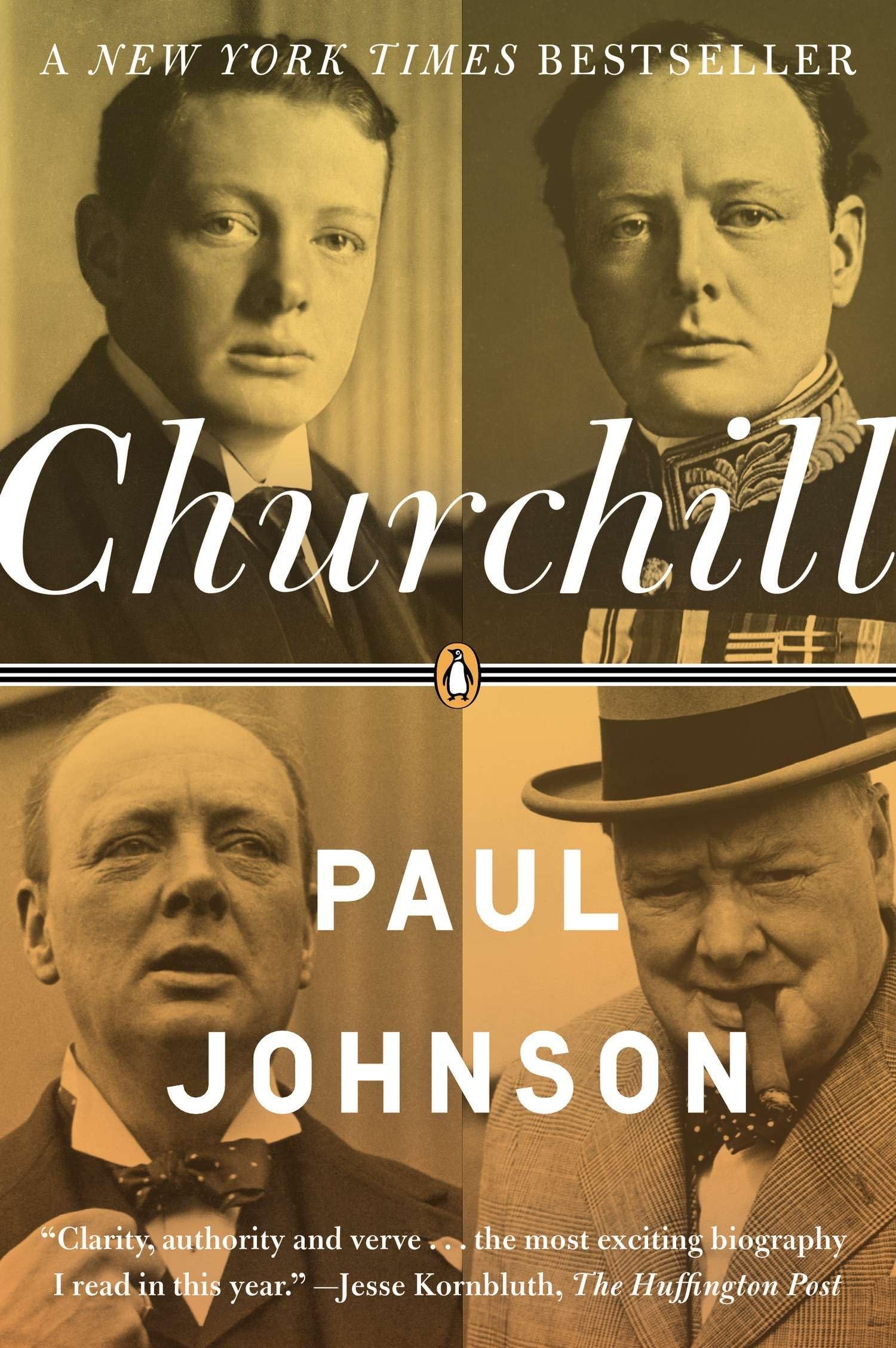
Churchill
Product ID: 2619502
⏳Covers a century of Churchill's life
⭐4.4/5 rating from 860 readers
📚170 pages of concise insight
Desertcart purchases this item on your behalf and handles shipping, customs, and support to GERMANY.
📖 Unlock Churchill’s legacy: leadership, grit, and humanity in one compelling read!
Churchill by Paul Johnson is a concise, 170-page biography that captures the extraordinary life and leadership of Winston Churchill. Praised for its engaging style and insightful analysis, it covers Churchill’s military, political, and personal journey, highlighting his resilience, humor, and strategic genius. With a strong 4.4-star rating from 860 readers, this book is a top choice for professionals seeking a quick yet profound understanding of one of the 20th century’s most influential figures.
| Best Sellers Rank | #238,463 in Books ( See Top 100 in Books ) #7 in U.K. Prime Minister Biographies #69 in Historical British Biographies #602 in Political Leader Biographies |
| Customer Reviews | 4.4 out of 5 stars 860 Reviews |
A**N
Superb introduction to a great man's life
It’s less fashionable in the practice of History these days to study the lives of great men, those individuals who by their words and deeds change the course of the world for better or worse. At one time, History was about these men: Alexander, Caesar, Washington, Napoleon, and others. Then that fashion fell out of favor and, in reaction, the role of Great Men was largely supplanted by the study of “impersonal forces,” those societal and intellectual trends that move History along, individuals being less important, often replaceable. This view was popular with progressive historians of the early to mid-20th century, seeing its extreme in Marxist historians. But the study of Great Men lives on, in this case in the form of Paul Johnson’s “Churchill,” a brief biography of Sir Winston Churchill, the British statesman, soldier, parliamentarian, and his nation’s Prime Minister during most of the Second World War. Johnson’s biography of Churchill is of an older school, which seeks not just to analyze its subject, but draw from it moral lessons for the reader. In this manner, it is comparable to Plutarch’s “Lives .” As Johnson writes at the start: "Of all the towering figures of the twentieth century, both good and evil, Winston Churchill was the most valuable to humanity, and also the most likable. It is a joy to write his life, and to read about it. None holds more lessons, especially for youth: How to use a difficult childhood. How to seize eagerly on all opportunities, physical , moral, and intellectual. How to dare greatly, to reinforce success, and to put the inevitable failures behind you. And how, while pursuing vaulting ambition with energy and relish, to cultivate also friendship, generosity, compassion, and decency." Churchill’s life is well-known, and Johnson glosses over the details to cover the important points the reader needs to know: his early childhood with a vaguely disapproving father; his military career , which established the young Churchill as a popular journalist; his political career with his rise to Cabinet rank as First Sea Lord during World War I; his role in laying the foundation for Britain’s welfare state, and his fall from power; his “wilderness” years out of government, when even his fellow party members rarely wanted him around and during which he warned incessantly about the rise of the Nazis in Germany; his return to power when the Nazis started World War II, again as head of the British Navy and then Prime Minister; and his postwar life and career, with one more pass as prime minister, until his death in 1965. That Johnson can cover all this in just 170 pages while telling a fascinating story and educating the reader is a mark of how good a writer he is. “Churchill,” if it was a joy for him to write, is also a joy for us to read. Johnson’s style is delightful, and he deftly weaves in small details and observations that humanize for us a towering figure who might otherwise be lost behind the noble statues and stern portraits. For example,one that sticks with this reviewer is the revelation that Churchill found happiness in, of all things, bricklaying. So much so, that he tried to join the bricklayer’s union. (He was declined.) Most people know that he was an accomplished painter, but a bricklayer? That such a common, workaday craft should bring satisfaction to a man born in a palace and who dealt regularly with kings and presidents, who commanded his nation’s armed forces in a global war, can’t help but build a bond between reader and subject, reminding us that Winston Churchill, for all the statues and portraits, was still a mortal man. “Churchill” is not without its weaknesses. A degree of superficiality is inevitable, given the task of compressing so full a life into such a short work. And it touches very lightly on his flaws, such as his Romantic fixations on strategies of dubious worth, for example his attempted defense of Antwerp in the First World War, or his obsession with invading Norway in the Second. A late Victorian in a rapidly changing 20th century, his attitudes toward non-European people were often at best patronizing, sometimes downright bigoted. But, to dwell on these lacks would be to criticize “Churchill” for not doing what it was never intended to do: to be a “balanced, modern” biography. As much hagiography as biography, Paul Johnson’s goal was to introduce us to the life of one of the greatest men who ever lived and show how it could serve as an example and an inspiration, especially for the young. In this, he has succeeded admirably. Highest recommendation. Format note: Churchill is available in both Kindle and softcover formats. I read the Kindle edition and can recall no problems with editing or formatting.
E**J
A nice, short primer on Churchill
This book is a brief biography of Winston Churchill during his political career, with very little focus on his life outside of politics. Churchill's contributions to society--as well as his failures-- are nicely told in broad strokes. There is no great detail with regard to any of the events in Churchill's life; the book is more of a superficial treatment. The author clearly has 'insider knowledge' of many of the events discussed in the book, and by providing a glimpse of this knowledge, Johnson avoids the dryness that is often inherent in biographies. Clearly the author is a great admirer of Churchill. At times the writing was quite sloppy, but not enough to put the reader off. I wouldn't recommend the book for those searching for a comprehensive, objective biography. However, if you'd like a brief overview of Churchill and his political contributions, this interesting little book would be perfect.
J**N
Half-page Management
We're pretty North American-centric here in the U.S. Watching the Winter Olympics reminds us that we Yanks are hardly the center of the universe. Plus, I've always felt a tad guilty that my reading list had never included anything on Winston Churchill. No more guilt. Paul Johnson's 166-page chronicle of Churchill's amazing life and leadership has received excellent reviews. The page count also works. The author's masterful scan of Churchill's 90 years (1874 to 1965) includes insightful detail, laugh-out-loud sidebars and absolutely relevant commentary on leadership and politics, war, success and failure (lots of failure). If you're under 40, don't skip this book--thinking it irrelevant to our Twitter times. Churchill was a member of Parliament for 55 years, 31 years as a government minister, and almost nine years as prime minister. He served in the trenches of (and reported from) 15 battles, was awarded 14 campaign medals, "had been a prominent figure in the First World War, and a dominant one in the Second." And get this: he published nearly 10 million words, including his 880-page book, The World Crisis: 1911-1918. His five-volume War Memoirs book deal in 1947 paid him $2.23 million ($50 million in today's dollars). And in his spare time, Churchill painted over 500 canvases. In 1953, he received the Nobel Prize for Literature. He overcame family challenges. His cousin noted, "Few fathers had done less for their sons. Few sons had done more for their fathers." Yet the author writes, "Among all the twentieth-century ruling elites, the Churchills must be judged to have had the most successful marriage." In the epilogue, the author includes five specific ways that leaders can learn from Churchill. Number 2: "There is no substitute for hard work." Yet, this giant of a world leader "also manifestly enjoyed his leisure activities," including his painting, which created a sanctuary-like retreat for his mind and body. He worked 16-hour days (often with full working mornings in bed--to conserve energy). "The balance he maintained between flat-out work and creative restorative leisure is worth study by anyone holding a top position." He knew the value of face time. He forced himself "to travel long distances, often in acute discomfort and danger, to meet the top statesmen face-to-face where his persuasive charm could work best." Speaking of charm, the writing enticed me page after page. Churchill's famed oratory: 111 words per minute, "with Gladstone's 100 as the standard." After touring Africa, he wrote My African Journey (completed on his honeymoon): "...full of schemes for industrializing Africa and harnessing the Nile." His politics: "Churchill was carried forward by intellectual conviction, but his reverence for tradition acted as a brake." He ribbed others, including the Labour Party leader, Clement Attlee. "Yes, he is a modest man, but then he has so much to be modest about." And this: "An empty taxi drew up outside the House of Commons, and Mr. Attlee got out." He popularized (if not invented) the terms "cold war" and "iron curtain." Dependent on U.S. help to win World War II, he became a student of FDR and wrote more than 1,000 letters to him. With pen and cigar (up to 12 a day) he was a brute force writing factory. He documented all verbal orders in writing, and his results-driven memos began with the famous headline, "Action This Day." "So did the endless series of brief, urgent queries: `Pray inform me on one half-sheet of paper, why...' Answers had to be given, fast." (This from Johnson's insightful list of 10 ways that Churchill saved Britain. Number 4: "a personal example of furious and productive activity.") All of this, and more, in just 166 action-packed pages. This is a fantastic book!
R**Z
What it is
Paul Johnson's new book on Churchill is a mini-biography that partakes of the 'character' tradition, so important in the seventeenth century. It covers Churchill's entire life, but in a schematic way. With less than 200 pp. of text there is not much room for detail. For a one-volume life Johnson himself recommends Lord Jenkins' 2001, thousand-page account. Still, Johnson's book is rich in anecdotal detail; it is clear that he could have delivered a much larger book, had he desired to do so. The portrait is highly favorable, as one would expect from Johnson's earlier written comments on Churchill, but it includes a significant number of criticisms. It is admiring, but not fawning. Most of all it is an enjoyable read, a kind of children's book version of history, but written for adults. For those who have little knowledge of Churchill and the great events with which his life intersected it is a good place to start. It is also a nice 'character' of a political leader. Johnson is not shy in recording his views and this is (as I recently wrote about John Lukacs' LAST RITES) a strength, since we know precisely where Johnson stands and we can agree or disagree with his clearly-articulated point of view. There is a brief but attractive series of photographs accompanying the text. This is a lovely afternoon read (one that should include whiskey or brandy and soda, fine claret, champagne, tea or some similar beverage of which Sir Winston would approve). It is uplifting without being unrealistic and brings both smiles and tears at various points. Highly recommended.
E**I
Enjoyable and witty, but overall unsatisfying
Johnson's account of Churchill is a noble attempt to condense the life of one of the most interesting characters of the twentieth century to a mere two hundred pages. Johnson's writing style is very lucid, witty, and overall very enjoyable. However, perhaps due to the shortness of the book, he tends to jumps from subject to subject with no apparent connection, thereby making it hard to follow the storyline. Also, the speculation on the author's part is somewhat troubling and is oftentimes quite misleading. To cite two examples: When discussing Churchill's reading habits he states, "He read everything of value he could get his hands on, and forgot nothing he read." Obviously, the author is in no position to know what Churchill remembered and what he forgot. Another example is when discussing Churchill's support of Western intervention in Russia during the 1917 Bolshevik Rebellion, the author states that if the intervention was allowed to continue as Churchill had wanted, "it is most unlikely that, with Bolshevism crushed, Mussolini could have come to power in Italy, or still less, Hitler in Germany. Imagine the post-war world without either triumphant Communism or aggressive Fascism!" I found this statement to be just pure speculation, without evidence, or at least a coherent argument to back it up. It would be rather naïve to attribute Hitler's and Mussolini's rise only to the success of Communism in Russia. Such statements as the above do add some appeal and dramatic tone to the book, but they also hurt the credibility of it as well. Due to its shortness, the book failed to convey the character of Churchill. Having finished reading it, I didn't feel I truly understood who Churchill was, but rather only learned some interesting anecdotes from his life. Overall, although far from perfect, it is a still every amusing book to read. Just remember to read it with a grain of salt.
C**N
Excellent Survey of a Great Life
Looking for an efficient and well written biography of Sir Winston? This is it. The author is clearly a fan, but he does not hesitate to point out a number of Churchill's flaws including his early opportunism in getting involved in battles, collecting medals from them and using his experiences and credentials to become a renowned correspondent. He also addesses the criticism that Churchill may have overdone the bombing of German cities....Dresden in particular. Finally, he observes that once out of office, Churchill used his wartime documents to spin the history, make millions on the memoires and then donate the papers in a tax advantaged arrangement to generate still more millions for his estate. Churchill's life is covered as thoroughly as possible in less than 200 very readable pages. Warts and all, Churchill is portrayed (quite correctly) as one of the greatest leaders of all times. This excellent biography contains more useful information per page than any I have read. It is a perfect starting point for anyone who wants to know about this great man.
J**E
Great Airplane Book
If you're taking a long flight, this is a welcome break from the usual airport bookstore pulp. Paul Johnson has written not so much a biography as a 192-page love letter. He catches the highlights of the great man's career and renders his own, mostly pro-Churchill, verdicts on the controversies. It's good to read the argument that Churchill got a bum rap over the disastrous Dardanelles campaign in World War I. And Johnson gets close to the truth of why Churchill was sacked by the voters at his moment of triumph in World War II, when he says the vote was "against the upper classes, the officer class who spoke in clipped accents, wore calvary breeches and drank port after dinner." My father was a GI stationed in Liverpool, a major port during the war, where he met returning British soldiers. He told me long ago that Churchill's government was voted out because of the broad resentment of the enlisted men at their treatment by the ruling class -- as disposable. (I'm reminded of how Queen Elizabeth I holed up with her court, reveling over the great victory over the Armada, while the sailors who gave her the victory languished in misery back in Plymouth.) Johnson might also have added that many voters didn't think they were actually voting Churchill himself out. I do think Johnson is a bit disingenuous about blaming the loss of eastern Europe to the Soviets on Eisenhower's "broad front" strategy, which, according to Johnson, slowed the advance of the Western front, allowing the Soviets to "beat" the Anglo-Americans to Berlin. He says Churchill and Montgomery wanted a "full speed drive" to Berlin. In fact, the British got their chance via Operation Market Garden, Montgomery's pet plan to make a dash for Berlin following the Normandy breakout. Market Garden became one of the most notorious fiascoes of World War II. Most interesting to me is Johnson's take on Churchill's hand in the creation of the modern Middle East. In a nutshell, in the Middle East vacuum left by the fall of the Turks following World War I, Churchill carved out the Gulf States, Transjordan (Jordon) and Iraq, to be ruled by the moderate Hashimites, in order to "pen in" the fanatical and "ferocious" fundamentalist Muslim Wahhabi Arabs, headed by the Saudis. But Britain was competing with the Americans in the region over oil. While Britain's BP (then called Anglo-Persian) and Shell were developing the Persian and Iraqi oil fields, America's Standard Oil sponsored the Saudis. "Thus the Wahhabi fundamentalists became the great power in the Middle East and immune from attack because of U.S. support and provided colossal sums of oil royalties with which to undermine the moderates everywhere and the Hashimites in particular." Because of Churchill's experience with Muslim fanatics in India and the Sudan, he "was painfully aware of the shadows this cast over the future." Of course, other historians don't see Churchill in the same light vis-à-vis the Middle East, particularly Christopher Catherwood in Churchill's Folly: How Winston Churchill Created Modern Iraq , but I find Johnson's argument persuasive...and depressing.
M**E
Engaging read for the Churchill expert and novice alike....
I've become more and more interested in the life of Churchill. Over the last two months, I've read Winston Churchill, CEO: 25 Lessons for Bold Business Leaders by Axelrod, and started Warlord: A Life of Winston Churchill at War, 1874-1945 . Johnson's brief tome was a welcome respite from Warlord. What immediately struck me was the fact that Johnson met and knew Churchill. There aren't many living authors left who can claim that and lucidly share their personal perceptions of the man. The book s not bogged down in "scholarship". This is not criticism, but rather a compliment for the way Johnson uses fact and analysis to present a detailed "sketch" of Churchill. Will the reader learn everything he or she can about Churchill in this book. Well, no. Will the reader, however, have a new lens to evaluate and judge the man? Absolutely. The prose is lively and interesting; like the life of Winston Churchill. Highly recommended.
R**N
Es muy buen libro
Aunque el autor no oculta su simpática por el biografiado, no parece muy sesgado. Es un libro sobre un hombre sobresaliente y quizás a veces es reiterativo en sus virtudes. Pero está muy bien documentado, está bien escrito, profundiza mucho en la psicología del personaje. El gran bagage de Johnson hace que lo encuadre muy bien en su época histórica y lo compare con otros personajes de la época.
B**Y
superb
A terrific brief but important essay summarizing Churchill's life, it's extraordinary accomplishments and many failures. It is both objective and passionate, and paints a very human and engaging portrait of the man and the power of his personality.
D**S
happy
Oustanding service; exactly as ordered; super quick delivery
黒**彦
チャーチルのエネルギッシュな生涯を描く
ウィンストン・チャーチルのエネルギッシュな生涯を描いた伝記。簡潔にポイントを絞って叙述の流れをつくり、ストーリーテリングもうまいので気軽に読める。第二次世界大戦におけるリーダーシップを山場に、そこに至るまでの挫折や紆余曲折をたどる構成。とりわけヒトラーの台頭に伴って再び注目を集めて強力な戦争指導者として表舞台に返り咲くあたりの描写はグイグイと引き込まれた。ただし、チャーチル大絶賛の調子には若干興醒めもした。
D**T
Churchill biographies proliferate and this one is worth reading.
An interesting biography of an interesting, intriguing, infuriating and inspiring man. An interesting contrast with the Boris Johnson biography.
Trustpilot
2 weeks ago
2 weeks ago