
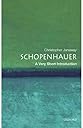
Schopenhauer: A Very Short Introduction
Product ID: 25255409
Desertcart purchases this item on your behalf and handles shipping, customs, and support to GERMANY.
Schopenhauer is considered to be the most readable of German philosophers. This book gives a succinct explanation of his metaphysical system, concentrating on the original aspects of his thought, which inspired many artists and thinkers including Nietzsche, Wagner, Freud, and Wittgenstein. Schopenhauer's central notion is that of the will--a blind, irrational force that he uses to interpret both the human mind and the whole of nature. Seeing human behavior as that of a natural organism governed by the will to life, Schopenhauer developed radical insights concerning the unconscious and sexuality which influenced both psychologists and philosophers Review: if you are interested in literature and the arts or would like have a deeper understanding of the challenges we all ... - Christopher Janaway's little book on the life and philosophy of 19th century German thinker Arthur Schopenhauer makes for a most engaging and thought-provoking read. Indeed, if you are interested in literature and the arts or would like have a deeper understanding of the challenges in life we all face yet are generally put off by philosophers and philosophy, this book is for you. By way of example, here are some Janaway and Schopenhauer quotes along with my comments. "Humanity is poised between the life of an organism driven to survival and reproduction, and that of a pure intellect that can rebel against its nature and aspire to a timeless contemplation of a `higher' reality. ---------- Schopenhauer is an atheist, viewing life as not created or guided by some all-knowing God but propelled by an irrational force he calls `the will'. This being the case, ordinary existence is an alternating between frustration and boredom. But do not despair! There is the possibility of escape: literature, music, the arts and aesthetic experience. "Although thoroughly conservative himself, Schopenhauer regarded the political state merely as a convenient means for protecting property and curbing the excesses of egoism; he could not stomach Hegel's representation of the state as `the whole aim of human existence'. Hegel was also an appalling stylist, who seemed to build abstraction upon abstraction without the breath of fresh air provided by common-sense experience, and Schopenhauer - not alone in this - found his writing pompous and obscurantist, even dishonest." ---------- Here is one of the keys to the appeal of Schopenhauer's writing. He is clear and approachable, a great literary stylist and essayist, at the opposite end of the literary spectrum from the vast majority of academic philosophers with their dense, obscure, technical language and syntax, forever quoting and referring to other equally dense, obscure, dry thinkers. "Nevertheless, in talking so bluntly about sexuality, and in making it such a cornerstone of his philosophy, he is again unusually forward-looking for his day, Sex is ever-present in our minds, according to Schopenhauer, `the public secret which must never be distinctly mentioned anywhere, but is always and everywhere understood to be the main thing. . . . It is the ultimate goal of almost all human effort; it has an unfavorable influence on the most important affairs, interrupts every hour the most serious occupations." ---------- Going back to Aristotle and ancient Greek philosophy, humans are defined as the `rational animal'. Schopenhauer didn't buy it. He could see that having reason doesn't free us from our constant preoccupation with sex; in fact, with our capacity for imagination, we humans are, in a way, even more bound to sex than other animals. With this thinking, Schopenhauer anticipates Sigmund Freud and the development of psychoanalysis. "Schopenhauer belongs to a tradition which equates aesthetic experience with a `disinterested' attitude towards its object, and is often cited as one of the chief proponents of such a view. The idea is that to experience something aesthetically, one must suspend or disengage all one's desires toward it, attending not to any consideration of what ends, needs, or interests it may fulfill, but only to the way it presents itself in perception. In Schopenhauer's case, aesthetic experience must always be an extraordinary episode in any human being's life." ---------- This is the prime reason generations of artists, writers and musicians have been moved and influenced by Schopenhauer. His emphasis on artistic transformation, creative imagination and the truth and dignity of aesthetic experience made a powerful imprint on Guy de Maupassant, Friedrich Nietzsche, Richard Wagner and Thomas Mann, to name several. Sidebar: When once asked what philosopher I would recommend on the topic of aesthetics, I suggested Schopenhauer. I also suggested to start an aesthetics journal where you can make daily entries of your own aesthetic experiences of art, music, performance, reading, nature, and everyday encounters with the world: faces of people, driving a car, drinking coffee, etc.. The idea is to continually open yourself to experiencing the world aesthetically - a powerful path to self-transformation. Janaway also writes on Schopenhauer's metaphysics, theory of knowledge, ethics and ideas on topics like the body, character and the self as well as how the great German thinker envisions a certain kind of mystical detachment as a way to salvation. A philosopher deserving our attention, to be sure, and Janaway's book is a great place to start. Review: By and large a solid introduction - This book focuses on the philosophy of Arthur Schopenhauer (1788-1860). The author states in his preface that "This book aims to give a sympathetic but critical account of Schopenhauer's philosophy." Indeed, the book at times is certainly critical; the very last paragraph of the book begins "Though Schopenhauer's metaphysics is not credible as a system..." Janaway's basic message throughout seems to be that Schopenhauer is very important for the influence he had on others (for example, Wagner and Nietsche), for the unique and often troubling questions he raised, and for the new ideas he brought into philosophy - but he is not a Schopenhauer apologist. The focus of the book is on Schopenhauer's ideas about philosophical topics like will, the body, the self, metaphysics, character, sexuality, the unconscious, art and aesthetic experience, ethics, and other issues. Special focus is given to Schopenhauer's The World as Will and Representation, which is presented as his greatest work, and much is made of the philosopher's idea of the will to life and physical reality as a manifestation of this will. All in all I would say that Janaway does a decent job in introducing Schopenhauer's ideas, although his summary at times is a bit less clear than some of the other books in the Very Short Introduction series.

| Best Sellers Rank | #383,786 in Books ( See Top 100 in Books ) #166 in History of Philosophy #210 in Modern Western Philosophy |
| Customer Reviews | 4.5 out of 5 stars 190 Reviews |
G**L
if you are interested in literature and the arts or would like have a deeper understanding of the challenges we all ...
Christopher Janaway's little book on the life and philosophy of 19th century German thinker Arthur Schopenhauer makes for a most engaging and thought-provoking read. Indeed, if you are interested in literature and the arts or would like have a deeper understanding of the challenges in life we all face yet are generally put off by philosophers and philosophy, this book is for you. By way of example, here are some Janaway and Schopenhauer quotes along with my comments. "Humanity is poised between the life of an organism driven to survival and reproduction, and that of a pure intellect that can rebel against its nature and aspire to a timeless contemplation of a `higher' reality. ---------- Schopenhauer is an atheist, viewing life as not created or guided by some all-knowing God but propelled by an irrational force he calls `the will'. This being the case, ordinary existence is an alternating between frustration and boredom. But do not despair! There is the possibility of escape: literature, music, the arts and aesthetic experience. "Although thoroughly conservative himself, Schopenhauer regarded the political state merely as a convenient means for protecting property and curbing the excesses of egoism; he could not stomach Hegel's representation of the state as `the whole aim of human existence'. Hegel was also an appalling stylist, who seemed to build abstraction upon abstraction without the breath of fresh air provided by common-sense experience, and Schopenhauer - not alone in this - found his writing pompous and obscurantist, even dishonest." ---------- Here is one of the keys to the appeal of Schopenhauer's writing. He is clear and approachable, a great literary stylist and essayist, at the opposite end of the literary spectrum from the vast majority of academic philosophers with their dense, obscure, technical language and syntax, forever quoting and referring to other equally dense, obscure, dry thinkers. "Nevertheless, in talking so bluntly about sexuality, and in making it such a cornerstone of his philosophy, he is again unusually forward-looking for his day, Sex is ever-present in our minds, according to Schopenhauer, `the public secret which must never be distinctly mentioned anywhere, but is always and everywhere understood to be the main thing. . . . It is the ultimate goal of almost all human effort; it has an unfavorable influence on the most important affairs, interrupts every hour the most serious occupations." ---------- Going back to Aristotle and ancient Greek philosophy, humans are defined as the `rational animal'. Schopenhauer didn't buy it. He could see that having reason doesn't free us from our constant preoccupation with sex; in fact, with our capacity for imagination, we humans are, in a way, even more bound to sex than other animals. With this thinking, Schopenhauer anticipates Sigmund Freud and the development of psychoanalysis. "Schopenhauer belongs to a tradition which equates aesthetic experience with a `disinterested' attitude towards its object, and is often cited as one of the chief proponents of such a view. The idea is that to experience something aesthetically, one must suspend or disengage all one's desires toward it, attending not to any consideration of what ends, needs, or interests it may fulfill, but only to the way it presents itself in perception. In Schopenhauer's case, aesthetic experience must always be an extraordinary episode in any human being's life." ---------- This is the prime reason generations of artists, writers and musicians have been moved and influenced by Schopenhauer. His emphasis on artistic transformation, creative imagination and the truth and dignity of aesthetic experience made a powerful imprint on Guy de Maupassant, Friedrich Nietzsche, Richard Wagner and Thomas Mann, to name several. Sidebar: When once asked what philosopher I would recommend on the topic of aesthetics, I suggested Schopenhauer. I also suggested to start an aesthetics journal where you can make daily entries of your own aesthetic experiences of art, music, performance, reading, nature, and everyday encounters with the world: faces of people, driving a car, drinking coffee, etc.. The idea is to continually open yourself to experiencing the world aesthetically - a powerful path to self-transformation. Janaway also writes on Schopenhauer's metaphysics, theory of knowledge, ethics and ideas on topics like the body, character and the self as well as how the great German thinker envisions a certain kind of mystical detachment as a way to salvation. A philosopher deserving our attention, to be sure, and Janaway's book is a great place to start.
C**M
By and large a solid introduction
This book focuses on the philosophy of Arthur Schopenhauer (1788-1860). The author states in his preface that "This book aims to give a sympathetic but critical account of Schopenhauer's philosophy." Indeed, the book at times is certainly critical; the very last paragraph of the book begins "Though Schopenhauer's metaphysics is not credible as a system..." Janaway's basic message throughout seems to be that Schopenhauer is very important for the influence he had on others (for example, Wagner and Nietsche), for the unique and often troubling questions he raised, and for the new ideas he brought into philosophy - but he is not a Schopenhauer apologist. The focus of the book is on Schopenhauer's ideas about philosophical topics like will, the body, the self, metaphysics, character, sexuality, the unconscious, art and aesthetic experience, ethics, and other issues. Special focus is given to Schopenhauer's The World as Will and Representation, which is presented as his greatest work, and much is made of the philosopher's idea of the will to life and physical reality as a manifestation of this will. All in all I would say that Janaway does a decent job in introducing Schopenhauer's ideas, although his summary at times is a bit less clear than some of the other books in the Very Short Introduction series.
Y**R
VERY RELEVANT FOR THE SINGULARITY HYPOTHESIS
For Rulers: Priming Political Leaders for Saving Humanity from Itself This is a well-written short introduction which presents the most cardinal ideas of Schopenhauer. To put them into a nutshell “to think that we are meant not to suffer, that we somehow deserve happiness, or that the world owes us the fulfilment of our purposes, is a mistake – as is also the belief that being alive is simply a good a thing, whatever it brings” (p. 117). Little wonder that he “was a true atheist, who fundamentally questioned the value of human existence. “Existence for Schopenhauer is a purposeless, painful striving, driven by an unconscious force that we cannot control. Release from this existence comes from losing one’s individuality in aesthetic experience, in compassion for the world, and in self-denial” (Kindle location 258-261). His temperament and views fitted one another: “He learned, and wrote, by relying on his own judgement and treating other people’s ideas as raw material to be hammered into the shape he wanted (p. 4)… he was not one to think that the world was right and he was wrong” (p. 8). Schopenhauer was a very original thinking, making significant contributions to a theory of ethics and preparing the ground for Freud: “His conception of will expressing itself within humanity, and the polarity he discovers between our being governed by the will and our escaping it, enables him…to present large tracts of our lives in a new light. It enables him to explain thought-processes as having an organic, survival-directed function, to show the influence of unconscious drives and feelings on the intellect, to suggest that our picture of ourselves as rational individual thinkers is in some sense an illusion, to place sexuality at the core of human psychology, to account for the power of music and the value of aesthetic experience, to argue that ordinary life is inevitably unfulfilled, and to advocate the renunciation of individual desires as the route to reconciliation with our existence” (pp. 40-41). At the same time, he adopted a high version of individual morality (also on human attitudes to animals), namely the classical principle of Neminem laede; imo omnes, quantum potes, juva (hurt no one, rather help all as far as you can (p. 97). But, in our episteme in which individual happiness is regarded as the supreme goal of life, Schopenhauer cannot gain much admiration. However, Schopenhauer is becoming increasingly relevant for the Singularity hypothesis, which views technological evolution as a continuation of biological evolution, leading to super-computers who are much more intelligent than humans and ae likely to displace our species. Schopenhauer would surely have welcomed this possibility and supported it, while most of contemporary humanity – if asked, which is doubtful -- will most probably oppose it strenuously. Professor Yehezkel Dror The Hebrew University of Jerusalem
H**R
A perfect introduction to Schopenhauer
The book was a genuine pleasure to read. The prose is crystal clear and many rather complicated concepts are presented in a way that even an amateur like myself was able to grasp them with relative ease. I honestly don't recall the last time a book made such a profound impact on me and my world view to some extent. Highly recommended
J**T
Understanding Schopenhauer
The author presented a fair and lucid interpretation of Schopenhauer's philosophy. However, his criticism at certain points during the presentation mitigated understanding. Yet, all in all, it was a find and solid introduction to a complicated philosophy. Professor Janaway's "Schopenhauer: A Very Short Introduction," fundamentally aided my understanding of the THE WORLD AS WILL AND REPRESENTATION
F**F
Useful summary of Schopenhauers work in my opinion
Reading Schopenhauer’s World as Will and Representation can be hard without a teacher explaining it to you or a companion book to clarify. This book summarizes Schopenhauer in an easy to follow way. I liked it. How good a summary it is I cannot tell you, but I liked it as it made reading Will and Representation easier.
A**R
Summary of Mr. Pessimism, Schopenhauer
The author has done an outstanding job of giving a concise summary of Schopenhauer's ideas and impact on philosophy. This book gives the reader an opportunity to read the major ideas of one of the main examples of German philosophy.
S**N
Intelligent and short
Exactly the intelligent short summary I wanted. Only omission, due to being so short, was lack of samples of text.
D**N
Very good Introduction to Schopenhauer
This small volume provides a very readable, succinct introduction to Schopenhauer's philosophy. The author manages to use just a bare minimum of technical terms. Special emphasis is on the impact of Schopenhauer's thought on our everyday lives. The author also points out and criticises some of the more problematic aspects of Schopenhauer's philosophy. Taken together, this is makes for both a highly interesting and entertaining reading.
A**S
An excellent introduction to Schopenhauer
I really enjoyed reading this Very Short Introduction to Schopenhauer. I didn't know much about him before I read the book but the author, Christopher Janaway, does a very good job of presenting Schopenhauer's complex thought in an accessible and highly readable format. It was fascinating to learn about the influence of Plato and Kant on Schopenhauer but also to read about how he impacted on a wide range of artists and thinkers, including Richard Wagner, Friedrich Nietzsche, Gustav Mahler, Thomas Mann, Thomas Hardy, and Ludwig Wittgenstein. I didn't agree with every aspect of Schopehauer's thought (I am not, as he was, an atheist) but I learnt a great deal from this excellent book. I would recommend it very highly to anyone who would like to know more about this intriguing thinker. It definitely warrants five stars.
J**M
Good book
good
L**N
Book was in excellent condition.
Book was in excellent crisp flawless condition! Greatly satisfied! Thanks!
H**O
excellent primer on Schopenhauer
A really good and succinct summary of a great Philosopher. Oxford short Intro is a huge time saver for the person undergoing time-poor studies...and also for those just wanting a 'taste' of a very large subject. I would recommend this for anyone studying Schopenhauer as it touches on all the major points with a great easy look-up index and lots of guides to further reading for those wanting a deeper dive.
Trustpilot
1 week ago
1 month ago