Desertcart purchases this item on your behalf and handles shipping, customs, and support to GERMANY.
🏡 Build the future you deserve—one pattern at a time.
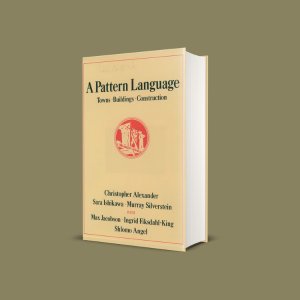
A Pattern Language by Christopher Alexander is a groundbreaking architectural guide offering over 250 practical design patterns to help individuals and communities create harmonious, human-centered buildings and neighborhoods. Celebrated as a top-ranked book in urban planning and architecture, it empowers readers to rethink and reshape their environments with a timeless, people-driven design philosophy.


| Best Sellers Rank | #11,731 in Books ( See Top 100 in Books ) #2 in Urban & Land Use Planning (Books) #2 in Architectural Criticism #2 in Architecture (Books) |
| Customer Reviews | 4.7 out of 5 stars 1,075 Reviews |
D**R
Good for non-specialists with an interest in architecture
Odd that this should come up for a review from me, when I must have bought and read it twenty years ago. I remember it well, however, and am glad that I read it. I have always been interested in architecture (one of those things I would have studied if I had several lifetimes). I learned a great deal from this about architecture in general, and what makes a building appealing to humans. It sometimes gave me the words for something I only felt about a house or a building. The 'low, sheltering roof' of a house in my neighborhood was just the phrase I needed to express why the first time I saw it, I was drawn to that particular house as an ideal, cozy home. This book helped me understand why we instinctively respond to older buildings, buildings with 'character' and 'history' to them, buildings that have a patina from decades or centuries of human inhabitants making their mark on the bricks and boards that make up the structure. However, I have to say that as a graduate of UC Berkeley, I was aware of the Marxist sub-text of some of the authors' recommendations in this book. It is clearly influenced by the Marxist current in academia in the late 1960s and early 1970s, for example in its assertion that in the future, people would want to live in sort of 'compounds' with less privacy and more shared space - architecture and housing being planned to in effect 'force' a 'communal' lifestyle on people. Of course, it is presented as 'what people want' and what people naturally desire: living with no privacy from your neighbors instead of individual private spaces. So some of the assertions about domestic architecture come across a bit like the promises that we'd all be driving flying cars and eating entire meals in tablet form. The ideology clearly has not been borne out by experience since the book was written, though there are probably Marxist-leaning readers who will take it as gospel and even try to convince people to live in compounds where all your comings and goings are known and noted, your neighbors will see everything you do through your windows and in your yard, and you will be happy.
B**N
brilliant series
i first learned about alexander through my study of software engineering. i'm an artist working on generative/evolutionary digital art, both visual and sonic, and i'm also in the process of studying to build a house. alexander's books have been an inspiration to me in all of these fields. i won't expound on the positives, as others have already done so, and my five stars give you an idea of how i feel about these books. there are quite a few negatives though: a) the price of these books is outrageous, why are they not available in a cheap paperback edition. if mr. alexander really wants to change the world he would do well to look at the open source software movement, specifically the ideal of open documentation. mr. alexander has a website on which he talks about freedom and idealism, etc... however, the book is not free, instead, it is very expensive, but more importantly, is not free to copy and redistribute. one gets the feeling that there is an element of the california guru in all of this. that he is peddling utopia to the hyper-comfortable. ok that sounds really harsh, but it makes me very angry that such a resource is not distributed freely, especially in the developing world. mr. alexander if you read this, please consider establishing an open on-line repository of your patterns, perhaps in wiki format, so that other patterns can be added, and so that your existing patterns can be amended through time and translated to other languages. i realize that most people in the developing world do not have access to the internet btw, but at least it would allow the people or organizations who do to print and distribute copies freely. b) there is quite a stark difference between the more rigorous and engineering oriented 'notes on the synthesis of form' and the later work. i think in the later work he correctly ditched the engineering jargon because he deemed it unnecessarily cumbersome, and also realized that it is not necessary to build a house. peasants with no engineering or mathematical background have been building beautiful buildings for ages, however in NOTSOF he spends considerable time espousing the idea of a generative grammar as a way of managing the immense complexity of most engineering/design tasks. for instance when he gets into the problem of manufacturing a tea kettle which solves both manufacturing and design constraints. i'd really like to see more patterns dealing directly with issues of energy management and ecological well being, which by definition would have to be more technical, but not by a great margin if explained in simple language. this way a house could be organically "grown", but with energy efficiency there as a morphological force from the outset. c) in general the books could be shorter and less repetitive. there is a bit too much advocacy, and they often read like a some kind of new age self help manual, on the surface that is. these books can survive the new age surface feel precisely because they are so deep, but i think that less self-advocacy would significantly lighten them and would probably also manage to shave off most of the new age baggage. and finally, my advice to the software engineer, is to first read 'a timeless way of building', which will give you a strong idea about how patterns work. i also highly recommend 'notes on the synthesis of form' to anybody designing anything. i don't think that 'a pattern language' is that necessary to read, unless you want to build houses, or are just a big fan of alexander's (of which i am both). i based this review on 'the timeless way of building', 'a pattern language', 'notes on the synthesis of form', and 'the production of houses'. i can't wait to read 'the nature of order' thanks mr. alexander!!
P**N
it isn't about architecture
Nominally about architecture and urban planning, this book has more wisdom about psychology, anthropology, and sociology than any other that I've read. Nearly every one of this volume's 1170 pages will make you question an assumption that you probably didn't realize you were making. In a section entitled "Four-Story Limit", Alexander notes that "there is abundant evidence to show that high buildings make people crazy." Underneath is a photo of San Franisco's Transamerica tower, captioned with a quote from Orwell's 1984: "The Ministry of Truth--Minitrue, in Newspeak--was startlingly different from any other object in sight. It was an enormous pyramidal structure of glittering white concrete, soaring up terrace after terrace 300 metres in the air." Alexander backs up this polemic with convincing arguments that high-rise living removes people too far from the casual society of the street, from children playing in the yard, and that apartment-dwellers therefore become isolated. Alexander spends a lot of time in this book trying to figure out how to restore the damage to our communities that have been done by automobiles. He argues for better public spaces and for more integration of children, old people, and workers. He argues for more access to water by more people. Many of Alexander's arguments are against the scale of modern systems. Public schools spend a fortune on building and administration precisely because they are so physically large [I've seen statistics showing that our cities spend only about one-third of their budgets on classrooms and teachers]. If we had shopfront schools and fired all the school system personnel who don't teach, we might be able to get student-teacher ratios down to 8 or 10:1 without an increase in cost. Similarly, Alexander argues for smaller retail shops, smaller factories (or at least identifiable small workgroups within factories rather than hundreds of faceless cogs) and more master/apprentice instruction. What if you like the depredations of modernity and aren't interested in a utopian world where basic human needs are met? Can you learn anything about architecture from this guy? Absolutely. You'll learn that light is everything. Your bedroom has to have eastern light so that the sun wakes you up. Your best living quarters should have southern light. All the rooms should have light from at least two sides, otherwise there will be too much contrast and you'll just have to draw the shades. If you've got kids, make them sleep and play in their own wing of the house. Build a realm for yourself and your wife on a different floor. Meet the kids in the kitchen. To avoid cluttering my apartment, I give away virtually all the books that I buy these days. I'm keeping this one and plan to re-read it every year.
R**G
If you need to understand and communicate design ideas, you will want this book
This is a seminal work that has had enormous influence on software design as well as other design professions. Oddly enough, my original BSc was in Urban Studies and I worked in software design when I read this book the first time. Blew me away. This book is based on ideas that seem obvious once you hear them. I just never would have heard them otherwise.
I**T
A great reference.
Book came in good condition and on great sale. Nice to see the Language of Design explained. Looking to get the other volumes.
S**N
If you are designing or building your own house this is a godsend
This book is aimed at non architects, written in short, practical entries that are easy to understand and hard to argue against. I used this book to build my house and it made the space more beautiful, practical and livable. I can't say enough good things about it. It is one of the most influential books on my life and has made an impact on me and my family who live in our house. It's inspiring and useful. There's not really anything else like it.
J**S
Perfect for Downsizing! Must read!!
The ideas in this book will forever change how you look at city and building design. Urban planners, architects, builders and interior designers who want to keep their jobs-- read up! This book will help you create low-cost solutions to the real estate downturns in your area. You have unprecedented opportunities to rethink your cities, towns, strip malls, etc. to make them more user-friendly and inviting while trimming the ugly wasted space that fills so many of our urban centers and McMansion neighborhoods. More careful expansion of the cities along logical pathways, with rainwater harvesting, edible self-managed self-watered landscaping, and tree-shaded roads with neighborhood shops and small industry woven in would have created more jobs and more meaning plus kept people together in sustainable neighborhoods at a much lower cost, both initially and long-term. Now we face the prospect of bulldozing entire vacant blocks and turning them into the rural spaces that so many longed to be near to begin with. This is not good business sense-- it's pathology. 'A Pattern Language' is the perfect medicine for this sickness. Like a healthy diet, it gets down to basics: how the human body relates to space; how people 'feel' in certain environments; the criteria of places that draw people in as opposed to others that are left usused or avoided. These principles are classic patterns that have stood the test of time, and Mr. Alexander gives numerous examples from around the world, from entire regions down to the height of windowsills and the best designs for office space. Anyone planning their own house needs this book! I designed a big house in Arizona for my large family using these principles and it's amazingly light and functional while being cool in summer and warm in winter. The kitchen is smaller than most custom homes, yet eight people can prepare food together comfortably while 3 more surf the internet and Dad reads his paper.
N**S
"One of the great books of the century".
Alexander tried to show that architecture connects people to their surroundings in an infinite number of ways, most of which are subconscious. For this reason, it was important to discover what works; what feels pleasant; what is psychologically nourishing; what attracts rather than repels. These solutions, found in much of vernacular architecture, were abstracted and synthesized into the "Pattern Language" about 20 years ago. Unfortunately, although he did not say it then, it was obvious that contemporary architecture was pursuing design goals that are almost the opposite of what was discovered in the pattern language. For this reason, anyone could immediately see that Alexander's findings invalidated most of what practicing architects were doing at that time. The Pattern Language was identified as a serious threat to the architectural community. It was consequently suppressed. Attacking it in public would only give it more publicity, so it was carefully and off-handedly dismissed as irrelevant in architecture schools, professional conferences and publications. Now, 20 years later, computer scientists have discovered that the connections underlying the Pattern Language are indeed universal, as Alexander had originally claimed. His work has achieved the highest esteem in computer science. Alexander himself has spent the last twenty years in providing scientific support for his findings, in a way that silences all criticism. He will publish this in the forthcoming four-volume work entitled "The Nature of Order". His new results draw support from complexity theory, fractals, neural networks, and many other disciplines on the cutting edge of science. After the publication of this new work, our civilization has to seriously question why it has ignored the Pattern Language for so long, and to face the blame for the damage that it has done to our cities, neighborhoods, buildings, and psyche by doing so.
M**N
Must-Read if You're Building a Home
If you want your new home to be comfortable and welcoming (and who doesn't?) - this is a must-read. The focus is really how to make a house .... a home, starting with the big picture. While I don't necessarily agree with a few of the concepts (from a lens 50 years forward) the 'patterns' (or qualities) truly will make a difference. There is a deep understanding of human nature/behaviour and how the minutiae of our surroundings profoundly impacts us. One thing they suggest is to list all 253 of the patterns and then systematically go through the ones within your control (e.g. you typically can't control the build of a town or transportation infrastructure). I did this on a spreadsheet for our new build and, wow, does it make you really think through your build design and what you really want in the end. Yes, it does take quite a while but so worth it when you see how your home can embrace family and friends in such a complete way. I recently read that, 50 years later, this book still sells thousands of copies a year and I can understand why; it is such a human-oriented point of view. Highly recommend this book!
A**F
Niche mais précieux
Où l'on comprend comment les villes ont été pensées, par des humains, pour des humains. Un cadeau parfait pour un architecte ou n'importe quel fan d'urbanisme.
R**R
Top
Gutes Buch
M**S
A must read for architects
Every architecture student must read this book !
R**Z
excelentehqed cover book binding and content
The haedcover book binding is of gigh quality, if feels sturdy in your hands, the ink seems if pigment type and dark enough, the paper is of good quality. The book itself is good as many other reviews have stated before. It covers the author's (there are several, not just Christopher Alexander, although he is the main author) views with his reasoning on why different approaches to building make us happier and bring calm and enjoyment to our lives. The author's use a confidece system where thow asterisks (**) mean they are highly confident in their suggestions, one (*) not highly and no asterisk means they believe that pattern to be true but thy lake empirical evidence. This book was highly influential in different areas such as computer science, where the pattern approach was used as a model to diffeten well known books. It was also an influence to game design books, which were inspired by its structure as shell's "a book of lenses". Nowadays it can be regarded as old, but it is still a classic and a gateway to understand the thinking process of Christopher Alexander.
Trustpilot
2 months ago
1 month ago