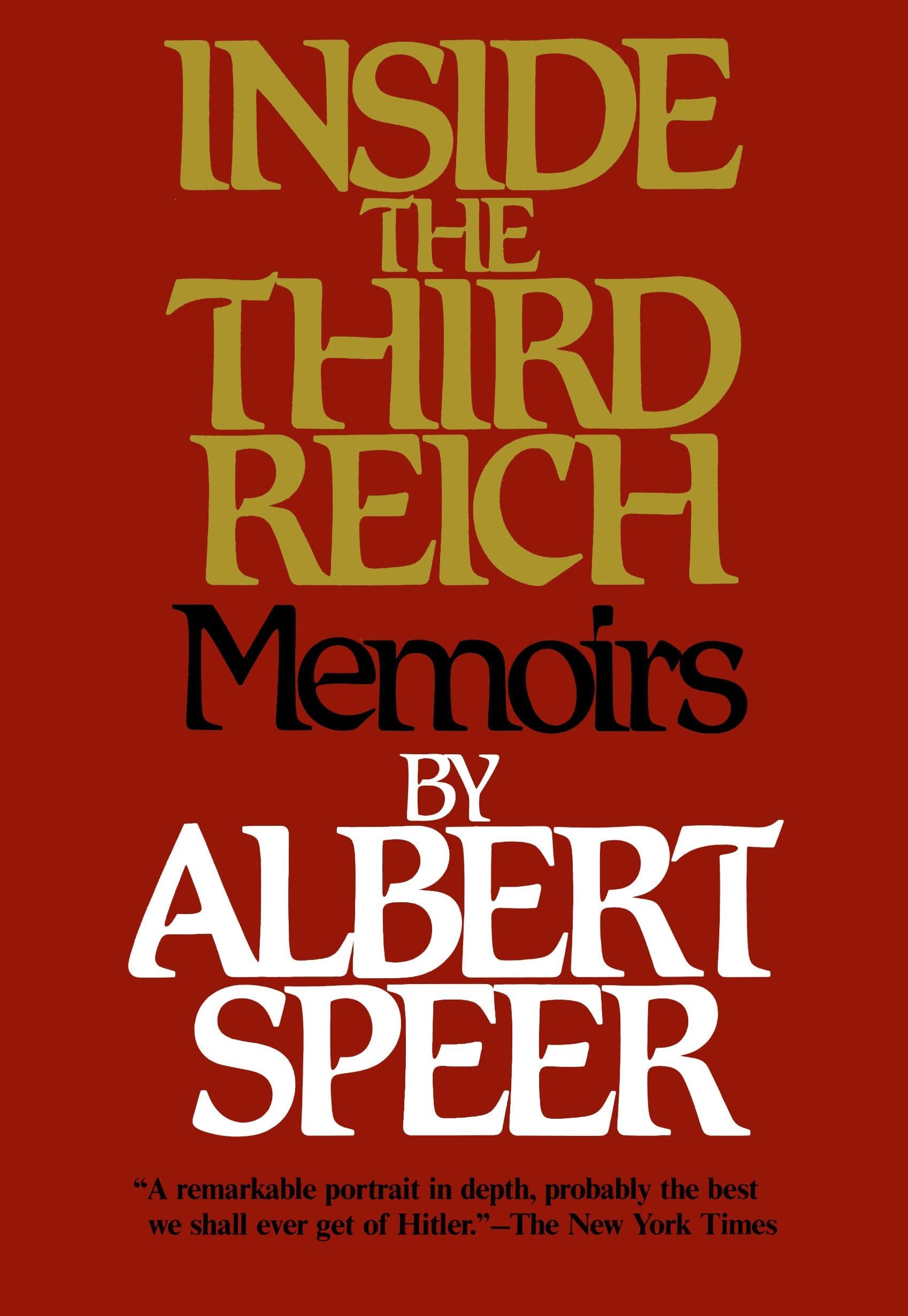
Inside the Third Reich
Product ID: 1608252
Desertcart purchases this item on your behalf and handles shipping, customs, and support to GERMANY.
“A remarkable portrait in depth, probably the best we shall ever get of Hitler.” — The New York Times Albert Speer, the man who had kept Germany armed and the war machine running even after Hitler's mystique had faded, takes a brutally honest look at his role in the war effort, giving readers a complete view of the inside of the Nazi state. Inside the Third Reich by Albert Speer provides an unparalleled glimpse into the inner workings of Nazi Germany from one of its key players. Written by Hitler’s Minister of Armaments and War Production, this memoir gives us as complete a view as we will ever get of the inside of the Nazi state offering a rare insider perspective on Hitler’s inner circle during World War II. Review: Worth the read - This is an interesting read. If you are a WW2 buff this will give you some insight into the other mindsets of the conflict. Review: A very good way to understand Nazi Germany - I assume that the facts in the book are basically true and that Speer actually felt as guilty as he said. The second assumption doesn't make too much difference, except to make it possible to understand how a human being could operate in the Nazi system. There is controversy over when Speer knew about the use and what he knew about the treatment of foreign workers in the various armaments industries he coordinated as armaments minister. He does not deny knowledge or responsibility, but tries to explain the basis for the decisions. His discussions of the numerous interactions with Hitler from ~1933 to 1945 give a lot of insight into Hitler. His discussions of the interactions between Hitler and the other Nazi leaders, his generals, industrialists, the Nazi party, and other institutions helps one understand how Nazi Germany functioned, both when successful (in its own terms) and as the tide turned (Stalingrad, etc.).


| Best Sellers Rank | #67,182 in Books ( See Top 100 in Books ) #107 in German History (Books) #322 in World War II History (Books) |
| Customer Reviews | 4.6 out of 5 stars 1,359 Reviews |
S**K
Worth the read
This is an interesting read. If you are a WW2 buff this will give you some insight into the other mindsets of the conflict.
D**G
A very good way to understand Nazi Germany
I assume that the facts in the book are basically true and that Speer actually felt as guilty as he said. The second assumption doesn't make too much difference, except to make it possible to understand how a human being could operate in the Nazi system. There is controversy over when Speer knew about the use and what he knew about the treatment of foreign workers in the various armaments industries he coordinated as armaments minister. He does not deny knowledge or responsibility, but tries to explain the basis for the decisions. His discussions of the numerous interactions with Hitler from ~1933 to 1945 give a lot of insight into Hitler. His discussions of the interactions between Hitler and the other Nazi leaders, his generals, industrialists, the Nazi party, and other institutions helps one understand how Nazi Germany functioned, both when successful (in its own terms) and as the tide turned (Stalingrad, etc.).
R**U
The Prodigal Son’s Tale
It’s been decades since I read Albert’s Speer’s memoir, Inside the Third Reich (1970), and felt the need to read it again after researching the German war effort for more than a decade. When I first read this book, the emphasis was upon gaining insight into Hitler’s inner circle since there were still many aspects of the Third Reich that were not well known. That was then. Now, decades later, we have a much better understanding of the inner workings of the Third Reich and Speer’s memoirs are but one piece. Furthermore, Speer’s prison-inspired mea culpa back in the 1970s seemed like the unvarnished truth – which is how he represented it – but this is not so evident upon further reflection. It’s now clear that Speer was intent upon ‘spinning’ his story a certain way, to make himself appear to be a more sympathetic and credible witness to history. After re-reading his memoirs, I’m not so sure that his effort to depict himself as a ‘prodigal son’ who believes in a common humanity was any more than a clever effort at historical white-washing. In any case, Inside the Third Reich remains an interesting read from someone who was a key decision-maker in leading Germany’s war effort. Speer’s memoirs begin by taking us on his journey from young architect to his initial contact with Hitler in 1933. Hitler’s plans for aggression. Of course, Speer was trying to distance himself from any connection to Hitler’s war-mongering, although it is implausible that he was unaware of it before September 1939. I also find it odd how Speer barely mentions his wife or children or other relatives throughout 500 pages of text; they are only mentioned in passing, but many minor Nazi party functionaries get paragraph after paragraph. Speer’s mother joined the Nazi party, but it gets but brief mention. I also thought that Speer was an established architect when he first met Hitler but in fact, he really was a novice straight out of school with virtually no paid work to his credit. Speer does point out that Hitler was genuinely popular with much of the German populace because he delivered on his early promises about the economy. The author readily admits that he fell under Hitler’s spell and became a willing follower; Hitler reciprocated by praising Speer’s rather pedestrian style and giving him various ad hoc tasks to fulfil. Speer’s only complaint in the 1930s was that the Nazis didn’t always pay him for his work but when he saw the wreckage inflicted by Kristallnacht, all he could say was that “the smashed panes of shops offended my middle class sense of order.” Speer wasn’t blind to Nazi excesses; he was a moral idiot, like so many of Hitler’s followers. Moving into the war years, Speer makes interesting observations about Hitler’s unwillingness to put off the reconstruction of Berlin even after the war in Russia had begun. Instead, scarce resources and labor were diverted away from war production for these prestige projects, which highlights that dictatorships are not necessarily more efficient at war-making. This wastage continued until December 1941, when the defeat at Moscow finally forced some scaling-back of civilian construction programs. By this point, Speer began making a name for himself as a hard-working improviser by helping to restore the railroads in occupied Soviet territory. Indeed, he positioned himself so well that Hitler made him Minister of Armaments in 1942. Speer, in fact, was very astute about working his way upward in the Nazi hierarchy in order to gain more power and prestige for himself – just like the other Nazis were doing. Speer does have some useful things to say about the German war effort. He says that air defense took significant resources away from production devoted to ground weaponry, but faults the Allies for not repeating attacks on damaged industrial facilities. He also notes the total mismanagement of labor resources and he points the finger at Nazi party officials for refusing to cooperate with releasing people to work in war industries. He also apportions a large share of blame to Reichsmarschall Hermann Goring, who had his fingers in everybody’s pie; Speer describes Goering as very intelligent but lazy and he managed to screw up every project that he touched. The role of the SS and Gestapo is also addressed, and it is amazing to hear that the rocket scientist Werner von Braun was arrested by the SS in 1944 for making remarks about civilian use of space. Speer’s conclusion is that the German war effort was mis-managed from the start due to personal agendas and empire-building within the Nazi hierarchy. Of course, Speer omits how any of his personal agendas and empire-building may have contributed to this mess, as well. Speer’s rationale is weird at times, particularly when he refers to Hitler’s “magnetic power” over him and another times he claimed that Hitler “paralyzed him psychically” which of course is intended to absolve Speer of personal responsibility – he had no choice. Yet other Germans could see Hitler’s evil and were not paralyzed – why was Speer different? He lamely refers to a half-baked attempt to assassinate Hitler in 1945, but says it failed due to altered security measures. It’s clear that this non-effort, which nobody else could corroborate, was inserted to belatedly cast Speer into the ranks of those who opposed Hitler. This of course is nonsense, since Speer loyally hung in with Hitler to the end, as if he had some kind of man-crush on him; in reality, he was always looking for crumbs from Hitler’s table – praise or new authorities. Ultimately, Speer was a talented conniver who put his own ambition first and Hitler was his venue for achieving his dreams. Speer lamely concludes that, “for twelve years, I had lived thoughtlessly among murderers,” as if he was merely a house-guest.
C**N
A Must Read Book
I read this book waaay back in the 70s and decided to reread it but I had lost my copy. Albert Speer is the only leading Nazi to take responsibility for his actions during World War II. This probably saved him from the hangman's noose. Speer was Hitler's architect and later minister of armaments. This is a very good book. The first half deals with Speer and Hitler planning and building monuments to the Nazi party. If the reader can get through all of the architect stuff, Speer then goes into great detail on the interworkings of the Nazi party and the usual suspects which is very interesting. Speer talks about his infatuation with Hitler and how he lost faith in him. Of course some of what Speer writes is self serving such as when he decided to assassinate Hitler. Speer deals with the war crimes trials at Nurnberg and touches on his 20 year prison sentence in Spandau prison in Berlin. In fact, Speer was the last prisoner released from Spandau. The last prisoner was Rudolf Hess who was sentenced to life and finally died in prison. Excellent book, an insider's perspective into Hilter's inner circle, the war and Germay's ultimate defeat. Soeer's follow up book "Spandau: The Secret Diaries" is a great follow up to this book. It not only deals with Speer's incarceration but his self reflection. Both books are must reads for the person interested in the Nazi era and wants a different perspective.
D**E
The book advertised
It's the book advertised. If you are looking for a critic's review, look somewhere else than Amazon product reviews.
M**Y
Excellent Read
The title is very accurate. This book gives a very detailed insight into the personalities of the men at the top of the Third Reich. Albert Speer was as close to Hitler, at times, as any man could have been. He shared Hitler's visions of a Reich that would last a thousand years, at least architecturally. Hitler fancied himself as an artist and a would be architect. He found a certain camaraderie with Speer as they dreamed together over drawings and models of great buildings that would last the thousand years of the Third Reich. This book tells the story of how Hitler's architect went from dreaming of great buildings to be in charge of all war production. Speer's organizational skills were extraordinary. How he kept up production of war materials in spite of around-the-clock bombing by the British and Americans was my main reason for wanting to buy and read this book. First of all I liked it because it is well written. Second I think it is the only real objective insight into what went on among the leaders at the time. The real mystery is how Speer lived to tell the story.
C**S
This book is essential in understanding Hitler and the Third Reich.
I just started reading this book. After many years I decided to finally buy it. The many books I have read on the Third Reich, on Adolf Hitler personally, on his life, this book seems to be the missing link. The fact is that many authors have used this book as a reference and fact checking point. In many ways this book by Albert Speer is the closest anybody will come in understanding the Third Reich in general and it's leader specifically. Hitler's story is so extraordinary it is almost unbelievable. Albert Speer was the only person of standing who could truly 'explain' this fenomenon. Also, Speer could be called Hitler's friend, if one could call it that. Anybody who is in the know about Hitler, knows he did not have any real friends. He kept everybody at bay really. This man kept to himself in a extremee way and it payed off big time for him. Speer was special in that he shared a love with Hitler: architecture. That was their bond. Speer's later involvement on the highest level takes te reader into the most inner circles of the Third Reich. An amazing story. And one we readers are very lucky to be able to read. I am very glad to have bought this book. It is an essential reference to understanding political life in Germany in the 1930's and ultimately the second world war. A must have.
R**E
Fascinating Insider Perspective
While you have to take much of what Speer says surrounding his guilt with a grain of salt, this book does provide a fascinating insiders perspective into the third reich. There are so few resources that can provide a high level insiders perspective of the events surrounding the third reich. Since most of the individuals that were close to Hitler died or committed suicide before sharing their experiences, crimes, memoirs, etc. it is usually only from an outsiders perspective and analysis that we are able to learn information in regards to this period. However with Speer being a leader in the third reich and being part of Hitlers inside circle, his memoirs allow us to explore numerous pieces of information that are not as well known or spoken about in other historical pieces. As a WWII historian, I find that most pieces of literature or documentaries cover perspectives and information that I was already aware of, however after reading this book I found a lot of small details that I was not aware of that helped to add context to the different characters of the third reich. I would definitely recommend reading this book for anyone interested in the third reich or WWII history.
P**M
Fascinating Read
Albert Speer. Was he really a Good Nazi? Yes, of course he was a good Nazi - otherwise he wouldn’t have been an intimate of Hitler’s inner circle and probably the latter’s only real friend since both men shared a passion for megalomaniacal architecture. I suspect his contrition (which is sometimes expressed in these pages) and limited admission of culpability owes nothing to the scales falling from his eyes like some latter-day Saul but solely to the defeat of Nazi Germany and his own fate pending the tribunal’s judgement. This self-serving but interesting book is in three main parts: Speer the great architect, Speer the genius of armaments production, Speer the saviour of what remained of Germany’s infrastructure. Like Coriolanus, alone he did it. A postscript could also include Speer the martyr. Through his sentence and that of others Speer claims extirpation of blame on behalf of his nation. Leaders alone atoned for the German people. Perhaps he should have demanded crucifixion by the tribunal for added symbolic effect. There are sins of omission and commission and it is patently obvious from the narrative that Speer omits a great deal about what he really knew and felt concerning the Reich’s unsavoury aspects let alone his direct involvement. Since he claims much knowledge ex post facto (or when he does admit guilt writes that he should have known better or that he was under the Führer’s spell) he’s bound to leave much out. What he leaves in, however, is interesting, informative and readable. There are even moments of comedy such as when he was scheduled to give a speech concerning the opening of Berlin’s East-West Axis to the assembled signatories and party big-wigs. Hitler would then take over, expanding on the speech. As the much anticipated speech consisted of two very brief sentences, Hitler was caught unawares, utterly flummoxed, not knowing how to respond to such brevity. Of particular interest to me was the effect of bombing as experienced by the Armaments Minister. Operation Gomorrah in 1943 was a real shock that, in his own words, put the fear of God in him. He reveals that the apocalyptic inferno visited upon Hamburg was precisely what the Reich had planned for London in 1940. He expresses genuine puzzlement that raids such as those on the Ruhr dams or Schweinfurt were not followed up: the damage inflicted by the Americans at Schweinfurt for example was far more significant than realised at the time. And why, after the dams were repaired at enormous cost was another small raid not repeated to smash them all over again? On a more personal note he divulges that he was transfixed by and unable to resist viewing the pyrotechnic spectacle of the Berlin raids from a flak tower: the searchlights, AA fire, masses of beautiful target indicators and parachute flares cascading down all created a scene that was compelling and unforgettable for him. Inside the Third Reich takes the reader through the Second World War and all the Machiavellian scheming and jostling for power is laid bare. The final insane days in the Berlin bunker have always held a morbid appeal and Speer doesn’t disappoint the reader, either here or in relating the subsequent farce of the Flensburg Government and his eventual arrest. Upper-middle-class from a prosperous Mannheim family, cultured and well-educated he clearly cut a more attractive figure than many others at the Nuremberg Trial. He also had longer than other defendants to prepare his own defence and took tranquilisers to steady his nerves when lying to the court. One thing’s for sure - he wasn’t an understudy for Truthful James. He was lucky to narrowly avoid a much-deserved hanging for his usage and organisation of slave labour in inhumane conditions. Small wonder he didn’t appeal his sentence. So, after twenty years rumination in Spandau he wrote this carefully guarded but fascinating narrative instead. After his release in 1966 he merged his memoirs with material from the Federal Archive for greater detail and authenticity. This paperback book is well-bound, the font is clear, contains many photographs and detailed notes referring to each chapter so two bookmarks are advised.
L**S
A vida na Alemanha Nazista
Livro muito bom vale muito apena a sua compra. Conhecer o terceiro Reich narrado por quem viveu não tem preço
P**N
Stunning!
This autobiography will forever change your perception of WWII. I have a warning for any prospective reader of the book; be prepared to have your jaw hit the ground. The inner workings of Hitler and his henchmen, makes for quite the history lesson. The incompetence of Hitler and how he manages the war, is almost unbelievable. Both from a military strategic standpoint, and the management of the German domestic economy, Hitler is a complete imbecile. Yet the one man, one party rule, does not allow for any interjections. Hitler`s scheming subordinates have no choice, but to play along with these terrible decisions. The reader will also get an inside view on Hitler`s inner cabinet. Speer gives very detailed accounts, of all the people involved with Hitler`s evil plans. Each of the party leaders are constantly trying, to cut into each others base of power. Overall, this was a fantastic read. Speer scores on two fronts. First, Speer is an intelligent man. Speer`s inside account of the war is very in-depth. Second, he also seems to be a good writer. The book is very hard to put down, and at times a page turner. I am convinced, that future historians will consider this book, to be one of the greatest accounts of WWII.
C**7
Illuminante
Uno dei libri piu' particolari che abbia letto negli ultimi anni, che da' una visione "da dentro" di molti aspetti del nazismo, che e' molto inconsueta. Speer e' una personalita' complessa e uno scrittore molto abile, ed e' capace di sorvolare su molti degli aspetti piu' controversi. Dopo aver letto questo libro ho letto anche "Albert Speer, his battle with the Truth" di Gitta Sereny che cerca di dare una visione meno parziale degli eventi. In ogni caso ne consiglio vivamente la lettura.
L**S
Penance.
A critical piece of history, written by an incredible and logical mind.
Trustpilot
1 month ago
2 weeks ago