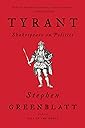
Tyrant: Shakespeare on Politics
Product ID: 130897171
Desertcart purchases this item on your behalf and handles shipping, customs, and support to GERMANY.
"Brilliant, beautifully organized, exceedingly readable." ―Philip Roth World-renowned Shakespeare scholar Stephen Greenblatt explores the playwright’s insight into bad (and often mad) rulers. Examining the psyche―and psychoses―of the likes of Richard III, Macbeth, Lear, and Coriolanus, Greenblatt illuminates the ways in which William Shakespeare delved into the lust for absolute power and the disasters visited upon the societies over which these characters rule. Tyrant shows that Shakespeare’s work remains vitally relevant today, not least in its probing of the unquenchable, narcissistic appetites of demagogues and the self-destructive willingness of collaborators who indulge their appetites. Review: Great Examination of Shakespeare's Tyrants - Tyrant is an examination of Shakespeare's exploration of government, society, and tyrannical figures throughout his plays. Chapters are sorted by topic (the influence of party politics on the rise of tyrants, the abuse for populism for political gain, the types and importance of enablers, the influence of personality and mental illness on tyrannical behavior, etcetera) and tend to examine one or two plays/characters at a time, complete with helpful quotations citing act, scene, and line. I only vaguely remember reading Hamlet and Macbeth in highschool, and was pleasantly surprised with how much I learned about the plays themselves over the course of Tyrant. I was also thankful that Greenblatt included so much information regarding the historical context of elizabethan England; it added a lot to my appreciation of the playwright's angled exploration of issues of power, something that weighed on everyone's mind, though it was something that could not be openly spoken of for fear of treason accusations. When a work is removed from its historical context, a vital part necessary for understanding the text is lost. The political landscape of near omnipotent kings and queens and the shifting tides of power between royal houses is an extremely important part of Shakespeare's plays that is only seen in its historical context, and that is something that most people do not stop to consider. Some other reviews complain that Tyrant is a thinly veiled criticism of Trump and the Trump administration, but that is not because Greenblatt wrote a criticism of Trump and called an examination of Shakespeare. It is because Greenblatt wrote about Shakespeare's criticism of tyrants. If you don't think Trump is a budding tyrant but still see the parallels to tyrannical characters, perhaps you should think about that connection more. All in all, Tyrant is a very well written work on Shakespeare's characters, plays, and the playwright's exploration of political power and I would recommend it. Review: The most enjoyable way to learn about tyranny - Rarely have I enjoyed a piece of political commentary as much as I did Stephen Greenblatt’s Tyrant: Shakespeare on Politics. In William Shakespeare’s day, it wasn’t safe to disagree with power. Unlike today’s America, with the protections of the First Amendment, his world was governed by the near-absolute power of the monarch, the aging Queen Elizabeth. And speaking ill of the queen led to swift and often deadly punishment. Instead, the Bard through his plays would examine the ways and means of tyranny, delving into the past and into foreign lands to create his voices that could say what could not be said frankly (“Greenblatt is the Harvard Shakespeare expert who co-founded new historicism, the lit-crit practice that seeks to place works in their historical context.”) In the vein of speaking obliquely, this is Greenblatt’s commentary on Donald Trump, though the president is not named in its pages. Instead, the Tyrant focuses on several of the same that appear in Shakespeare's plays, examining them in their foibles for the causes and results of their tyranny. The book is rooted in an article that Greenblatt wrote for the New York Times in 2016. At a friend’s encouragement, he expanded it to a full book. He focuses his examination on Macbeth, Richard III, Lear, Coriolanus and Leontes from A Winter’s Tale (notably leaving out Claudius, perhaps because he is more well-known than most). While it is ostensibly a commentary on politics, it does not read like just another piece of political punditry or tribal drivel. On the contrary, Greenblatt makes Shakespeare accessible and, well, interesting, as well as providing principles that can be read and interpreted to apply to almost any power selfish politicians or businessman. Reading it is as enjoyable as watching Shakespeare performed well. As Constance Grady puts it in her review of the book, “There is a certain pleasure to watching Shakespeare’s tyrants work, to watching Richard III brazenly woo Lady Anne over the body of a man he killed or listening to Macbeth’s mournful, poetic speeches.” Perhaps the biggest observation for me, and where the book most departs from other books that more directly take on Trump, is that Tyrant leaves the reader to make his own observations and conclusions. Here is what a tyrant does; is this what we are living through?

| Best Sellers Rank | #102,650 in Books ( See Top 100 in Books ) #9 in Political Literature Criticism #48 in Shakespeare Literary Criticism #49 in Fascism (Books) |
| Customer Reviews | 4.6 out of 5 stars 718 Reviews |
A**Y
Great Examination of Shakespeare's Tyrants
Tyrant is an examination of Shakespeare's exploration of government, society, and tyrannical figures throughout his plays. Chapters are sorted by topic (the influence of party politics on the rise of tyrants, the abuse for populism for political gain, the types and importance of enablers, the influence of personality and mental illness on tyrannical behavior, etcetera) and tend to examine one or two plays/characters at a time, complete with helpful quotations citing act, scene, and line. I only vaguely remember reading Hamlet and Macbeth in highschool, and was pleasantly surprised with how much I learned about the plays themselves over the course of Tyrant. I was also thankful that Greenblatt included so much information regarding the historical context of elizabethan England; it added a lot to my appreciation of the playwright's angled exploration of issues of power, something that weighed on everyone's mind, though it was something that could not be openly spoken of for fear of treason accusations. When a work is removed from its historical context, a vital part necessary for understanding the text is lost. The political landscape of near omnipotent kings and queens and the shifting tides of power between royal houses is an extremely important part of Shakespeare's plays that is only seen in its historical context, and that is something that most people do not stop to consider. Some other reviews complain that Tyrant is a thinly veiled criticism of Trump and the Trump administration, but that is not because Greenblatt wrote a criticism of Trump and called an examination of Shakespeare. It is because Greenblatt wrote about Shakespeare's criticism of tyrants. If you don't think Trump is a budding tyrant but still see the parallels to tyrannical characters, perhaps you should think about that connection more. All in all, Tyrant is a very well written work on Shakespeare's characters, plays, and the playwright's exploration of political power and I would recommend it.
D**N
The most enjoyable way to learn about tyranny
Rarely have I enjoyed a piece of political commentary as much as I did Stephen Greenblatt’s Tyrant: Shakespeare on Politics. In William Shakespeare’s day, it wasn’t safe to disagree with power. Unlike today’s America, with the protections of the First Amendment, his world was governed by the near-absolute power of the monarch, the aging Queen Elizabeth. And speaking ill of the queen led to swift and often deadly punishment. Instead, the Bard through his plays would examine the ways and means of tyranny, delving into the past and into foreign lands to create his voices that could say what could not be said frankly (“Greenblatt is the Harvard Shakespeare expert who co-founded new historicism, the lit-crit practice that seeks to place works in their historical context.”) In the vein of speaking obliquely, this is Greenblatt’s commentary on Donald Trump, though the president is not named in its pages. Instead, the Tyrant focuses on several of the same that appear in Shakespeare's plays, examining them in their foibles for the causes and results of their tyranny. The book is rooted in an article that Greenblatt wrote for the New York Times in 2016. At a friend’s encouragement, he expanded it to a full book. He focuses his examination on Macbeth, Richard III, Lear, Coriolanus and Leontes from A Winter’s Tale (notably leaving out Claudius, perhaps because he is more well-known than most). While it is ostensibly a commentary on politics, it does not read like just another piece of political punditry or tribal drivel. On the contrary, Greenblatt makes Shakespeare accessible and, well, interesting, as well as providing principles that can be read and interpreted to apply to almost any power selfish politicians or businessman. Reading it is as enjoyable as watching Shakespeare performed well. As Constance Grady puts it in her review of the book, “There is a certain pleasure to watching Shakespeare’s tyrants work, to watching Richard III brazenly woo Lady Anne over the body of a man he killed or listening to Macbeth’s mournful, poetic speeches.” Perhaps the biggest observation for me, and where the book most departs from other books that more directly take on Trump, is that Tyrant leaves the reader to make his own observations and conclusions. Here is what a tyrant does; is this what we are living through?
M**T
autocrats everywhere.
This is dense Shakespeare. I am not his scholar. It discusses the playwrights focus on people of power, how they got there, and finally what they do with it. To my judgement, it demonstrates after 400 years that humanity is up to the same old pathology on a more global stage. Autocrats everywhere.
P**S
Incisive insights on tricky lessons of history from Shakespeare
Conservatives often cite "those who do not learn the lessons of history are doomed to repeat them." As we enter a difficult and even mind-boggling period of history, it is ever more important to cultivate deeper insights about what we can learn from the past. This intense and incisive book about what Shakespeare tells us today is a must-read. Before buying this book, I read the first few pages at Costco, and then the Amazon reviews. It is so sad how many people rated the book based on their feelings about Donald Trump, who is not even mentioned. The negative reactions of some Trump supporters reminds me of a cartoon I often see in the back of my mind: At a New York theater, a policeman suddenly shows up on stage, saying that people should be calm, the event is closed down because a totally crazy axe murderer has come to the audience and plans to start murdering random people very soon. At which point, a man in the audience screams out "Who you calling crazy?" It is the old story, "if the shoe fits, wear it." More seriously, the book also has clear incisive points relevant to the Moslem Brotherhood, and to the MANY conspiracies working against each other (and against Trump and Clinton); if only people would get so far as the chapter on Henry VI.. Trump himself would lose a lot by not swallowing his pride, and getting to the more advanced chapters. In a way, the insights in this book are things we all know... but we need to know we know, and not let current events blind us to what we know.
S**K
An Exceptionally Fine Essay
One would have to be extraordinarily dense not to see at whom this wonderful little book is aimed. Nonetheless, it is a wonderful thoughtful treatment of issues that merit serious thought in America - and perhaps the Western World - today. I am skeptical that Shakespeare was the liberal Enlightenment figure that Greenblatt suggests, but this doesn’t in any way detract from his splendid observations. I heartily recommend this book for high IQ beach reading this summer and I feel enriched by the time and effort I spent with it. One point upon which I disagree with the author however is his reading of Coriolanus. To Greenblatt this is an essay in social democracy and a diatribe against authoritarianism. That approach overlooks the fact that the play is a tragedy, Shakespeare’s last and that it’s source is Plutarch’s Lives of the Noble Romans. Coriolanus is no fascist because he is the essential anti-populist who eschews all of the sleazier tools of the tyrant. To the contrary, the Bard reserves - quite properly- his contempt for Coriolanus’s foils, the tribunes, who practice the sophistries and demagoguery so attacked in Richard and MacBeth. In that misdirection, Greenblatt abandons much of the high ground of his otherwise fine essay.
A**R
Good, but not up to Greenblatt's standard.
Professor Greenblatt is one of the century's eminent Shakespeare scholars, as well as a cracker jack writer. Unfortunately, this book was a missed opportunity. Tyrant is a good analysis of Shakespeare's political views. However, less than 50 pages in you begin to realize that Greenblatt isn't as interested in Shakespeare's politics as much as applying those politics to Donald Trump. I am not defending Donald Trump, but the obvious political motivations behind this book left a bad taste in my mouth for the rest of the read. Professor Greenblatt's critique of populism is spot on, but Trump wasn't the first major populist in American politics, nor was he the only major populist in the 2016 election. You could easily paint Jack Cade's hatred of the elite onto the rhetoric of the Sanders campaign, for example. At the end of the day, all populist movements (whether Right or Left) have elements in common. Saying, "this populist movement is similar to Trump" is tantamount to saying "this Republic is similar to the Roman Republic." I get it. Comparing President Trump to tyrants of the past is marketable, and not altogether inaccurate. However, I was hoping this book held Shakespeare's politics as an end in itself rather than a prism in which to view America.
A**R
Prompt Arrival and Arrived in Good Condition
On time arrival and in the condition promised. The short work itself is an excellent overview of the role of the tyrant in selected Shakespearian tragedies.
B**D
A readable and relevant view of a few Shakespeare roles that are alive in 21st century politics
The book presents some of Shakespeare's tyrants, with an eye to the English tyranny he inhabited. The author points out, for example, that a man was hanged, drawn, and quartered for posting a copy of a papal bull that implied Elizabeth I was not legitimate. One can only recall that Donald Trump propelled himself to the White House with a lie that Barack Obama was not a legitimate president. It would appear that producing a series of plays featuring tyrants might have endangered Shakespeare, but Greenblatt describes the care that Shakespeare took to avoid offense, and a close call that might have cut is life short when he, for a moment, let his guard down. This is an exciting book, encompassing politics through the centuries, from the early Roman republic to the present.
R**A
Comprehensive analysis
Very interesting reading. A new way to see Shakespeare's work.
A**R
perfect
prompt delivery and excellent item
M**L
"Shakespeare on Power" and "Shakespeare on Politics" are IDENTICAL books
"Shakespeare on Power" and "Shakespeare on Politics" are IDENTICAL books.You should make that clear to your customers!
R**C
Fascinating, Readable, and Relevant to Our Interesting Times
A fascinating look at the mind of the Tyrant through Shakespeare's eyes. Highly readable and frighteningly relevant in a world where tyrants and would-be tyrants seem to be emerging almost everywhere.
J**M
nice read!
enjoyed this book
Trustpilot
2 weeks ago
2 weeks ago