
Laden Sie die App herunter


Kundendienst
Copyright © 2025 Desertcart Holdings Limited
Laden Sie die App herunter
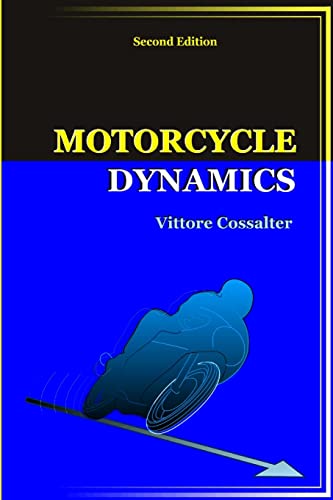


Motorcycle Dynamics [Cossalter, Vittore] on desertcart.com. *FREE* shipping on qualifying offers. Motorcycle Dynamics Review: Graduate level reading on motorcycles! - Motorcycle Dynamics, 2nd Edition After reading numerous books about motorcycling, authored by Keith Code, Lee Parks, David Hough, and Nick Ienatsch, I came across Motorcycle Dynamics written by Vittore Cossalter an Italian professor of applied mechanics. Doing a Google search revealed a whole university curriculum dedicated to the physics and theory behind motorcycles! As a gearhead and licensed professional engineer, I too have a passion for figuring out how things work. First, I would consider books written by Code and Hough to be excellent foundations for those interested in riding motorcycles. The content is explained in simple layman's terms, with words like counter-steer and pivot steer, lean, and turn dominating the primary activities. With Cossalter's Motorcycle Dynamics, you are dealing more (much more) with the physics and theoretical aspect of motorcycles. Moment of inertia, torque, yaw, roll, angular momentum, gyroscopic effects, torsional stiffness, and a myriad of variables and equations are used to describe the events covered by Hough and Code. So in essence, I consider the books written by Code and Hough to be more of an undergraduate level - important and useful. Cossalter's book is more of a graduate level reading - important, useful, but not very easy to understand or directly apply into the real world without some background in physics, science, or engineering. As an example, the first 7 chapters of Cossalter's Motorcycle Dynamics models the behavior and characteristics of motorcycles. From kinematics, tires, chassis dynamics, trim, vibration, to stability, it covers the theoretical/actual behavior of motorcycles in great detail with equations and references. The last chapter, Motorcycle Maneuverability and Handling, is what I consider the meat and potatoes of this book. It starts almost immediately discussing topics covered in the "undergraduate" series of books where the effect of wheelbase and trail are related to changes in directional stability. Counter-steering and dynamics testing are discussed in great detail, with graphs showing steering angle and steering torque to describe what happens at speed while taking a turn or entering a slalom. Some might argue that Cossalter is using 1000 words to describe something that can be said using 5 words. I would disagree, because if you are looking for a Cliff's Notes version of motorcycles, you're in the wrong place. I bought Motorcycle Dynamics because I was curious as to WHY counter-steering is necessary and when it should be applied. Lee Parks did a terrific job of splitting the U-Turn technique from the counter-steering maneuvers, because direct steer is necessary for low speed turns (under say, 5-10 MPH). Parks kept the U-turn section last to prevent any confusion after spending chapters talking about the application of counter-steering. Cossalter does provide simple relationships between real world events and the theoretical. In one scenario, he described how a rider planned to negotiate a right turn while traveling at a velocity of 20 m/s or about 45 MPH. The rider steers left, and the lateral force generated at the front tire contact point causes a yaw motion to the left, which begins a roll motion to the right. Then he follows up with diagrams and graphs to back up the verbal statements. This makes a lot of sense and inherently describes the science behind what was covered with Hough and Code's texts. It is unlikely the average rider would be interested in Motorcycle Dynamics, but to gearheads and engineers, Cossalter's book is definitely a mandatory purchase for one's library. Overall: 5/5 stars Review: Dense - Great book! Requires graduate-level physics for understanding, but it was still fun to grasp the mechanics as a non-physics major. Useful when planning an electric motorcycle build.
| Best Sellers Rank | #586,245 in Books ( See Top 100 in Books ) #193 in Motorcycles (Books) #9,653 in Engineering (Books) |
| Customer Reviews | 4.7 4.7 out of 5 stars (164) |
| Dimensions | 5.98 x 0.93 x 9.02 inches |
| Edition | 2nd ed. |
| ISBN-10 | 1430308613 |
| ISBN-13 | 978-1430308614 |
| Item Weight | 2.31 pounds |
| Language | English |
| Print length | 372 pages |
| Publication date | September 17, 2006 |
| Publisher | Lulu.com |
| Reading age | 1 year and up |
C**O
Graduate level reading on motorcycles!
Motorcycle Dynamics, 2nd Edition After reading numerous books about motorcycling, authored by Keith Code, Lee Parks, David Hough, and Nick Ienatsch, I came across Motorcycle Dynamics written by Vittore Cossalter an Italian professor of applied mechanics. Doing a Google search revealed a whole university curriculum dedicated to the physics and theory behind motorcycles! As a gearhead and licensed professional engineer, I too have a passion for figuring out how things work. First, I would consider books written by Code and Hough to be excellent foundations for those interested in riding motorcycles. The content is explained in simple layman's terms, with words like counter-steer and pivot steer, lean, and turn dominating the primary activities. With Cossalter's Motorcycle Dynamics, you are dealing more (much more) with the physics and theoretical aspect of motorcycles. Moment of inertia, torque, yaw, roll, angular momentum, gyroscopic effects, torsional stiffness, and a myriad of variables and equations are used to describe the events covered by Hough and Code. So in essence, I consider the books written by Code and Hough to be more of an undergraduate level - important and useful. Cossalter's book is more of a graduate level reading - important, useful, but not very easy to understand or directly apply into the real world without some background in physics, science, or engineering. As an example, the first 7 chapters of Cossalter's Motorcycle Dynamics models the behavior and characteristics of motorcycles. From kinematics, tires, chassis dynamics, trim, vibration, to stability, it covers the theoretical/actual behavior of motorcycles in great detail with equations and references. The last chapter, Motorcycle Maneuverability and Handling, is what I consider the meat and potatoes of this book. It starts almost immediately discussing topics covered in the "undergraduate" series of books where the effect of wheelbase and trail are related to changes in directional stability. Counter-steering and dynamics testing are discussed in great detail, with graphs showing steering angle and steering torque to describe what happens at speed while taking a turn or entering a slalom. Some might argue that Cossalter is using 1000 words to describe something that can be said using 5 words. I would disagree, because if you are looking for a Cliff's Notes version of motorcycles, you're in the wrong place. I bought Motorcycle Dynamics because I was curious as to WHY counter-steering is necessary and when it should be applied. Lee Parks did a terrific job of splitting the U-Turn technique from the counter-steering maneuvers, because direct steer is necessary for low speed turns (under say, 5-10 MPH). Parks kept the U-turn section last to prevent any confusion after spending chapters talking about the application of counter-steering. Cossalter does provide simple relationships between real world events and the theoretical. In one scenario, he described how a rider planned to negotiate a right turn while traveling at a velocity of 20 m/s or about 45 MPH. The rider steers left, and the lateral force generated at the front tire contact point causes a yaw motion to the left, which begins a roll motion to the right. Then he follows up with diagrams and graphs to back up the verbal statements. This makes a lot of sense and inherently describes the science behind what was covered with Hough and Code's texts. It is unlikely the average rider would be interested in Motorcycle Dynamics, but to gearheads and engineers, Cossalter's book is definitely a mandatory purchase for one's library. Overall: 5/5 stars
R**H
Dense
Great book! Requires graduate-level physics for understanding, but it was still fun to grasp the mechanics as a non-physics major. Useful when planning an electric motorcycle build.
R**N
Deep dive into motorcycles...
This is a excellent work on the engineering foundations of not just the HOW but also the WHY a motorcycle does what it does. Be warned though...this is a technical "head first into the shallow end" look at motorcycle design and the extreme engineering behind it. If you have a good foundation in applied mathematics and physics you will enjoy this! Another upside is that it also serves as a excellent insomnia cure.
R**D
A great book for understanding motorcycle dynamics if you have the background.
As an avid longtime motorcyclist and mechanical engineer, I have been looking for a book like this that clearly and concisely explains the dynamics of motorcycles for many years. When the first edition of this book appeared, the price was rather high. The second edition is much less expensive and I bought it as soon as I learned that it was available. It is exactly the book I have been looking for. It assumes that you have a working knowledge of dynamics, calculus and ordinary differential equations. If you are a physics or engineering graduate with an interest in motorcycles, you will find it a great pleasure to read as I did; but if you are not, you will find it very difficult. Chapter 2 on tires is especially interesting and lays the basis for understanding the influence of tire slip on motorcycle dynamics in the subsequent chapters. We all know that tires have a great influence on motorcycle handling, this book shows how and why. I have one minor criticism; that is the use of centrifugal force in describing the dynamics of turning. It is not necessary to introduce this fictitious force which, as Newton's second law shows is just equal to the product of mass and normal acceleration. The essential point is that the normal accelerations generated by the lateral forces at the tire contact patches are what cause the motorcycle to follow a curved trajectory, it does not enhance understanding of the physics to include the centrifugal force. Nevertheless, those with the background to understand this book will already understand this point. This is not a do-it-yourself book and will probably not help to make you a better rider. It is written in a more casual style than a text book but with far more technical content than a mass audience work. The graphs are extremely well done and are very data rich. It will satisfy the intellectual curiosity of those of us interested in understanding the details of how motorcycles work and who have the background to do so. Many thanks to Professor Cossalter for writing this wonderful book.
C**G
Motorcycle Dynamics
This is one of the most thorough books i've seen on classical vehicle modeling, I just wish some of the car books were as complete.
N**T
Great text book on motorcycle dynamics.
If your are a engineer who is interested in motorcycle dynamics this is THE book for you. It's literally a text book on motorcycle dynamics but has some hints of the authors passion for two wheels. Great read if you want to know how they "actually" work. You probably want to have an engineering or physics background to read it though.
V**E
If you don't think this book is for you, hold on to it for future generations.
Quote from the Forward by the Author: "I have tried to offer a new approach to technical-scientific writing by combining the exact and often aseptic nature of scientific discourse with my passion for this perfect vehicle." The author has succeeded admirably in his attempt. While I agree with many of the other reviewers that this book requires an engineering level education to grasp all the presented concepts, I disagree with the idea that it is only for engineers... If you don't know the maths, let this book inspire you to learn them; the physics are beautiful. My one caveat is that the rider (Pilot?) is under-represented. As a mass significant to the dynamic duo of machine/human interaction I think the concept could use some development.
D**R
I have used this book extensively over the past three years whilst undertaking motorcycle engineering projects. It provides the best and most comprehensive explanation of the dynamic behaviour of a motorcycle I have found. B.S and hearsay are abundant in the field, whereas this is based entirely on experimental observations / derivations from traditional physics. There are a number of interesting translations from the original Italian version, however these are small and can be forgiven. An absolute must read for anybody who hopes to work with racing machines or is interested in how a motorcycle really works. Not an easy read, three years in and I still have to re-read passages a number of times to fully understand the content - not entirely a bad thing!
G**.
Finally, a full treatise on moto physics! I only wish I could take the course. Clear English, appears to be good quality paper and ink for long life.
A**O
La bibbia della dinamica del motoveicolo
C**N
Un excellent ouvrage, qui met en équation dans le détail la cinématique d'une moto. Attention : - c'est en anglais (vous l'aviez deviné), - c'est incompréhensible si vous n'avez pas un très bon niveau en maths et en physique.
K**N
Bought for my adult son who is into both motorbikes & physics, he was very happy with it.
TrustPilot
vor 1 Monat
vor 1 Woche