We remain fully operational. Our teams are working around the clock to ensure your deliveries continue safely.

Laden Sie die App herunter


Kundendienst
Copyright © 2025 Desertcart Holdings Limited
Laden Sie die App herunter


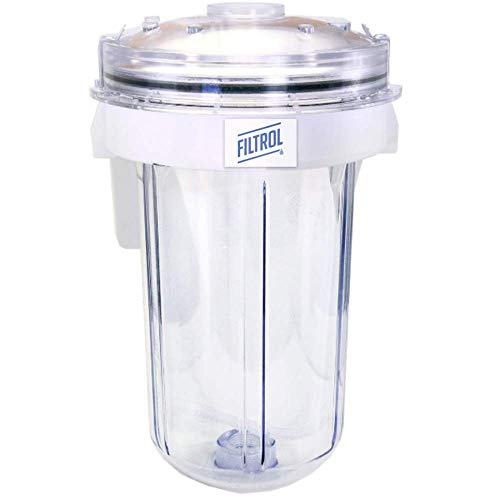


🌿 Stop microfibers at the source — protect your home and planet with Filtrol!
The Filtrol Lint Filter is a patented, reusable microfiber filter designed to attach to your washing machine’s discharge hose. It effectively captures synthetic fibers, pet hair, sand, and other debris before they enter septic or public sewage systems, preventing costly clogs and environmental microfiber pollution. The unit includes all necessary fittings and mounting hardware for easy installation and features a durable polyester filter bag that is simple to clean and built to last for years.
| ASIN | B002KEMABQ |
| Batteries required | No |
| Best Sellers Rank | #988,881 in Health & Household ( See Top 100 in Health & Household ) #4,963 in Lint Removers |
| Brand | Filtrol 160 |
| Color | Clear With White Bracket |
| Customer Reviews | 4.2 4.2 out of 5 stars (371) |
| Handle Material | Nylon |
| Is Discontinued By Manufacturer | No |
| Item Weight | 4.13 pounds |
| Item model number | F160-1 |
| Manufacturer | Wex Companies, Inc. |
| Material | Polyester |
| Operation Mode | Manual |
| Product Dimensions | 8"D x 9"W x 15"H |
| UPC | 753182334905 |
| Warranty Description | This product is not warranted by the manufacturer when purchased on amazon. |
N**.
Easily one of the least-regrettable purchases I have made in my entire life
I was hesitant at first because $149 isn't nothing. I am glad I took the chance. We bought our house March of 2017 and its septic system had been replaced about 6 months prior, at great expense. We plan to live here long term and so I wanted to be sure we took good care of the septic system so we'd never have to worry about replacing it. I waffled on buying this for several months until we bought a dog, at which point I worried all the fur (she's a husky) from laundry might eventually cause problems. That fear was unfounded, as virtually no dog hair comes out in the wash--it all comes out in the dryer. That fact is clear by seeing the filter trappings of each unit. That said, this Filtrol does solve a big problem for septic tanks that never really occurred to me: synthetic fibers. Septic tanks were devised at a time when most people were wearing mostly natural fibers, such as cotton. That can break down over time in a septic system, but the synthetic fibers in most modern clothes such as polyester, nylon, lycra, elastic, rayon, and fleece can't. Even worse, many of these fibers can behave as neutrally bouyant in a septic system, meaning they neither sink to the bottom nor float to the top, and as such, they are capable of flowing out to the perforated pipes in your drain field and clogging them permanently. This won't happen quickly, but it's irreversible and once it gets bad enough you could be looking at a repair bill of $2-15k. Yikes. After thinking about that, I bought this unit. I have never regretted it. Once installed, you can see after the first and every other wash how much fiber is being kept from the drain field, and it's a LOT. It traps much more than the crummy net things you put on a drain hose, it eliminates a need for a separate drain tub, it can go longer than the nets before clogging, it's reusable and easy to clean instead of wasteful like the nets, and so it eventually pays for itself. The filter material is definitely synthetic, but I'm not sure what kind, exactly. Maybe polyester. It's smooth to the touch, completely snag and lint proof, and extremely durable. I bought my Filtrol unit about 3-4 years ago and I am still using the original filter. We do use bleach as needed (not great for septic tanks in large quantities, so we try to keep it at a minimum), and we regularly incorporate vinegar in our wash cycles. Neither product has harmed the filter. The filter has some minor discoloration at the bottom, which is to be expected at the very least, and is only visible once I pull the filter out to clean it. It shows absolutely zero signs of wear such as widening of the mesh, stretching, failed stitching, odors, etc. To clean, I remove the filter from the canister, dump out all the lint and stuff it's trapped, and then hand-wash with dawn dish soap, sometimes with hot water, sometimes cold. I've never bothered cleaning the canister, and it's never seemed to need cleaning. Filter gets cleaned every five loads or so, and it has never developed any odors or other issues except on occasion when my wife has done lots of laundry (she never cleans it because I mounted the canister a bit too high for her to reach easily--the top of the canister sits about 6' from the floor, and it's never caused drainage problems) the filter sometimes gets a bit slimy, which seems to be an accumulation of soap/detergent residue rather than something yuckier. If it goes too long between cleanings the mesh becomes too clogged for water to drain through it, at which point it spills over the top of the filter (but still contained by the canister and lid) and safely drains as unfiltered washing machine drainwater, as it would with no Filtrol unit in place, until the filter gets cleaned again (at which point it's back to working like new). I came to write a review after all this time because I am preparing to buy my first replacement filter just in case the old one finally rips one day, or whatever. I expect it'll collect dust for at least a couple more years. A final benefit I should mention: if you accidentally put something in the laundry you don't want to lose, if it would have otherwise been washed away with the drain water, the filter will catch it instead. Could save your butt one day, as it has saved mine a couple of times already. (The dark stuff in the bottom of the photo is easily rinsed away by pouring some clean water in with the filter removed, or else it just gets cycled out with the next drain/rinse cycle. Mine looks so dark because I just washed some very grimy shop towels.)
A**R
It's the only thing out there to remove microplastics from your laundry
This is the only device out there for removing the microplastics from your laundry. Sewage processing doesn't remove these microplastics, so they go to our rivers, groundwater, lakes, and oceans. For existing and being reasonably priced, I give it a 5 stars. I am not handy and needed to hire a handy man to attach it to the inside of the basin my washing machine drains into. He used the fittings it came with, though he needed to drill a hole high into the sink to secure it. This has worked fine, but there is no way I could have done it myself. Pros: It really works. It collects a lot of lint, especially when you wash fleece. The instructions were clear and even I could figure out how to clean the filter. Its cost, even taking into account the $150 for the handyman, was much less than the alternative (purchasing clothes made only of cotton, wool, linen, and other natural fabrics). There are bags you can put your laundry into (sold by Patagonia), but there is no way they could handle all the laundry we do. Cons: We are a family of four who do a lot of laundry, so this filter needs to be cleaned every 2 weeks. It is a pain to clean the filter, about a 15 minute job. You need to scrape off the lint into the garbage (and it is rather slimy and disgusting). Then you rinse it into a bucket and pour the bucket into your yard. This is following the directions - the point being to prevent the microplastics from going into the sewer or septic system. It is also sometimes hard to get the lid of the filter off, even though they provide a sort of grease to put on it to make it slide more easily. Eventually, I would like to just be able to buy a washing machine with a microplastic filter that can be more easily cleaned, but, as it is, this appears to be the only real option.
C**L
Does exactly what it is designed to do - Eliminate laundry microparticulates from septic stream
I found the Filtrol 160 some 20 years ago and purchased my first unit. It was easy to install and I mounted it on a dovetail insert instead of a french cleat on my washroom wall. That way I could take it off and clean it - not a great idea since you can pull the canister our from the holder anyway! But does it work! If you have pets and a lot of hair, the filters are going to need regular cleaning. We are a family of 4 with no pets currently, we can last 1 week between cleanings. When I purchased it came with 2 filter bags that had the elastic pleated middle - that IS a pain - but those bags are still working for me! To deal with the cleaning, I have copper pipes overhead in my basement laundry room so I have plenty of places to put a hanger. The filter bag has a plastic rim with 4 holes for "overflow" when the 100 micron filter mesh gets too impermeable. I open the canister by popping the clips with a large flat head screwdriver, then pop the top off by placing the screwdriver with it's nearly 1/2 inch blade in the notch to each side of the clip and twist to open the lid. Then I take a wire coat hanger in one hand, pull the filter with some accumulated waste water out of the canister, put the clothes hanger hook through one of the overflow holes, and then right over my wash sink in my older home laundry room I hang the hanger & filter to drip dry. It takes about 24-36 hours to drip dry. I always have one clean filter ready to go - my wife and children are not enthusiastic about proper maintenance schedules. I've set a 1 week of washing schedule - usually on Saturday afternoon after the yardwork - or Sunday when I remember I didn't get to it - I find the filter gunked & holding some wastewater. So I've reduced my washing machine micro-particulate discharge by 50-75% over the years, I only have to snake my main kitchen/laundry room drain every five to ten years now. I'm on my third Filtrol 160 and love the new filter bags. My cleaning tip is to use a pair of quality mechanics gloves (with the rubberized coating so you can grip) and take the dry filter bag, go outside to the garbage can or if you have a fence row or hole in the yard you want to fill, and turn the bag inside out. Just start rubbing the 100 micron filter media and most of the dried gunk will come off. I've used it to fill holes left by rabbits in our yard. There will still be some residue - so I get my air compressor and spray nozzle and blast the entire filter bag - including the edge where the media is sewn or swedged onto the plastic rim. That is usually clean enough, but we have a front load washer that needs to run a dry cleaning cycle every few weeks or so - I have purchased about 10 filter bags over the years which are still going strong - during the cloth diaper days in our household we were needing a new filter bag every 2 to 3 loads so we stocked up - and I throw all the degunked filter bags in the front loader with the washing machine cleaning cake and run a cycle on hot. The filter bags come out looking like new and very little gunk (some - the washing machine does collect soap scum and gunk that really does require that dry-cleaning-cake to work it's magic) anywhere except the filter in the Filtrol 160 on the wall. I'm in an urban area in a 70 year old home, I've had only minor sanitary drain issues since installing the Filtrol 160 for the laundry room and using sink strainers in my kitchen. I do believe the major 'gunking' of the drains was a combination of a garbage disposal (rarely used now - bones and large cooking waste goes to compost bucket or garbage bucket) and laundry wastewater microparticulates. Incidentally, we save our dryer lint from washing our cotton sheets & blankets for starting fires - my sons are scouts and have learned to use a fire drill and flint & steel to spark a fire, the dryer lint from any material actually will catch the sparks and ignite slowly. Just writing this I'm wondering if some of the soap scum/washer lint might also be useful for fire-starting. But why bother - I've still got holes in the yard to fill. We used to have an urban fox (red fox) that kept the rabbits & squirrel population in check, but they seem to have disappeared and both populations have taken over in the area. New holes in my yard every spring! So lots of yard to put my Filtrol 160 captured washer lint into!
S**E
I used this all last Summer and found it to filter a lot of lint. This is hooked up to my washing machine at my off grid cabin. The cabin has a "Grey Water" barrel buried in the ground for washing machine run off. If not for this great item my "Grey Water" drainage would eventually clog up from lint. This devise is a game changer. Highly recommend for anyone that is "Off Grid"
G**E
Le filtre est trop étanche, l'eau ne réussit pas à s'évacuer assez rapidement pour ne pas refouler.
TrustPilot
vor 3 Wochen
vor 3 Tagen