We remain fully operational. Our teams are working around the clock to ensure your deliveries continue safely.

Laden Sie die App herunter


Kundendienst
Copyright © 2025 Desertcart Holdings Limited
Laden Sie die App herunter


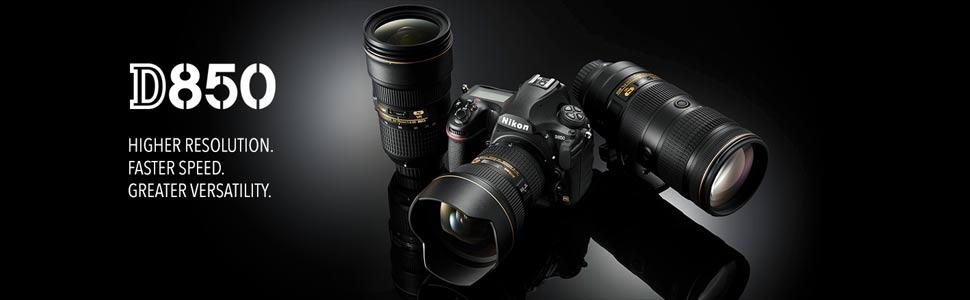
🚀 Elevate Your Vision: The Nikon D850 – Where Speed Meets Stunning Detail
The Nikon D850 is a professional-grade full-frame DSLR boasting a 45.7MP backside-illuminated sensor without an optical low pass filter, delivering extraordinary resolution and dynamic range. It supports up to 9 fps continuous shooting with full autofocus, features a tilting touchscreen, and excels in 4K UHD video and 8K time-lapse capture. Designed for serious photographers, it offers dual memory card slots (XQD/CFexpress and SD), robust weather sealing, and an advanced 153-point autofocus system, making it a versatile powerhouse for high-resolution stills and creative video.




| ASIN | B07524LHMT |
| Age Range Description | Adult |
| Aperture modes | Aperture Priority (A/Av) |
| Are Batteries Included | Yes |
| Aspect Ratio | 1.50:1 |
| Auto Focus Technology | Phase Detection |
| Autofocus | Yes |
| Autofocus Points | 153 |
| Best Sellers Rank | #28,408 in Electronics ( See Top 100 in Electronics ) #16 in DSLR Cameras |
| Bit Depth | 14 Bit |
| Brand | Nikon |
| Built-In Media | Battery |
| Camera Flash | Hotshoe |
| Camera Lens | Fisheye, 1x optical zoom |
| Color | Black |
| Compatible Devices | Smartphone |
| Compatible Mountings | Nikon F |
| Connectivity Technology | Bluetooth, HDMI, NFC, USB |
| Continuous Shooting | 9 FPS |
| Crop Mode | Full-Frame |
| Customer Reviews | 4.7 out of 5 stars 778 Reviews |
| Digital-Still | No |
| Display Fixture Type | Tilting |
| Display Maximum Resolution | 463 x 260 |
| Display Resolution Maximum | 2359K dots |
| Display Type | LCD |
| Dots Per Screen | 2,359,000 Dots |
| Effective Still Resolution | 45.7 MP |
| Expanded ISO Minimum | 32 |
| Exposure Control | aperture-priority |
| File Format | JPEG, Raw, TIFF |
| Flash Memory Installed Size | 64 GB |
| Flash Memory Type | Slot 1: SD/SDHC/SDXC (UHS-II)Slot 2: CFexpress Type B / XQD |
| Flash Modes | Automatic |
| Flash Sync Speed | 1/250 Second |
| Focus Features | autofocus self-illumination light |
| Focus Mode | Automatic AF (AF-A), Continuous-Servo AF (AF-C), Manual Focus (MF), Single-Servo AF (AF-S) |
| Focus Type | manual-and-auto |
| Form Factor | DSLR |
| Generation | 2 |
| Global Trade Identification Number | 00018208015856 |
| HDMI Type | Type C Mini HDMI |
| Hardware Interface | AV Port |
| Has Color Screen | Yes |
| Image Capture Type | Stills & Video |
| Image Stabilization | No |
| Image stabilization | No |
| Item Weight | 2.02 Pounds |
| JPEG Quality Level | Basic, Fine, Normal |
| Lens Type | Fisheye |
| Manufacturer | Nikon |
| Manufacturer Part Number | 1585 |
| Maximum Aperture | 5.6 Millimeters |
| Maximum Image Size | 45.7 MP |
| Maximum Shutter Speed | 1/8000 Seconds |
| Memory Slots Available | 2 |
| Metering Methods | Center Weighted |
| Minimum Shutter Speed | 1/8000 s Seconds |
| Model Name | Nikon D850 |
| Model Number | 1585 |
| Model Series | D850 |
| Movie Mode | Yes |
| Night vision | No |
| Optical Zoom | 1 x |
| Phase Detection Sensor Points | 99 |
| Photo Sensor Resolution | 45.7 MP |
| Photo Sensor Size | Full Frame (35mm) |
| Photo Sensor Technology | CMOS |
| Real Angle Of View | 27 Degrees |
| Recording Capacity | 30 Minutes |
| Remote Included | No |
| Screen Size | 3.2 Inches |
| Self Timer | 10 Seconds, 2 Seconds, 20 Seconds, 5 Seconds |
| Sensor Type | CMOS |
| Series Number | 1585 |
| Shooting Modes | Fotograma a fotograma, continuo a baja velocidad, continuo a alta velocidad),Obturador silencioso, Obturador silencioso continuo,Disparador automático, Espejo arriba. |
| Skill Level | Professional |
| Special Feature | Multi-CAM 20K 153-Point AF System; 8K Time-Lapse, Negative Digitizer Mode |
| Specific Uses For Product | Photography |
| Supported File Format | JPEG, Raw, TIFF |
| Supported Image Format | JPEG, RAW, TIFF |
| Total Still Resolution | 45 MP |
| Total USB 2.0 Ports | 1 |
| Total USB 3.0 Ports | 1 |
| Total USB Ports | 1 |
| Total Video Out Ports | 1 |
| UPC | 018208954117 018208015856 843367129072 |
| Unit Count | 1.0 Count |
| Video Output | HDMI |
| Video Resolution | FHD 1080p |
| Viewfinder | flexible LCD |
| Viewfinder Magnification | 0.75x |
| Warranty Description | manufacture |
| White Balance Settings | Auto, Cloudy, Color Temperature, Fluorescent, Incandescent, Shade |
| Wireless Technology | Bluetooth, Wi-Fi |
| Zoom | Digital Zoom, Optical Zoom |
J**.
Phenomenal Camera
This camera is possibly my favorite thing I've ever purchased. It's an absolute beast. My wife and I are both photographers of different types. She does portrait photography (newborn, family, etc) and I do landscape/astrophotography. For years we've been on the very-mid-range D5200. We bought it while we were still both working part time in school, so we had to go for the best one we could on the extremely limited budget we had. While it has served us well, it's obviously a cropped sensor body and it was time to upgrade to full frame, and many years later we're in a far better place financially. (READ: No more school tuition and full time job yay) We figured if we're going to spend the money on full frame, we might as well get the "dream camera", so to speak, and not feel like we need to upgrade again soon. And so we come to the D850. Lots of research went into the decision to go with the D850, there is no shortage of videos and reading material about it, it's a landmark camera body for many reasons. Sure it's pricey, but this sucker is going to last us for years and years. I'll try to touch on all my personal favorite points, but there are literally so many that I'll probably forget some, but here we go. Body: Super well designed, comfortable, if not a tad on the heavy side. It's a beast of a camera though, so I can absolutely forgive the weight, and it's by no means uncomfortably heavy. Just a tad heavier than I would have thought. The weatherproofing is excellent. You can watch tons of review videos where you'll see them leaving the camera on a tripod in rainy weather to do a timelapse, and then they simply dry it off with a towel later. As a result of the weather proofing there is no built-in popup flash to make it far more sealed off. This doesn't bother me at all because I never use that flash, if I need flash I'll use an external one. Autofocus: If you know anything about the D850, you'll know that the autofocus in the body is industry leading. (the same autofocus as the D5) A huge number of autofocus points, incredible focus speed, it's absolutely incredible. I will simply leave this at what I've said so far since that's really all that needs to be said. It's awesome. Controls: Having come from the D5200 I feel like the controls are much more intuitive and better placed so as to be more ergonomic. They feel much higher quality than the D5200 which just helps with the overall premium nature of this camera. As a person who loves to do astrophotography, one of my favorite tiny improvements is the illuminated buttons! I don't know how I survived without that before this. It's one of those quality of life improvements that just makes so much sense when you finally have it. Memory Card Slots: So as I'm sure you're aware by now, this camera has two slots. One SD slot and one XQD slot. I originally thought I wouldn't get an XQD card, they're so much more expensive than their SD card equivalents, and I hadn't done much research into them, so I thought they were basically a chunkier SD card. I have since done the research and bought a 240 GB capacity card. The read/write speed is seriously blazing fast. Basically it can keep up with the D850, whereas an SD card by itself will start slowing you down during continuous shooting because it can't clear the buffer fast enough. Transfer speeds to my computer are so much faster than my SD card. (note that you do need to buy a card reader for it) It's also incredibly durable which is a great thing to not worry about when you're in more rugged environments. My only complaint about the D850 now that I've bought into the XQD vision is that they only have one XQD slot and one SD card slot. I understand that XQD isn't widely adopted right now, and that increases the barrier to entry for this camera, but I do wish that there were two XQD card slots in this camera rather than one of each. I have a large enough card, however, that I haven't had a big enough session that I started writing to the SD card yet, so that's not that big of a deal. (I usually remove everything off the card when I import right after my session, so I always start at empty) Touchscreen/Live View: I was skeptical that I would ever use the touchscreen aspect of the screen but I must say I was wrong. I use it very often. The screen itself is large, bright, and great resolution. You can pinch to zoom on your pictures and zoom in to see some incredible detail this camera takes. (something I couldn't really do before until I was on my computer) It tilts up and down, a really handy feature that I forget about too often. (as I stand on my tiptoes to see when the camera is up high, I suddenly realize I don't need to do that, the screen tilts) Live View is also incredible on this camera, again I use it far more than I thought I would. You can even autofocus on specific areas/objects by simply tapping the screen. It's incredibly useful, and the screen is high enough quality that it really does your pictures justice. Very impressed with it. Timelapse: You can create a 4k timelapse video right in-camera. You can even create an 8k timelapse using the interval mode and the full resolution photos able to be taken by the D850, although this is not stitched together in-camera, so you'll need to do that yourself. There are some incredible timelapses out there produced by the D850 that you can watch, the image quality is exceptional. You can also use Silent Live View mode, and that'll not use any mechanical shutter. As stated in the camera's product description, this is great for saving on shutter cycles and improving battery performance. Video: In addition to the photography I enjoy, I love shooting video. As everyone knows, Nikon doesn't do as well as Canon in this regard. Of all Nikon's cameras, the D850 appears to be the best when it comes to shooting video. The autofocus while shooting video is not good, so you'd better settle on using manual focus. None of this means that the D850 will produce bad video. If you know how to work around some of the annoyances and less-than-stellar features, you'll get video that is just fine. Most of us, however, aren't getting the D850 for shooting video, so let's talk about the true purpose of this camera. Image Quality: Thus we arrive to the most important aspect of any camera review, the image quality. This is actually a section where I have very little to say, partly because I covered a lot of supporting info, and the other part because it's quite simple. This camera is a beast. It's got a whopping 45.7 megapixels. This was a major upgrade for me, coming from the 24.1 megapixels in my D5200. I'm incredibly impressed with the sheer amount of data collected in the RAW images especially coming from my D5200. The amount of detail I can bring out in post is impressive. As such, the RAW files are very large, so hopefully you have plenty of storage space. It has great low-light capabilities, and the autofocus works surprisingly well even in low light. I can't think of a single complaint about this category, which speaks to the incredible images this camera produces. If you can afford it, I can't recommend this camera enough. It's an incredible piece of technology, one of the best cameras you can buy. If you are looking for an incredible full frame DSLR with no compromises (minus video of course) then look no further than the Nikon D850.
H**R
A Big Upgrade
The D850 is a big improvement over my D7000. Using the same lens and exposure, the D850 does a noticeable better job. Can't tell if it is the increased pixel density, lack of anti aliasing filter, or what, but a definite improvement. Haven't used all the available options, but life is easier with the D850. Focus stacking is so much easier. The D7000 would do it, but only after being tethered to my tablet/phone or connected with wifi using the TP-Link. Still not clear on how the length of a focus step is calculated, but just following the instructions have worked well so far, even when doing macro with tubes. Focus Peaking makes using manual lenses, including the Celestron C5, so much easier. Nice to have HDR as a menu option. I do like the HDR option on qDSLRDashboard better with up to 19 exposure available instead of only 3, but then I am back to having to carry my tablet again. With the improved dynamic range, also a noticeable improvement over the D7000, HDR may be almost a thing of the the past. The D850 is supposed to get more photos per battery than the D7000. I think it will but you have to leave the live view/touch screen alone and that is hard to do. It works very well. Easy to see in bright sunlight, focus and shoot by touching the screen, using focus peaking, or setting up many of the on camera options require its use. The electronic shutter, with no noise or vibration, only works in live view. I can go through a battery on the D850 way faster than with the D7000. Do miss not have a IR shutter release. It was so simple and quick to use on the D7000. Had to do a search on the internet to verify it wasn't on the D850. Still haven't figured out a fast way to do a wireless shutter release. Snapbridge is always there, but that is not fast. You could change your mind by the time that gets set up. It requires the WIFI connection to work. The WIFI connection was a big disappointment at first, still not my favorite thing, but I have found a procedure that gets it up and going every time. Ignore the instructions when you try to connect with wifi. The bluetooth hasn't been a problem. Use the camera menu to turn it on and, if the phone/tablet is paired, it will quickly connect. The only thing bluetooth can do is use the phone/tablet GPS data to geotag your photos, update the time/date on your camera, and turn the camera wifi on. To turn the camera wifi on select "Download pictures" or "Remote photography" on the Snapbridge app on your phone/tablet. Every time I do this I get the message that the connection has failed. Ignore that and go to settings on the phone/tablet where you can now select the camera wifi on the list of available wifis because Snapbridge did turn it on, and select connect. Then go back to Snapbridge, select "Remote photography" and it will connect. Haven't found Snapbridge to be all that useful to control the camera so I usually go to qDSLRDashboard and connect with it. Works great and works every time, but why can't I just have a menu option, ON THE CAMERA, to turn the wifi on and off. The other annoyance with the D850 was the cover for the hot shoe not being provided. I thought at first it must have been left out when the camera was packaged. Nope. You just don't get one. Over $3000 dollars for a camera and you have to get your own cover for the hot shoe. This is not my first new Nikon camera but it is the most expensive. I am almost positive this is the first time I had to go find my own hot shoe cover. It is a nice cover. Hopefully Nikon continues updating Snapbridge and the D850. I do like the camera, but I will still find uses for the D7000, like long range backpacking, since it is lighter and easier on batteries. But then again, the D850 is only about 1 lbs heavier and I think I could learn to leave the live view alone....maybe. Update The latest firmware update, part C 1.10, added the option to turn WIFI on/off to the WIFI menu on the camera. Snapbridge is no longer needed to control the camera WIFI.
C**E
The Camera Nikon Needed to Release
This is the camera Nikon needed to release. Please allow me to explain. Over the last 12-18 months I have found myself migrating away from my D750. For our production company I do about 50% stills and about 50% video. For video I use my GH5 - which for video - is a unbelievable. However.... it isn't that great for stills. The low light performance isn't great and as a whole... it lacks the finer points of higher end cameras. So I would use my D750 combined with my Otus 55mm for stills. The Otus is a beast - a fantastic lens that significantly outperforms the sensor on the D750. This combination of the GH5 is fine for the studio... but when I travel it just becomes too much to carry. For travel I use a Fuji X100F -which is a fantastic little camera. It has a 50mm equivalent lens and produces photos that are the same resolution as my D750+Otus combo but with marginally less sharpness and color accuracy. So my dilemma... why use Nikon equipment at all? I am not shooting sports or using telephoto lenses. Nikons are not superior for video.... and some of high end compact cameras nearly equal their performance (if you are primarily shooting mid-focal length primes ). Frankly, my Nikon D750 was ONLY being used when I was pairing it with a specialty lens. Sure there was the D810, but the increase in functionality didn't exactly overwhelm me. So - even in the studio - I was reaching for my Fuji X100F while leaving the larger Nikon D750 on the shelf. Enter the Nikon D850 This is the camera they needed to release. The new sensor and increased resolution gives me a very compelling reason to use this camera. When combined with my Otus 55mm lens I have something that closely resembles medium format. I can crop, crop, and crop and still get excellent resolution and edge contrast. It is amazing. When used with autofocus lenses (like most normal people) I find it to be fast and extremely accurate. Easily the best I have ever used. The D850 low light performance is also much better than the D750. Again it is the best I have ever used. I have taken high quality photos at ISO 3200- and honestly it is workable all the way to 12,800. While the GH5 still has many more video features than the D850. That does not mean the D850 is a one trick pony. I can carry it on location with confidence that if I have issues with the GH5 the D850 can step in (or be used for B roll). Even better the D850's large sensor can provide far superior DOF control and low light performance. In fact, for some controlled interview settings I would speculate that the D850 could be the DSLR that you could use (when paired with a high end lens). The D850 sensor beats the GH5 and I would put Nikon's glass up against Sony (but that is just me). A few things to remember - Buy the high speed SD cards. They are crazy expensive, but they will fit directly into most computers while allowing you take photos almost as fast as you can push the button. - This camera will start to expose lower end lenses. Consider the price of high quality glass into your equation for your overall investment. - Most importantly... what are you doing with your camera? This is not... I repeat... NOT ... a camera for beginners. I would say that unless you are a real enthusiast or someone who uses their camera as a tool to make money you probably do not need the D850. If you can't answer the question "What specific feature of this camera do I NEED to aid me in taking (insert type of photo)" then don't buy it. Not only do you not need the D850 - it will be a hindrance to you. The menus can get complicated. The files will be unnecessarily large. If you shoot JPEGS in automode - do yourself and your wallet a favor and step down in camera. Final verdict - A hand-down improvement in the Nikon line-up. Unless you need the high speed output of the D5 I am not sure why any pro wouldn't invest in the D850.
S**8
I especially love picking focus points on the rear touch screen -- ...
I am not a professional photographer, but I do consider myself a serious-enough amateur to spend the amount this camera costs. I had been using a D810 previously and I kept the same trio of F2.8 zooms that I had been using with the D810. In the month, my main focus was two weeks of shooting during a family trip to Greece and then videoing a house concert that my wife and I sponsored. Plusses: 1. Even contrasted with the D810, the bigger sensor is worthwhile. In particular, if you are going to blow up a portion of an image, bring on the pixels! Using a Nikkor 70-200mm zoom with a 1.7 extender (the largest extender I've tried that does not visibly degrade the image quality, you can do more to bring out far objects in your shots. I know this will matter to me when I am shooting wildlife on a planned trip this summer. 2. The focusing system is more flexible than the D810 and more accurate. I especially love picking focus points on the rear touch screen -- so much easier than doing so using the buttons on the camera 3. Speaking of which... That rear screen. It is so clear and bright it pushes me to make more use of Live View, And about time Nikon offered a tilt screen. A great help when I was shooting the concert with the camera on a tripod. Last fall, I photographed the solar eclipse (from a park south of St. Louis. Camera on tripod, sun high in sky and I was lying in the dirt so I could keep an eye on the screen. With this camera, tilt the screen and that makes a difference for people my age. (I am old enough to have used a Nikon F when it was new.) 4. The ergonomics -- a lot of people have commented on the deeper hand grip. A real positive for handheld. And the move of the ISO button makes a lot of sense. 5. Expeed 5 processing. Almost every time, I adjusted the exposure to override the processor in Greece (lots of bright backlighting in Greek ruins) I found the camera's exposure was superior to my correction. Heck, its tough to teach an old dog like me new tricks, but I respect that processor. 6. Overall speed. I avoided the D800 because I thought it was too slow for my needs. The D810 was acceptable. This is great -- I do like shooting wildlife 6. ISO 64. Yes!!!! In that Greek sunshine I keep the ISO at 64 and the colors and resolution are just beautiful. Cons: 1. This camera is heavy. Its the first Nikon I have owned where it has felt heavy in my hands. Not a problem walking around with the camera on a BlackRapid strap, but a whole day of hand held shooting... not sure. In Greece, we kept running into "no photography allowed" museums which is fine. But twice I elected to save weight by bringing a D610 body in the expectation that a museum would bar photos anyway. Both times, photos were allowed but shooting in a museum one does not need high pixel counts or speed. 2. The absence of the U1/U2 settings on the D610 -- easy to define personal settings. The Shooting Banks in the menu are not stable and not nearly as appealing.
J**U
Amazing Camera
I own a Z8 and love it but, there’s something about my D850 that still makes me reach for it on a regular basis. The fact that it can still be purchased new in 2026 is a testament to its great capabilities and rugged build.
J**B
Great for night shots
Love my camera takes great photos took me a while to learn it but love taking milkyway photos
S**S
Nikon Best DSLR Camera
This is a replacement for my first D850. This is one of the best camera Nikon ever built. There are so many functions this camera comes with that enhance your picture taking abilities. Using this camera is not easy, but with a little practice, you will not want to put it down. The battery will last you a couple days if you are just casually using the camera. This camera is not cheap, but it is worth the price to me.
E**.
This is probably the last and most advanced DSLR Camera that will ever be built.
The best DSLR camera I have ever used. Learning curve is a bit steep
TrustPilot
vor 1 Woche
vor 1 Tag