We remain fully operational. Our teams are working around the clock to ensure your deliveries continue safely.

Laden Sie die App herunter


Kundendienst
Copyright © 2025 Desertcart Holdings Limited
Laden Sie die App herunter
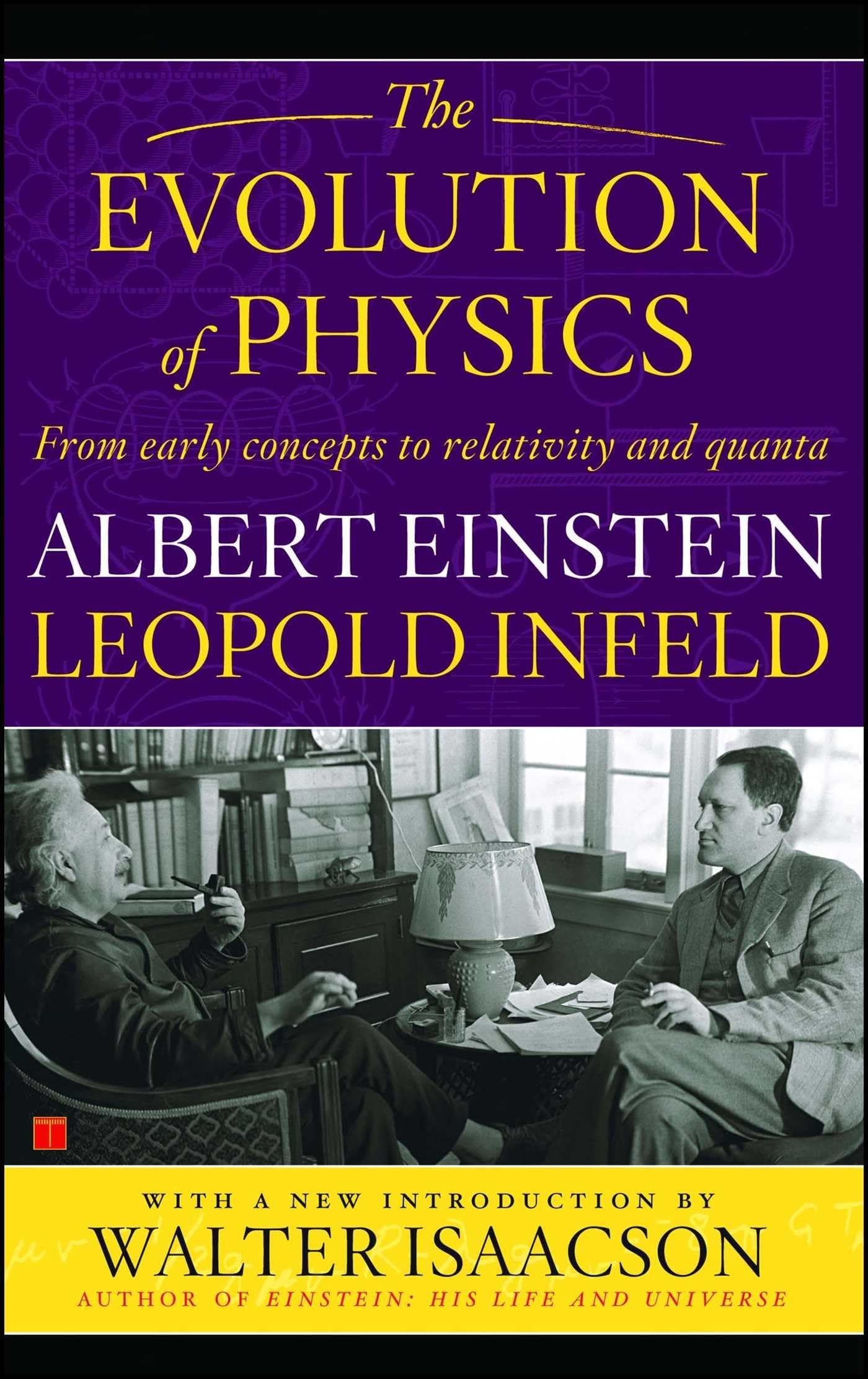
The Evolution of Physics [Einstein, Albert, Infeld, Leopold] on desertcart.com. *FREE* shipping on qualifying offers. The Evolution of Physics Review: Overall Brilliant - The book has three parts: classical physics, relativity, and quantum physics (there wasn't much particle physics or cosmology in 1938, after all). The classical treatment is an extended examination of Galilean invariance, and is both brilliant and nicely presented (without equations). The special relativity theory part explains the twin principles of inertial frames and the constancy of the speed of light. It is very nicely done, although it has to be mysterious for the reader when even the simplest algebra is off limits. The general relativity part is presented as the extension from inertial to arbitrary frames, from with gravity is introduced via the equivalence of inertial and gravitational mass. I suspect this is mostly mysterious for the reader, but I'm not sure. The quantum section is the least successful. The authors center on particle energy discreteness, but do not really get into the strange and mysterious aspects of quantum mechanics. Nor do the explain spin, fermions, bosons, etc. Review: Physics for everyone! - Probably one of the best introduction books to physics that i've ever read. The book explains the theoretical problems that physicists had to face throughout history and their solutions. It really puts the emphasis on the philosophical aspect of physics and the thought process that comes with it, without getting in too much to the technical part. I would consider this book a must for physics students, or generally, to anyone who always wanted to understand physics but had problems with the math... As for me, I think that this book could have been perfect if it would explain a little also the mathematic aspect, but nevertheless it's a good read!
| Best Sellers Rank | #189,306 in Books ( See Top 100 in Books ) #66 in Research Reference Books #723 in Physics (Books) #9,726 in Education & Teaching (Books) |
| Customer Reviews | 4.5 4.5 out of 5 stars (253) |
| Dimensions | 5.31 x 1.1 x 8.25 inches |
| Edition | Illustrated |
| ISBN-10 | 0671201565 |
| ISBN-13 | 978-0671201562 |
| Item Weight | 12 ounces |
| Language | English |
| Print length | 336 pages |
| Publication date | October 30, 1967 |
| Publisher | Touchstone |
H**S
Overall Brilliant
The book has three parts: classical physics, relativity, and quantum physics (there wasn't much particle physics or cosmology in 1938, after all). The classical treatment is an extended examination of Galilean invariance, and is both brilliant and nicely presented (without equations). The special relativity theory part explains the twin principles of inertial frames and the constancy of the speed of light. It is very nicely done, although it has to be mysterious for the reader when even the simplest algebra is off limits. The general relativity part is presented as the extension from inertial to arbitrary frames, from with gravity is introduced via the equivalence of inertial and gravitational mass. I suspect this is mostly mysterious for the reader, but I'm not sure. The quantum section is the least successful. The authors center on particle energy discreteness, but do not really get into the strange and mysterious aspects of quantum mechanics. Nor do the explain spin, fermions, bosons, etc.
E**C
Physics for everyone!
Probably one of the best introduction books to physics that i've ever read. The book explains the theoretical problems that physicists had to face throughout history and their solutions. It really puts the emphasis on the philosophical aspect of physics and the thought process that comes with it, without getting in too much to the technical part. I would consider this book a must for physics students, or generally, to anyone who always wanted to understand physics but had problems with the math... As for me, I think that this book could have been perfect if it would explain a little also the mathematic aspect, but nevertheless it's a good read!
N**E
I bought this book mainly because of its citation value ...
I bought this book mainly because of its citation value for the statement on page 92 about the importance of framing inquiry and research parameters before developing "the answer." Since grad school, I have privately questioned the cliche that "the questions are more important than the answers," which struck me as essentially nonsense. But Einstein's basic statement of this concept is so much more nuanced and sensible. Beyond page 92, I discovered a very readable and enjoyable book -- I only wish Hawkings was as transparent!
B**S
Conceptualization made easy
I read this book many years ago and loved it. I bought this copy so I could re-read it. It was well worthwhilte. The authors have totally eliminated math from their presentation. As a result, the stickler may feel slighted, because there are no proofs in the scientific sense. However, they take you through 'thought experiments' which occur only in your head. If you take the time and make the effort, they will build in your mind a picture of how various broad ideas happen; ideas such as the complex interactions between electric and magnetic fields, and they even give you an appreciation for the four equations known as 'Maxwell's Equations', and do so without ever showing you the equations. They take on the duality of light (how it sometimes behaves as a wave and sometimes as corpuscles), and hint at a similar duality in the quantum world of sub-atomic particles. From those discussions, they go directly into special relativity. Who could ask for anything more. If you like trying to understand physical ideas, you should really like this book.
S**N
Einstein's explanation of physics
This is the text selected by Prof Richard McKeon (University of Chicago) up to the 1970's to teach the evolution of scientific understanding from times of earlier humanity to the 1938 publication date. Sadly, only a small fraction of modern humanity has a clue to the wisdom and critical understanding it offers us so accessibly....
P**.
A mystery novel of nature. What is ultimate reality?
The book is touted as explaining the evolution of physics from early mechanical theory thru quanta without using mathematics. The authors did a swell job doing this. The analogy of mystery novel creator dropping a few clues such that we "know" what happens, then later giving up new clues which changes previous conclusions works well as to scientists solving natures secrets then new scientists discover new information with new conclusions. It helps to have had a scientific background (engineering). It is any easy read and examples and explanations are at a level all can grasp.
J**E
Amazing story of special and general relativity
When Einstein published his General Theory of Relativity, only a small fraction of physicists understood his work. One of the most remarkable aspects of this book, written for the curious non-physicist, is that special relativity, then general relativity, is unfolded for the lay reader in such a way that the reaction is, "Of course!", as if the universe could not be any other way. I now understand better Einstein's purported statement to a journalist when asked how he would have felt if the bending of starlight around the sun during a solar eclipse had NOT confirmed predictions of the General Theory. Einstein purportedly said, "Then I would have felt sorry for God." Amazing book.
D**N
Of historical interest
You won't learn modern physics from this book, but it's an interesting window on Einstein's view of physics from 1938. It's written by a man who worshipped Einstein, and his adulation is clear in the text. The style is very wordy, but clear if you're a patient reader. I like the insight that there are many ways to view reality, depending on your perspective - macro, micro, or smaller. A much finer book on modern physics is The Elegant Universe, by Brian Greene.
A**ー
This book was written in 1938. Still it is worth reading for a better understanding on physics riddles. Authors explained in plane words without any mathematics why we were forced to change our way of thinking on physics. They began “Mechanical vs Field”, then, “Corpuscle vs Wave”, “Ether vs Relativity”, and finally “Continuum vs Quanta.” If a reader of the book had a basic introduction of science at University. He would agree that addition or subtraction should be limited within the same type of set. To our surprise, Relativity gives the “Space Time mixture.” I understand the intervening light velocity “c”, and also agree with the “Lorentz transformation.” If this mixture is OK, can I invent my “new” Lorentz transformation with my “new c’s” on, say, “Color and Pressure?” Of course NOT. But why? If Physics demands, would our basic logic be overridden? Einstein insisted that mass “m” is equivalent to “energy.” This is much more serious riddle. Mass defect on gluon has been discovered. Still I don’t have a clear image how this transformation would be realized. On “Quanta,” I still remain completely confused. Say, a physics teacher came in the class and taught me that my mountain was a beautiful meadow in summer sunshine, another guy came in and insisted that NO, NO. I had to go around the mountain and looked at it. It would be rocks, snow and ice precipice in winter storm. I hoped understand my mountain, and tried “meadow plus precipice and divide it by 2.” The result was ridiculous nonsense. Again our basic logic failed. In my young day, I noticed and bought the book, but left it on my shelf. Recently I found an article in which the book was said to be adopted as a textbook of the first year in physics department. I dear suggest the book is not perfectly suitable for fresh year students before they are given basic physics. Rather, after experience the advanced physics and even after understanding on relating mathematics, the students would have still uneasy feeling on riddles. They would try this book personally and secretly in their midnight study. After finishing the book, my fog on physics gets denser. Could you please, anybody, HELP MEEEE?
L**U
This book beautifully describes the idea behind Relativity (and other physical phenomenon) in such a way that anyone can understand it, regardless of your current knowledge in physics. Rather than using mathematical formulae and equations to describe how Relativity (and other laws) behaves, Infeld and Einstein bring you through a series of logical puzzles and thought experiments to explain to you how the theory of Relativity came about. You will then realize how this sort of logical thinking was paramount in creating some of the most important theories in modern physics. The clarity expressed in Einstein's thought process is fascinating, and will give you insight into how to breakdown complex problems into very simple and seemingly obvious pieces.
A**R
Good read and quality
C**S
Ne he leído totalmente el libro. Le puse 3 estrellas por la baja calidad del libro, lo compré en descuento y sólo así lo pagaría. Es una lástima sea tan pobre la impresión del libro siendo una verdadera joya de la divulgación científica escrita por un gigante de la física como Einstein.
A**A
A wonderful journey in the world of physics, from classical mechanics, through special relativity and general relativity, to quanta... Not a single equation... Just fundamental ideas and their interplay... On a conversational mode with no other than Einstein !
TrustPilot
vor 3 Wochen
vor 1 Monat