
Laden Sie die App herunter


Kundendienst
Copyright © 2025 Desertcart Holdings Limited
Laden Sie die App herunter


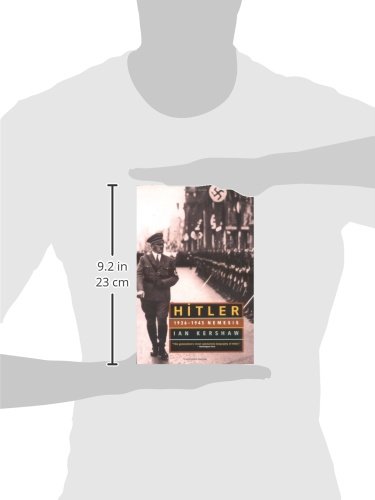
desertcart.com: Hitler: 1936-1945 Nemesis: 9780393322521: Kershaw, Ian: Books Review: An Unsurpassed Account of the Rise and Fall - This book, along with volume 1, is amazing piece of work--exhaustive and at times exhausting, but for the most part eminently readable. The opening paragraph, from volume 1, is indicative of Kershaw's talent: "The first of many good strokes of fortune for Adolf Hitler took place thirteen years before he was born. In 1876, the man who was to become his father changed his name from Alois Schicklgruber to Alois Hitler....Certainly, 'Heil Schicklgruber' would have sounded an unlikely salutation to a national hero." That paragraph also presents one of the recurring themes in Kershaw's rendering: that without several instances of "the luck of the devil" (as Kershaw puts it in the chapter on the Valkyrie assasination plot that in 1944 came so close to being successful) Hitler might never have come to power or his reign might have ended considerably earlier. The subtitles of these two volumes--HUBRIS and NEMESIS--also succintly summarize the arc of Hitler's career as demagogue: his defiance of the Versailles Treaty after WWI and his incursions into Austria, Czechoslovakia, and Poland were met with virtually no resistance, leading him to believe in his infallibility when he decided not only to enter a war on two fronts but to take command himself of the armed forces, repeatedly overruling his military leaders and sending troops into hopeless battles. Kershaw portrays Hitler, after he could no longer pretend that his Reich would be triumphant, as fashioning for himself an epic (Wagnerian) ending, a conflagration that would consume him as well as the minions that had proven themselves unworthy of his leadership. Besides being strictly speaking a biography of Hitler, these two volumes make up another version of The Rise and Fall of the Third Reich--that is, there is a wealth of detail about political, social, and military history. This detail can be overwhelming--keeping track of just the military leaders involved in the war is mind-boggling, since so many fell in and out of Hitler's favor over the years. There is a glossary of much-used abbreviations (SA, SS, SD, SPD, etc, etc) which is very helpful; I wish there had been something like a personnel list as well, since the cast of characters is enormous. There are a fair number of maps, but when it came to all the military maneuvering, I could have used much more help. Still, I can't recommend highly enough these two volumes to anyone curious about Hitler and his regime. Footnote: In 2008 Kershaw abridged his 2-volume work into a shorter one (only 1072 pages!) called HITLER: A BIOGRAPHY. In September he published THE END: THE DEFIANCE AND DESTRUCTION OF HITLER'S GERMANY, 1944-1945, which I am tempted to buy, though it's hard to imagine what can be added to that subject that wasn't covered in NEMESIS. Review: Outstanding writing - The skill needed to transform events into a good read whilst maintaining perspective and providing a balanced judgement from the evidence now available to scholars is clearly one of Professor Kershaw's strengths. This is an excellent biographical history to read in conjunction with social, economical and military histories of Germany in the 20th Century. I am a general reader and found this more than a worthy companion to the first, unfolding as it does, like some great Wagnerian Opera yet, full of telling detail to make the events sickenly vivid and memorable. In brief, I recommend it because: * it is brilliantly written * it had access to diaries previously unavailable * it provides perspective regarding the significance of events - Dunkirk was strategically much more important than I otherwise knew - the Battle of Britain less so - the Russian campaign seminally important * it provides strategic analysis * it provides vivid detail - a local enthusiast in Lithuania clubbed to death 50 Jews in 45 minutes then hopped up on to the pile of corpses and played his accordian (p.464) * it reminds us of events such as Babi-Yar where 33,771 (mainly)women and children were butchered * it shows why Hitler did not destroy Athens * it shows how Stalin's deportation East of one million German-Volgas helped to galvanize action regarding the final solution.
| ASIN | 0393322521 |
| Best Sellers Rank | #428,226 in Books ( See Top 100 in Books ) #30 in Historical Germany Biographies #353 in World War II History (Books) #760 in German History (Books) |
| Book 2 of 2 | Hitler |
| Customer Reviews | 4.6 4.6 out of 5 stars (578) |
| Dimensions | 6.1 x 1.4 x 9.1 inches |
| Edition | First Edition |
| ISBN-10 | 9780393322521 |
| ISBN-13 | 978-0393322521 |
| Item Weight | 2.29 pounds |
| Language | English |
| Print length | 1168 pages |
| Publication date | September 17, 2001 |
| Publisher | W. W. Norton & Company |
D**K
An Unsurpassed Account of the Rise and Fall
This book, along with volume 1, is amazing piece of work--exhaustive and at times exhausting, but for the most part eminently readable. The opening paragraph, from volume 1, is indicative of Kershaw's talent: "The first of many good strokes of fortune for Adolf Hitler took place thirteen years before he was born. In 1876, the man who was to become his father changed his name from Alois Schicklgruber to Alois Hitler....Certainly, 'Heil Schicklgruber' would have sounded an unlikely salutation to a national hero." That paragraph also presents one of the recurring themes in Kershaw's rendering: that without several instances of "the luck of the devil" (as Kershaw puts it in the chapter on the Valkyrie assasination plot that in 1944 came so close to being successful) Hitler might never have come to power or his reign might have ended considerably earlier. The subtitles of these two volumes--HUBRIS and NEMESIS--also succintly summarize the arc of Hitler's career as demagogue: his defiance of the Versailles Treaty after WWI and his incursions into Austria, Czechoslovakia, and Poland were met with virtually no resistance, leading him to believe in his infallibility when he decided not only to enter a war on two fronts but to take command himself of the armed forces, repeatedly overruling his military leaders and sending troops into hopeless battles. Kershaw portrays Hitler, after he could no longer pretend that his Reich would be triumphant, as fashioning for himself an epic (Wagnerian) ending, a conflagration that would consume him as well as the minions that had proven themselves unworthy of his leadership. Besides being strictly speaking a biography of Hitler, these two volumes make up another version of The Rise and Fall of the Third Reich--that is, there is a wealth of detail about political, social, and military history. This detail can be overwhelming--keeping track of just the military leaders involved in the war is mind-boggling, since so many fell in and out of Hitler's favor over the years. There is a glossary of much-used abbreviations (SA, SS, SD, SPD, etc, etc) which is very helpful; I wish there had been something like a personnel list as well, since the cast of characters is enormous. There are a fair number of maps, but when it came to all the military maneuvering, I could have used much more help. Still, I can't recommend highly enough these two volumes to anyone curious about Hitler and his regime. Footnote: In 2008 Kershaw abridged his 2-volume work into a shorter one (only 1072 pages!) called HITLER: A BIOGRAPHY. In September he published THE END: THE DEFIANCE AND DESTRUCTION OF HITLER'S GERMANY, 1944-1945, which I am tempted to buy, though it's hard to imagine what can be added to that subject that wasn't covered in NEMESIS.
I**N
Outstanding writing
The skill needed to transform events into a good read whilst maintaining perspective and providing a balanced judgement from the evidence now available to scholars is clearly one of Professor Kershaw's strengths. This is an excellent biographical history to read in conjunction with social, economical and military histories of Germany in the 20th Century. I am a general reader and found this more than a worthy companion to the first, unfolding as it does, like some great Wagnerian Opera yet, full of telling detail to make the events sickenly vivid and memorable. In brief, I recommend it because: * it is brilliantly written * it had access to diaries previously unavailable * it provides perspective regarding the significance of events - Dunkirk was strategically much more important than I otherwise knew - the Battle of Britain less so - the Russian campaign seminally important * it provides strategic analysis * it provides vivid detail - a local enthusiast in Lithuania clubbed to death 50 Jews in 45 minutes then hopped up on to the pile of corpses and played his accordian (p.464) * it reminds us of events such as Babi-Yar where 33,771 (mainly)women and children were butchered * it shows why Hitler did not destroy Athens * it shows how Stalin's deportation East of one million German-Volgas helped to galvanize action regarding the final solution.
P**R
I couldn't give it 5 stars ....
I was tempted to give it 5 stars only because of its sheer length (over 1400 pages when the 2 biographies are combined), its copious footnoting, and its obvious "scholarliness." And it was certainly a good biography, which I would recommend. But despite all that, I had a few problems with it, some trivial and some not: 1. I found the book to be both overinclusive and underinclusive. I mean the former in the sense that the lens of the author was so tightly focused on Hitler and Hitler only that it seems as if Hitler's every utterance, every thought, and every movement was included. The problem with this is that so many of Hitler's thoughts and sayings were repetitive that we didn't need to be advised each of the umpteenth times they occured. The author was also repetitive in his own right. For example, how often did we read the following? (10? 20? 100? In any case, TOO MANY.) 1. Hitler was determined that there would be no repeat of 1918. 2. Hitler insisted on a military success before any talk of settlement. 3. Hitler had an "either-or" way of thinking with no middle ground. 4. Hitler refused to capitulate. 5. Whenever anything went wrong, Hitler looked for scapegoats upon whom to case the blame. 6. Hitler felt the Jews and Bolsheviks were the root of all evil. 7. Hitler felt that Gemany's fortunes would turn around as soon as new weapons were developed. 8. Hitler felt betrayed by his generals. 9. Hitler ordered [fill in appropriate geographic area which was being wiped out the Allies] to be held at all costs. 10. By doing X [especially if it's something nasty against the Jews], Mr. Y was "working towards the Fuhrer". 11. The little phrases used over and over such as "pushing at an open door". By about the 5th time I read each of these sentiments, I got the point. I didn't need to be advised another 20 times. I think that one of the "dirty little secrets" of Hitler's life is that, once the war started to go sour--say after the failure of Operation Barbarossa--his life was not only unchanging but also not all that interesting. It was just one straight downward path culminating in his ultimate suicide. It seemed as if there were no ups and downs after 1942--it was just straight down. For that reason, I feel that the second half of the book could have been shortened significantly with virtually no loss in understanding Hitler the man. But just as I felt the book was overinclusive in terms of the author's steadfast focus on Hitler, it was also underinclusive in terms of how little attention was paid to various major events during the war. I recognize that the book was not about Nazi Germany per se and it is not called "Hitler and his times", but couldn't the author have devoted more than a few sentences to major events such as: The Warsaw Ghetto uprising? The British decoding efforts? The concentration camps? D-Day? Yalta? These events were almost completely ignored. Finally, one trivial--but for me annoying--trait of the book--was the author's constant translation of words, phrases and sentences into German. What exactly did this add to the book? That the author knows German? That the Nazi leaders spoke in German and not in English? What was the point?? He could have knocked off 20 pages right there. I was particularly annoyed with the translation of "annihilate" to vernichten. It must be no exaggeration to say that we are given that little translation at least 50 times (particularly if you include the offshoots such as "annihilation" which are also helpfully translated for us). Did the author not feel that the first 10 times were sufficient? Also, on some occasions, we are told that "vernichten" means "annihilate", while on several other occasions, we are told it means "destroy." I don't know about German, but for my money, those words may be--but are not necessarily--synonymous. Don't get me wrong--the book is a real achievement and "as I noted" (to use another of Kershaw's pet phrases without the royal 'we'), I would recommend it. I just think it could have been a little better.
D**B
To put it succinctly: this book is amazing. It explains how Hitler was possible, because an educated and cultured society decided to support him. If you want to know how and why this could happen, this is your book. The reading can get a little hard at times, but you will be rewarded. However, volume 1 (Hubris) should be read before this one - at least, you should have some basic knowledge of Hitler's life before 1936. The author also assumes that his readers know the general facts about the Second World War.
P**N
Good book.
A**S
Ian Kershaw a fait le choix de ne pas s'attacher au personnel tant la figure d'Hitler et son impact sur l'Allemagne et le monde fut une œuvre politique, le résultat d'un parcours idéologique porté jusqu'à son paroxysme le plus destructeur. Le personnel alors se mêle avec les forces politiques et sociales qui permirent à Hitler d'imposer jusqu'à la fin pratiquement sa vision autoritaire et génocidaire. Le tome 2 de la biographie est en lui-même une somme car il couvre la période allant de 1936 (où Hitler, ayant la main sur les affaires intérieures de l'Allemagne commence à poser les jalons de l'expansionnisme nazi) à 1945 (la chute et la fin d'Hitler - sa description des derniers jours dans le bunker berlinois est saisissant de réalisme). Tout y est intéressant, dense et précis. L'enchainement qui aboutit au génocide des juifs est décrit avec minutie. Les opérations en Russie et l'implication d'Hitler dans les détails des opérations militaires est passionnant. Ce sont là surement les éléments les plus cruciaux de cette histoire aussi épique que profondément tragique pour les hommes. Il faut un peu de temps pour venir à bout de cette somme mais elle est pleine d'enseignement, encore aujourd'hui malheureusement. Dans la biographie d'Hitler c'est toute une époque que nous revivons.
K**R
Ian Kershawの2部作のこの後編では、ヒットラーの三つの野望・・・1.反ユダヤ(ユダヤ人の抹殺と資産没収)、2.反ボルシェヴィズム(打倒ソヴィエトと社会主義の根絶)、3.ドイツ民族の生活圏拡大(東方への版図拡大)が破綻していくプロセスが克明に描かれている。 ポーランド侵攻をきっかけに英仏との全面戦争を招き、ソヴィエトへの侵攻、米国への宣戦布告を経て劣勢を強いられたヒットラーのドイツ第三帝国は破滅に向かう。 平和な現代社会の社会通念や倫理観を錦の御旗に戦争や独裁者を悪と決めつけ断罪したり過去の出来事として捉えるのではなく、独裁者を生み出すその時代の社会背景や戦争を誘発する世界情勢を識ることが本当の歴史教育だと思います。 戦勝国で書かれた戦勝国史観の歴史書や敗戦国で出版された自虐史観の歴史書が多い中で、平衡感覚を失わない客観的な叙述がお勧めの理由です。 ヒットラーの伝記という枠にとらわれない第一級の歴史書だと思います。
M**T
Ian Kershaw is one of my favourite WW2 authors, and I have enjoyed all of his books immensely. But this book is in my opinion is his very best piece of work, also it is my favourite WW2 book by any author, and I have read scores of them. The book showed not only the dark side of Hitler and the influence that dark side had upon the world. But it offered an insight into the why's and how's of his thinking. Not only did it focus on Hitler, but also on those around him, the pressures he put them under, the rewards he offered and punishment for failure. It describes his mentality and showed how that mentality effected politics,everyday lives, battles and military thinking. This book I cannot recommend enough, if there was a ten star rating that would perhaps be enough.
TrustPilot
vor 2 Wochen
vor 1 Tag