We remain fully operational. Our teams are working around the clock to ensure your deliveries continue safely.

Laden Sie die App herunter


Kundendienst
Copyright © 2025 Desertcart Holdings Limited
Laden Sie die App herunter


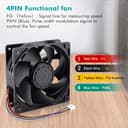

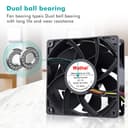

❄️ Stay cool, stay ahead — because overheating is so last season!
The Wathai 4.72" 12V fan delivers a blistering 5300 RPM and 230 CFM airflow, engineered with durable dual-ball bearings for a 67,000-hour lifespan. Its 4-pin PWM connector enables smart speed regulation, making it ideal for high-demand cooling in gaming PCs, mining rigs, and servers. The 38mm thickness ensures maximum air volume, while the included mounting hardware guarantees easy installation. Perfect for professionals who demand reliable, high-performance cooling with a touch of tech-savvy control.


| ASIN | B07SGWNV5J |
| Air Flow Capacity | 530 Cubic Feet Per Minute |
| Best Sellers Rank | #48,722 in Industrial & Scientific ( See Top 100 in Industrial & Scientific ) #8 in Electronic Cooling Fans #122 in Computer Case Fans |
| Brand | Wathai |
| Brand Name | Wathai |
| Compatible Devices | Desktop, Gaming Console, Inverter, Server, computer case |
| Cooling Method | cooling |
| Customer Reviews | 4.5 out of 5 stars 1,135 Reviews |
| Item Dimensions L x W x H | 4.72"L x 4.72"W x 1.5"H |
| Manufacturer | Wathai |
| Material Type | Plastic |
| Maximum Rotational Speed | 5300 RPM |
| Noise Level | 58 Decibels |
| Power Connector Type | 4-Pin |
| Product Dimensions | 4.72"L x 4.72"W x 1.5"H |
| UPC | 702334356784 |
| Unit Count | 1.0 Count |
| Voltage | 12 Volts (DC) |
| Wattage | 22.8 watts |
E**S
Quiet Powerhouse for Cooling Needs
Quiet Powerhouse for Cooling Needs This Wathai 120mm x 38mm 12V cooling fan has turned out to be a real workhorse in my setup. Right out of the box, it feels solid and well-built, and once running, it pushes a serious amount of air. The dual ball bearings are a big plus—they give the fan a longer life and let it run smoothly without the rattly noise that cheaper sleeve-bearing fans sometimes develop over time. I put this into a network cabinet where heat tends to build up, and the difference was immediate. Temperatures dropped several degrees, and the system stays much more stable under heavy use. It’s not whisper-quiet, but for the airflow it provides, the noise is a steady, low hum that blends into the background. Definitely not distracting in a garage, workshop, or server room environment. The 2-pin connector makes installation simple, though keep in mind you won’t get PWM speed control—this is either on or off. For most industrial or electronics cooling applications, that’s perfectly fine. Just make sure you have space for the extra thickness (38mm vs. the more common 25mm), since it moves more air partly because of that larger size. Bottom line: A durable, high-airflow cooling fan that trades speed control for sheer effectiveness. If you need reliable cooling power and don’t mind a bit of fan noise, this is a rock-solid choice.
A**N
Superb airflow if you can tolerate the noise level
Amazing air output and noise level! I found operating it at a low 3-6 watts, it is moving as much air as most of my other 120mm fans. Crank it up to full power of 20+ watts and it's like facing a 30+ mph headwind. Thankfully I purchased a speed control to go with this. Unless you are mounting this fan inside a sound proof chamber you'll definitely need one to restrain the noise. I purchased this fan for cooling under my tractor canopy so the noise isn't that bad compared with the tractor diesel engine spinning 2500rpm. Most of the time I'm using the speed control at about 1/2 of maximum. But it's wonderful to crank it up when the outside temps are getting high. Size is correct match for 120mm mounting. The speed control I used is 4 pin version so fan connected right up. I haven't had any problems with operation. Get a speed control that permits setting a minimum speed also helps. Overall I am very, very pleased. I've bought several other Wathai fans and this one is just as well built as the others. I will definitely to buy Wathai fans.
W**T
These fans really move the air
First of all, they can be very very loud if set to the highest level of speed. This is exactly what I wanted to replace the jet flow fan cases I got originally for my pc many many years ago. You can adjust the speed using the fan control in bios or any other fan control program. I have mine set to manual because trust me if I have it set to cpu temp it sounds like it will take off...lol. Anyway, I can feel the air move and it doing much much better than any regular cpu fan. These are server fans and they can move the air. I think the manufacturers setting is off because I think it moves more than they say. Which is great for me and i have them set at 35% in the front and 45% in the back and the sound is okay. I am very very happy with my purchase. I might end up ordering one more but for now these are fine
A**A
Great Powerful 12mm Fan for PC but pay attention to 2 pin connector
I purchased the Wathai 120mm x120 x 38mm 12V 2Pin Dual Ball 12cm Industrial Cooling Fan High Airflow It is an amazing Fan, Extremely powerful. I needed a more-than-usual powerful 12mm Fan, and this one is great. 4 STARS RATING BECAUSE: I rated 4 stars ONLY because the 2 pin conector (white plastic) has a "2 arrows" plastic lip/protruding the plastic surface that is not a common connection for Computers, so I had to cut it carefully making the surface flat. It should have a standard protruding safe-lock as other connectors, making it easier and more secure to connect and avoid a loose connection. Since I had to cut it (very carefully), I secured with gaffer tape the female connection at the end of the cable to the male connector from the extension cable that I used to connect to the computer, to avoid any risk of accidental disconnection. NOISE: since it's very powerful fan, you can't expect to be quiet using it at 100%. I have more quieter 12mm fans, but less powerful by far. This one is rated at 125CFM and compared to my 110CFM (that was noticeable quieter) it pushes LOT more airflow. So for my purpose I stored the quieter one and used this one instead. Since I use it for computer and it pushes so much air, I use an air filter, to avoid so much dust getting inside the case. Essential to me. There are many cheap plastic grills that include foam filters that can be easily unmounted and washed periodically (if it can be accessed from outside) SUMMARY: Great Powerful Fan.
M**L
Christ on a Cracker...
Okay, so, I've been using this thing for about a year and here are my thoughts. In order to use this, I bought a barrel-jack/fan connector and an adjustable fan controller that fits said barrel jack connector. Upon opening the box the first thing that you notice is the sheer girth of this unit. I mean, it feels much heavier than it should. The build quality is amazing and it runs like a top. at low speed its nearly silent and cools my mid-tower cpu case and heat-sink to a comfy 45c. I want whoever reads this to understand, I don't have a fan on my cpu heat-sink, this thing is connected to the front inside top of my case so as to suck fresh air in and blow it. It blows enough air, from that position to not only cool my heat-sink on its LOWEST setting but to also hit the fan in the back of the case. On medium, the fan sounds like what I imagine a duck hitting a airplanes turbine hears before it becomes meat shrapnel. It's just, Incredibly loud. Like, you can hear it 30+ feet away at half speed. The cooling performance though, matches the noise. I'm able to drop from 71c post Vulcan shader render to 42c in 20 seconds at half speed. Now comes the complicated part. Depending on the heatsink you use, There's little to no point in using this thing past half speed. Let me explain. The heatink can only throw so much heat, and this fan moves air so fast, after half speed, it reaches a point where it just doesn't remove any more. I am able to hold a paper towel to a wall at 3 feet from the back of my case at the fans full speed though lmao. Bottom line is, It's stupid, overkill, and I'm in love, buy three. Just don't forget the adapter and external fan controller, this may kill your power supply.
L**R
Efficient and reliable fan
Me and my friend bought several of Wathai fans for kids science project. Work reliably and efficiently. Our only issue was we were not able to find a 120mm fan in 2 wire configuration (only 4 wires but we do not have a circuit to control pwm). With the 4 wire version we get the necessary air-flow/ weight needed for our project but cannot control speed/ slow down based on supply voltage. With change in voltage there is feedback within the fan to compensate and we cannot slow down. If you have a fan in 2 wire prototype version, we can test it.
R**S
Like a nice power tool, unapologetically loud but worth it if you need the power!
First, this "12V" dc fan's manual casually mentions that it can be damaged if run more than 20% above 12V rated voltage. It's *remarkably* thoughtful to design it to survive at the lead-acid car battery voltage 14.4V since most people I know call a cigarette lighter plug "12v." Now I don't need to add voltage regulation before hooking it up to to my car (or my 10 x AA Ni–MH power pack that runs between 13v and 14v)! They even include instructions on how to swap the wires in their plug if you have different polarity on your device. (I also bought the "Dual Ball Centrifugal Fan High Airflow" model from the same manufacturer, and it's equally superb, but as a "reasonable quietness outweighs sheer air flow" alternative, which also works beautifully even mounted flat against a solid surface.) I *almost* wired a PWM controller sharing the same power source, but I was in a rush so I used a simple power PWM controller as the power source instead of a constant 12V with PWM signaling speed and, while it doesn't get the fan below 50% power, that level isn't terrible if you have something else making noise in the room, so in a pinch that's an option for many projects using the fan. For those who are less comfortable with the details of electrical engineering the my amatuer self (but somehow have a 12v pulse-width modulation power regulator hanging around?), I should note that I get extremely non-linear scaling behavior using it (cut-in around 5% to 10% pulse width), ramp up to about 80% fan speed at about 25% pulse width, and the remainder of the speed is spread over the last 75% of the pulse width. As I write this, I realize the relationship is probably roughly logarithmic starting at the cut-in and I suspect (since I don't want to rip apart one of my two favorite fans of all time) there's a cap or inductor or something smoothing out my pulses before they hit the brushless motor controller IC so it's just seeing a very dirty reduced input voltage when I have a PWM wired in. At 100% speed, it's about as annoying as a vacuum cleaner (not nearly as loud, but much more piercing and distinct overtones). At half speed, the annoyance is about the same as an air window conditioner unit. I cranked it up to 100% and verified the advertised speed and discovered as some (possibly useful) characteristics. I recorded the sound of the fan and found the fundamental resonant frequency is 600Hz, which divided by 7 for the seven blades making each revolution, is about 85 Hz, or (multiplied by 60 to convert Hz to RPM is) 3600 RPM. If you are still reading, you must be looking for something wrong with it. Sorry, I can't find a single thing to complain about. :-)
M**N
Great for innovative projects!
I converted a 120 VAC space heater to 48VDC. I wired two of these fans in series to blow the hot air out. After several days of use, they're working great. A little loud, however, I think it's because they're mounted to thin metal.
TrustPilot
vor 3 Wochen
vor 5 Tagen