We remain fully operational. Our teams are working around the clock to ensure your deliveries continue safely.

Laden Sie die App herunter


Kundendienst
Copyright © 2025 Desertcart Holdings Limited
Laden Sie die App herunter
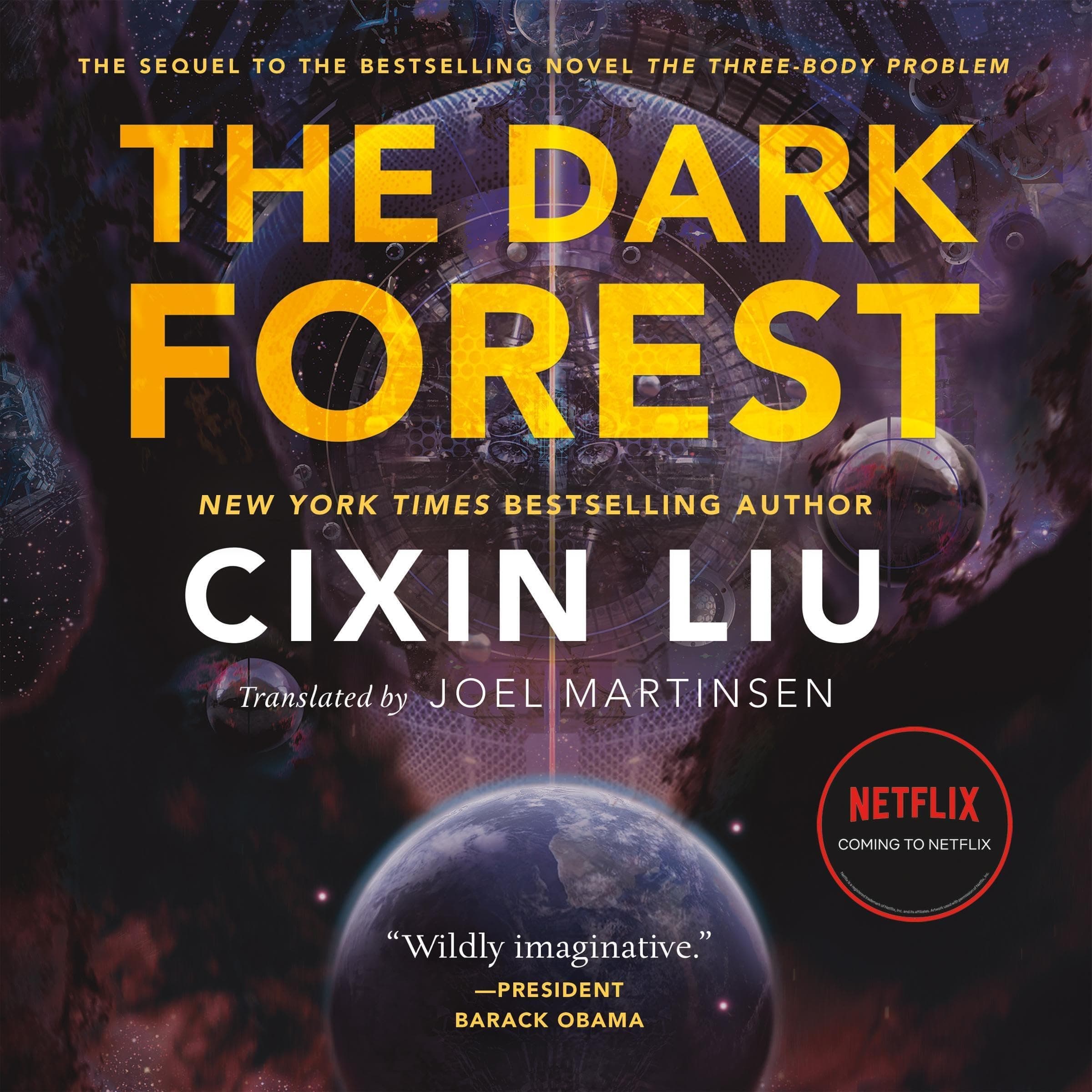
desertcart.com: The Dark Forest (Audible Audio Edition): Cixin Liu, P. J. Ochlan, Joel Martinsen - translator, Macmillan Audio: Audible Books & Originals Review: Even more epic and compelling than its predecessor - It's hard to know where to begin talking about The Three-Body Problem trilogy (officially known as the Remembrance of Earth's Past series), a truly staggering piece of science-fiction written by Chinese author Cixin Liu and translated to English by Ken Liu and Joel Martinsen (Liu did books 1 and 3, while Martinsen did 2). A trilogy that spans literally thousands of years, deals with quantum physics, game theory, sociology, religion, space exploration, space colonization, and more, all driven by the nature of first contact with alien intelligence - there's a lot going on in this series, and that's before you start realizing just how much Cixin (reminder: Chinese names are traditionally written with the family name first and the given name second) truly takes on the advanced science of his ideas. And yet, when you finish it, you realize that you've read something truly incredible - a piece of hard science-fiction whose ambition, scope, richness, and ideas are impossible not to find yourself thinking about for days afterward. Once you read The Dark Forest, the series' second volume, Cixin's ambition for this saga starts to come into focus. The question of first contact is settled, and the nature of the alien's approach is known: this is to be a takeover of our planet. But how can we deal with a race so much more advanced than our own, constant surveillance by extra-dimensional forces, and fractured elements of humanity working against us? If The Three-Body Problem was a first contact novel done as hard science-fiction, The Dark Forest is an alien invasion novel, albeit one in which the actual invasion is still many, many years away. It's the first time Cixin starts using hibernation to leap through decades and even centuries, spanning huge chunks of time as humanity changes and evolves in the face of an arrival which will change everything. As humanity struggles to find ways to either defend itself or show that it means no harm, the race has to deal with its own fears of inevitable defeat or a desire to retreat from the only planet we've ever known. It's not as if The Three-Body Problem wasn't already ambitious, but The Dark Forest is on a whole other level, dealing with interplanetary fleets, lightspeed travel, quantum computing, and more, watching as they evolve over huge swaths of time. But more than that, the novel is a deeply philosophical one, discussing the nature of life in the universe, questions about human nature and how we react in the face of threats, how we work together (or not), and game theory in how we try to handle uncertain intentions in allies and foes alike. Indeed, the central metaphor that gives the book its title (which doesn't arrive until near the novel's end) is a stunning one that helps you understand that what Cixin is writing about isn't just this particular alien invasion, but about the nature of all life in the universe and how we attempt to define ourselves in the face of reality. That Cixin does this while, again, mixing in such a compelling story (focusing especially on the "Wallfacers", a small group of people tasked with covertly planning humanity's resistance against the invasion) is nothing short of remarkable. The Dark Forest builds beautifully off of the questions and ideas raised in The Three-Body Problem, but turns them into something else entirely, changing the questions from "how do we initially react" to "how would we redefine ourselves in the face of such news". Far from suffering from any sort of "middle book syndrome," The Dark Forest is incredible, engaging with incredible concepts but never neglecting the human characters that anchor its massive scope nor the ticking clock at its story's core. To explain this series is a difficult challenge, to put it mildly. This is a series that spans a huge amount of time, deals with advanced scientific concepts in complex terms, grapples with rich philosophical and political ideas, debates questions without easy answers, and gives you a scope that can be daunting. It's a story of alien invasions, yes, but one in which the action sequences we're so used to are replaced with existential dread, a rethinking of our own lives, and a fear of the unknown that's hard to quantify. It's also the story of people caught up in these times, trying to give themselves a good life while never forgetting the larger questions of their era, and juggling their own fears with fears for humanity. In other words, it's what hard science-fiction is great at - thoughtful questions, big ideas, and speculation, all of which change the way you think about the world. This series is a truly incredible achievement, one that honestly left me a bit staggered and reeling as I attempt to think about it all, but one that I love all the more for what it accomplishes. If you're a hard science-fiction fan, or simply someone who loves dealing with the complex ramifications of common ideas, this is a must read series. I've never read anything like it in my life, and I'm a richer person for the ideas it's inspired me to think about. Review: Enjoyed the first two books, but the ending of the second book is ... - Just finished The Three Body Problem and The Dark Forest. Liu hired an excellent translator - the story comes through, it's compelling, and it's good hard sci-fi. I'd recommend these two to sci-fi geeks like me. I've decided not to read the third and fourth books for two reasons: first, the second book ends strangely - it's almost like the last chapter was written by someone else, and, unfortunately is unsatisfying. Second, while I enjoyed the books, they have large sections that plod along a bit - maybe after a break I'll tackle another one, but not for awhile. 😁 The app won't allow me to mark with 3 stars (which I would give the second book) but will allow 4 (which I would give the first book.)
J**E
Even more epic and compelling than its predecessor
It's hard to know where to begin talking about The Three-Body Problem trilogy (officially known as the Remembrance of Earth's Past series), a truly staggering piece of science-fiction written by Chinese author Cixin Liu and translated to English by Ken Liu and Joel Martinsen (Liu did books 1 and 3, while Martinsen did 2). A trilogy that spans literally thousands of years, deals with quantum physics, game theory, sociology, religion, space exploration, space colonization, and more, all driven by the nature of first contact with alien intelligence - there's a lot going on in this series, and that's before you start realizing just how much Cixin (reminder: Chinese names are traditionally written with the family name first and the given name second) truly takes on the advanced science of his ideas. And yet, when you finish it, you realize that you've read something truly incredible - a piece of hard science-fiction whose ambition, scope, richness, and ideas are impossible not to find yourself thinking about for days afterward. Once you read The Dark Forest, the series' second volume, Cixin's ambition for this saga starts to come into focus. The question of first contact is settled, and the nature of the alien's approach is known: this is to be a takeover of our planet. But how can we deal with a race so much more advanced than our own, constant surveillance by extra-dimensional forces, and fractured elements of humanity working against us? If The Three-Body Problem was a first contact novel done as hard science-fiction, The Dark Forest is an alien invasion novel, albeit one in which the actual invasion is still many, many years away. It's the first time Cixin starts using hibernation to leap through decades and even centuries, spanning huge chunks of time as humanity changes and evolves in the face of an arrival which will change everything. As humanity struggles to find ways to either defend itself or show that it means no harm, the race has to deal with its own fears of inevitable defeat or a desire to retreat from the only planet we've ever known. It's not as if The Three-Body Problem wasn't already ambitious, but The Dark Forest is on a whole other level, dealing with interplanetary fleets, lightspeed travel, quantum computing, and more, watching as they evolve over huge swaths of time. But more than that, the novel is a deeply philosophical one, discussing the nature of life in the universe, questions about human nature and how we react in the face of threats, how we work together (or not), and game theory in how we try to handle uncertain intentions in allies and foes alike. Indeed, the central metaphor that gives the book its title (which doesn't arrive until near the novel's end) is a stunning one that helps you understand that what Cixin is writing about isn't just this particular alien invasion, but about the nature of all life in the universe and how we attempt to define ourselves in the face of reality. That Cixin does this while, again, mixing in such a compelling story (focusing especially on the "Wallfacers", a small group of people tasked with covertly planning humanity's resistance against the invasion) is nothing short of remarkable. The Dark Forest builds beautifully off of the questions and ideas raised in The Three-Body Problem, but turns them into something else entirely, changing the questions from "how do we initially react" to "how would we redefine ourselves in the face of such news". Far from suffering from any sort of "middle book syndrome," The Dark Forest is incredible, engaging with incredible concepts but never neglecting the human characters that anchor its massive scope nor the ticking clock at its story's core. To explain this series is a difficult challenge, to put it mildly. This is a series that spans a huge amount of time, deals with advanced scientific concepts in complex terms, grapples with rich philosophical and political ideas, debates questions without easy answers, and gives you a scope that can be daunting. It's a story of alien invasions, yes, but one in which the action sequences we're so used to are replaced with existential dread, a rethinking of our own lives, and a fear of the unknown that's hard to quantify. It's also the story of people caught up in these times, trying to give themselves a good life while never forgetting the larger questions of their era, and juggling their own fears with fears for humanity. In other words, it's what hard science-fiction is great at - thoughtful questions, big ideas, and speculation, all of which change the way you think about the world. This series is a truly incredible achievement, one that honestly left me a bit staggered and reeling as I attempt to think about it all, but one that I love all the more for what it accomplishes. If you're a hard science-fiction fan, or simply someone who loves dealing with the complex ramifications of common ideas, this is a must read series. I've never read anything like it in my life, and I'm a richer person for the ideas it's inspired me to think about.
D**L
Enjoyed the first two books, but the ending of the second book is ...
Just finished The Three Body Problem and The Dark Forest. Liu hired an excellent translator - the story comes through, it's compelling, and it's good hard sci-fi. I'd recommend these two to sci-fi geeks like me. I've decided not to read the third and fourth books for two reasons: first, the second book ends strangely - it's almost like the last chapter was written by someone else, and, unfortunately is unsatisfying. Second, while I enjoyed the books, they have large sections that plod along a bit - maybe after a break I'll tackle another one, but not for awhile. 😁 The app won't allow me to mark with 3 stars (which I would give the second book) but will allow 4 (which I would give the first book.)
S**Y
Perhaps the Best Science Fiction I Have Ever Read
I have been reading science fiction for over forty years. I think I have had a broad exposure to all forms of the genre during that period. After a brief hiatus, several years ago I dove back in; focusing on some of the newer authors, and have been very satisfied with most of my selections. I try to read most of the Hugo and Nebula Award winners, and having done so, I think I have a pretty good idea of what makes outstanding science fiction. With all of that said, I feel strongly that The Dark Forest may be the best work of science fiction I have ever experienced. I read the English translation of Cixin Liu’s Chinese science fiction novel, The Three Body Problem. I thought that it was very good, but not excellent. I was sufficiently intrigued to proceed on to the second novel of the trilogy, The Dark Forest, and I am eternally grateful that I did. I am just floored by how good this novel is, on so many levels. I have read so many science fiction novels that are little more than spaceships and aliens, with poor underlying stories or character development. The Dark Forest is an outstanding piece of literature, above and beyond its label as a work of science fiction. It has very thoughtful themes, touching on philosophy, anthropology, sociology and psychology. The advanced technology and elements of hard science fiction are outstanding, second to none. The underlying story is absolutely captivating, as are the characters. At the conclusion of the Three Body Problem, we are left with an alien race, the Trisolarans, who have embarked on a four hundred year long trip across the galaxy, ostensibly to conquer and inhabit the Earth. Through use of their advanced technology, they have arrested the technological development of the human race and are able to eavesdrop on every aspect of life on Earth. Faced with this scenario, how does the human race respond? As the years pass and different generations are tasked with coming up with strategies to face the threat, the author continues, time and again, to impress with his vision and the elements of human psychology and philosophy that he employs. Most impressive to me is the author’s ability to deal with these philosophical and technological themes in such a way that the reader can easily follow and appreciate. To me, he walks the perfect line between being intellectually challenging, yet approachable (unlike some of Frank Herbert’s work, which was more than I could handle). So, if you have read The Three Body Problem and are trying to decide whether to proceed on to this second installment, I cannot encourage you strongly enough to do so. If you have not read the Three Body Problem, I urge you to do so, with the knowledge that the follow up book will be worth the effort. The Dark Forest wraps up very nicely and could easily be the end of the story; however this is a trilogy, so I will gladly continue to the final chapter, hoping not to be disappointed. The Dark Forest is a terribly difficult act to follow.
G**S
The most refreshing Science Fiction in a long time!
As an avid reader of sci-fi, it was refreshing to read the Remembrance of Earth's Past series. It's inventive, well-written series so and Liu is a master at keeping enough information from you to keep you guessing what everyone is thinking. If you like realistic explanations of alien technology then this is your book. It's not like you reading an astrophysics textbook but it's not Star Wars soft either. Liu aims right for the sweet spot for believable sci-fi. I'll admit, I was a little skeptical about the sequel because I didn't know if it would be able to top the fantastic Three Body Problem. Dark Forest dragged a bit in the beginning and I feared that he wouldn't be able to top the first novel. But the story keeps building and building until the second half of the book where all the ideas really come together. You can feel the pressure humanity is under to survive or enjoy their days as the timer counts down to the doomsday battle. And it's so fun and exciting to see a character's plan to come through as they create their own fate only to be put in a tougher dilemma. Liu moves into the future with this book. Unlike the previous book, Liu takes the story into the future. Three Body spent quite a bit of time in revolutionary China and was one of the fascinating aspects of the story. I like that I got a little cultural lesson as I read. There is less of that in the sequel. We have a hero but he isn't our focus. We are given an assortment of characters to root for or against. They aren't the most developed characters I've read but I didn't find myself caring too much about that the world itself is the main character here. I even found myself empathizing with the Trisolarans, they have their rational reasons for wanting to exterminate humanity. Who's to say we wouldn't do the same if we were in their position?. I'm not leaving any spoilers here.There are no boogeymen in this universe unless you're talking about the other hunters in the dark forest. You're going to have to read the book figure this one out. It's great, read it. Five Stars!
J**E
Plot had been changed for one of the Wallfacer, and a little question about a translated term
Containing a little bit Spoil. Be careful. This English version changed its original plot and become totally different from Chinese version for the part about one of the Wallfacer. As far as I concerned, the changes influenced a lot in the characterization of that Wallfacer, and his character, therefore, had been influenced in some ways. 'Please notice the terms: characterization and character. Their definitions are totally different in plot-writing.) Whether this influence in character is good or bad depends on each reader. However, I am a person always prefer and respect the ORIGINAL ideas from the writer. (Not even for this book, but for many other situation, such as the changes made by GOT series. :( ) These changes in the major plot, I heard from someone, had been requested by the US editor due to the reason that the original plan made by this Wallfacer was related to another book, "Ball lightning“ (also written by Mr. Liu), which were not published in English yet. In this case, Mr. Liu had to change the plot by himself. Frankly speaking, I do not think this request was a good idea. I had not yet read that book when I first read The Dark Forest (in Chinese), either!!! There was no problem to understand it AT ALL!!! The only consequence was that I then eagerly bought that book after finishing The Dark Forest. Why not keep this original plot and introduce the other book in the footnote? Maybe it will be published in English later, right? Then, strange things happened. Another character, Dr. Ding Yi, who also originally came from that Ball Lightning, had survived in this book, for the fact that he was so important and could not be replaced or deleted in anyway from this book. When introducing this character, the plot did mention something about Ball Lightning. Therefore, if you read The Dark Forest in English first, you might find some strange "evidences" left behind in the words just as the one I mentioned above. Here is another strong evidence: after this poor Wallfacer revealed his true plan to the hero, there was a paragraph describing the hero's internal activities, which containing some terms that related to the unchanged (original) plan but had nothing to do the changed one. You may also find the reputation of this Wallfacer shifted from time to time in different parts of this book. Finally, you might become confused, especially when you are not an original Chinese reader of this trilogy. There are always something could not be changed in a written book, even the changes were made by the original writer (under pressure? unwillingly? I suppose so.). Designing a story is a very complicated thing. When it is done, it should be done. For a book with so many intersections among subplots like this trilogy, it is almost impossible to change one of the subplot without disturbing the others or disturbing the overall picture of itself. If you were a writer, who have experiences in writing long stories, you must know what I am talking about. :) I am writing novels as well, so I know how these things going on. My conclusion is that this changes are not necessary, but they have not threatened the whole picture of this second book of the trilogy. Although it might become strange in those places I pointed out, the strangeness falls majorly on that poor Wallfacer (Well, I admit I like this guy in the original Chinese version better.) . Therefore, I gave this FIVE STAR to Mr. Liu, not for the editor or someone else who is responsible of this issue. I will not blame the translator, either. The translation itself is quite good. In fact, I read this one more comfortably than the previous book. Ken's work was also brilliant, but not as native/straightforward as this translator. The translation of the previous book tasted with more Chinese culture inside (I mean, not just the story, but the translation. Ken definitely understands Chinese culture and language better.), and this might be the reason why it is not so straightforward as this one. The two different style of translation both have their own strengths and weakness. p.s. I have one question for Joel...and for native English speaker here...Do you guys feel strange when encountering the term (appeared in the Dark Forest) "inquire one's mother"? The original words in Chinese version was "''xx'''", whose direct translation could be "greet one's mother". "Inquire", however, should be "''" or "''" in Chinese. They are quite different from each other and I was confused by this indirect translation. Well, you guys may be able to get the idea that "''xx'''" is a very suggestive term for that F*** word term. (Please do not tell me this word can not be existing in published novels. There are a bunch of them in GRRM's A Song of Ice and Fire, and directly appeared in TV series. I read a lot of English novels, and F words are here and there, but I have never encountered the expression, "inquire one;s mother".) My question is...does this "inquire one's mother" term originally exist in English? If so...just forget what I am asking about (Maybe you can show some examples here, if possible). If not...do you think a native English speaker can get this idea easily from the translation without knowing the original Chinese term? Thank you in advance. :) Discussions are welcomed, for both opinions about plot changes and the little question above.
A**R
Cosmic Sociology
From reading the user reviews here, I gather that this is not a book for everyone, which was also true with the first book in the series, The Three-Body Problem. However, I found this second installment to be as engrossing as the first, and in some ways, even more so. The translation of this book is more colloquial for English speakers than last time, and I quickly adjusted to the change in tone (although I liked the first book's translation too). Liu has a fertile imagination. He masterfully melds science fact with science fiction. He writes plot like Mozart wrote operas. His style runs the gamut from dry and declamatory to wildly evocative and romantic. He has human nature pegged, especially our habit of idealizing and handing our power over to dictators -- religious, political and social -- and the way this causes us to betray our higher ethics and values. His hypotheses on the consequences of space travel -- cosmic sociology -- are mind-blowing. This sounds abstract, but I'm avoiding spoilers. The Dark Forest is not abstract. It's concrete, loaded with complex characters, intrigue, irony and tragedy. The plot has many unexpected twists, but is easy to follow. We get to experience what space travel might actually be like for human beings a few centuries on. It's fascinating. It's not Star Trek, it's a lot more rough and tumble. Liu's solution to the problem of traveling at hyper speeds on a space vessel is truly amazing. This is a four-star review rather than five-star because the depiction of women is terrible. As a female sci-fi fan, I've had to accept that sexism is common in the genre. Liu's female characters were better represented in the first book, but the fantasy lover who turns up in The Dark Forest is like a blow-up doll that a guy might purchase at a porn store for personal use. Patriarchal stereotypes are not archetypes, they are an offensive shorthand designed to diminish the autonomous humanity of women. Still, I loved the book. Liu is brilliant despite his less-than-evolved perspective on women. When I learned what the title refers to, I was very moved. The explanation pulled together the many plot threads in an astonishing way. I disagree with those reviewers who claim that Liu got lost mid-story and had to write his way out of a tangled mess. On the contrary, the story's architecture was pre-determined and well constructed, and I had no trouble following it or finishing it. Travel through The Dark Forest and hang on for book three. It's quite a ride.
P**L
Hugo / Nebula award please
The second book of this series, “The Dark Forest”, has its obvious shortcomings. The most glaring flaw I personally feel is Luo Ji (the leading character of the second book)’s romance with his “dream girl”. But how many engaging love stories have been told by scifi authors anyway? In addition, for American readers who have enjoyed the Chinese cultural/historical aspects of book one, reading The Dark Forest requires no understanding of the Chinese culture. Some of my friends also think that the Wallfacer project does not make much sense, but I disagree. This book deserves a five-star rating thoroughly. Unlike the Three-Body Problem that bears the burden of slowly laying the contextual foundation for the plot of the entire book series, the pace of The Dark Forest moves rather quickly from the beginning. There is no three-body computer game anymore. But a different game is played between four Wallfacers and their respective Wallbreakers. Each Wallfacer tried and failed in searching for a way to counter the looming invasion. Yet it does not seem to matter because, before the first alien fleet arrives, human technology has accelerated and risen to a level that rivals the alien race. Yes, inter-planetary peace is afoot. Part III of The Dark Forest is the climax and most dramatic stage of the entire trilogy series. Both Luo Ji and Zhang Beihai – two leading characters of the book – are awaken from century-long hibernation to witness the human race’s first physical contact with the aliens. I am not going to the details because it will spoil the fun of your reading. Suffice it to say there are several brilliant twists of the plot that forces the question: what is humanity after all? In my mind, the best scifi novels are not so much about the light-speed space dashing or spectacular galactic wars, but how we define humanity when facing an alien encounter or invasion. The Dark Forest just did that, in a chilling way. Almost like a social scifi, the socio-psychological elements give the book a provocative depth and resonance Zhang Beihai comes out almost as a Vulcan from StarTrek. Not only did he go undercover for many centuries, but also he came up with a shockingly unhuman solution to save the human race in the most dire moment. Morality is of no concern. Just another rational but dark choice in the face of desperation, which is quite consistent with the pervading sense of pessimism about humans through the first two books. This book presents an interesting theory about how different civilizations view each other in the vast universe, hence the reason for the book title “The Dark Forest”. It’s similar to the famous prisoner’s dilemma where betrayal or hostility seems to generate the biggest rewards. The overall concept reminds me of the Inhibitors in “Revelation Space” by Alastair Reynolds. Again, the theory does not produce any good prospect for cosmic harmony. If u think the Three-Body Problem is a bit depressing, the Dark Forest gets bleaker. And of course, Liu is not done yet because the final installment of the trilogy is called “The Dead End”. The Three-Body Problem was the finalist for both Hugo and Nebula awards this year. I will not surprised if the Dark Forest actually win it. That’s how GOOD it is.
T**H
Better than The Three-Body Problem
I was blown away by the inventiveness of The Three-Body Problem, the first book in this trilogy. I wasn’t sure what to expect from this, the second book. Would it be an excellent continuation or a let down from admittedly high expectations? Well, I’m pleased to report that I enjoyed this book immensely, and in some ways, more than the original. Mr. Liu’s inventiveness continues in The Dark Forest. I am completely taken with the Wallfacer/Wallbreaker concept that drives much of the novel. I enjoy his vision of an earth 200 years in the future, waiting for first physical encounter with an alien culture—a probe in advance of the invasion fleet still 200 years away. I absolutely love how this contact runs completely against expectations, confirming that, by definition, we cannot have expectations of a culture that is truly alien, especially one that is more advanced than ours. The emotional bait-and-switch he performs before and after the encounter is excellent. Finally, the conclusions of this story are at once both logical and surprising. This novel is a tour de force of science fiction. Of course, because it is a powerful science fiction novel, it has some of the weaknesses that seem to be inherent in even the best science fiction. Primarily, since this book is driven by a clever plot, character seems to suffer. Other than Wallfacer Luo Ji and his protector Da Shi and, perhaps, soldier Zhang Beihai, none of the other characters seem to have any real depth. And, frankly, Mr. Liu’s depiction of the universe as a “dark forest” is quite depressing, though that is not to say he is wrong. Still, he offers us only faint glimmers of hope. In the end, this is a story that, like the best novels, invites rumination about the nature of the human race and what is out there. If my view is not as dark as Mr. Liu’s, he challenges me to wonder why I believe what I do. I am also left wondering what he has left in store for us in the final novel of the trilogy. I look forward to getting in to that one soon.
TrustPilot
vor 3 Wochen
vor 1 Monat