We remain fully operational. Our teams are working around the clock to ensure your deliveries continue safely.

Laden Sie die App herunter


Kundendienst
Copyright © 2025 Desertcart Holdings Limited
Laden Sie die App herunter
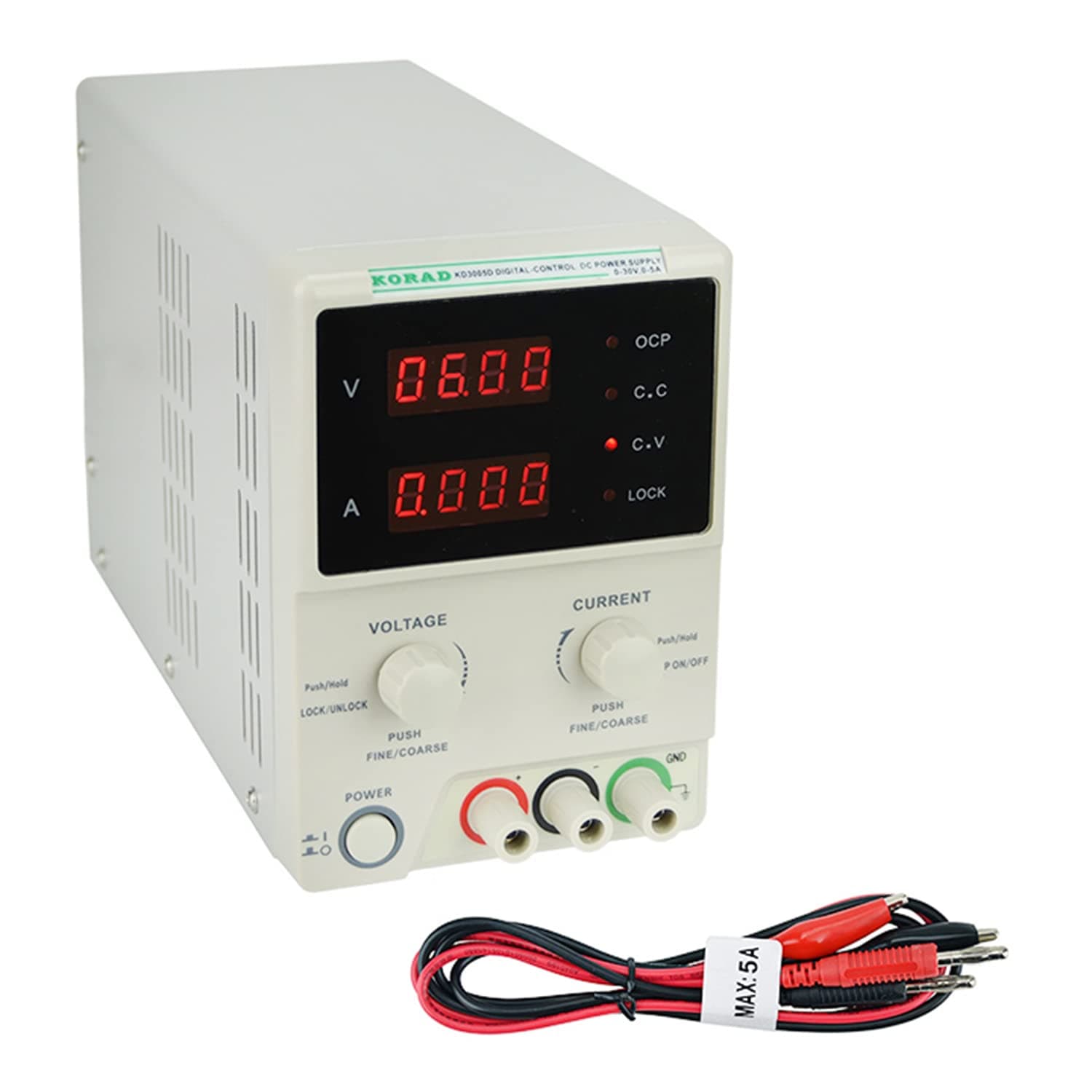
⚙️ Precision Power Meets Professional Performance — Never Settle for Less!
The Korad KD3005D is a compact, lab-grade DC linear power supply offering adjustable 30V and 5A output with dual 4-digit LED displays for precise voltage and current control. It features automatic switching between mA and A readings, supports dual voltage inputs (110/220V), and includes comprehensive circuit protections against overload, short circuit, and overheating. Designed for engineers and tech professionals seeking reliable, accurate power delivery in a sleek, durable metal enclosure.


| ASIN | B00FPU6G4E |
| Batteries Included? | No |
| Batteries Required? | No |
| Best Sellers Rank | #54,724 in Industrial & Scientific ( See Top 100 in Industrial & Scientific ) #34 in Lab Power Supplies #71 in Life Science Supplies |
| Customer Reviews | 4.4 4.4 out of 5 stars (363) |
| Date First Available | May 19, 2012 |
| Included Components | 5 Amp Test Leads, KD3005D Power Supplu, Power Cord, User Manual |
| Is Discontinued By Manufacturer | No |
| Item Package Quantity | 1 |
| Item Weight | 9 pounds |
| Item model number | KD3005D |
| Manufacturer | Korad |
| Material | Metal |
| Part Number | KD3005D |
| Product Dimensions | 14 x 10 x 10 inches |
| Style | KD Series - 5 Amp |
| Wattage | 150.00 |
B**B
Surprisingly accurate
My unit checked out very close to my fluke 87V. It's easy to adjust and will do 5a constant with no problem. Great for the price.
A**E
Perfect home supply
I looked at a lot of supplies and bought this one based on the reviews. As a retired engineer, I'm used to using the high-end stuff, but $500+ is a little much for home use. The $30-$50 units seemed too cheap and the reviews certainly reflect that. The first thing I did when I got this was to pull the cover off. I was impressed with the assembly. Good practice was used. The cables are laced (always a good sign of care being taken), the transformer is huge and the heat sinking looks good. I don't have access to a schematic, so there is no way to evaluate the design, but the innards look great. The controls exceeded my expectations and are very easy to use. The voltage displays in units of .01V and current in units of .001A. Of course, the accuracy is not that good (and doesn't need to be) but you can tweak the settings easily for fine control as needed. To adjust either, just turn the knob. Pressing the knob changes which digit it's changing (10's of volts, 1's of volts, 0.1's of volts or 0.01's of volts). Ditto for current. Note that the knob clicks but it isn't always perfect. So, for instance, to change a setting on the fly, I may select the next unit down and come at the new setting by using 10 clicks instead of one. I'll describe how to use the supply in constant voltage mode. True constant current mode is rarely used, so I won't spend any time on that. To start out, unhook all the outputs. The GND terminal is nothing more than earth ground carried though from the AC line card. It is usually good practice to connect the ground to whatever is consider "common". (Yes, I know about ground loops and the need to sometimes avoid them, but for digital work that is rarely an issue). For most of what we do, common is the "-" post, so hook it to ground. This is easy to do by using some hookup wire and making a jumper using the holes in the posts that you see when you unscrew them a little ways. Now turn on the supply and set the voltage to what you need (for example, 5.0V). Adjust the current to something you think is perhaps twice the expected current needed. This will help protect your circuitry in case something is hooked up wrong. If you now press and hold the current knob until the OCP light comes on, you will set the supply to shut down if the current limit is exceeded. If you don't do this and too much current is being drawn, the supply will enter constant current mode and just reduce the voltage to whatever is needed to push out the current set by the current limit adjustment. If this is caused by an incorrect hookup, you may at this point be frying your circuit. OCP will help prevent that by shutting down the supply. You may still end up blowing something out, but the chances are less. If the supply shuts down, you can start it up again by just tweaking the voltage knob a bit. After things are set up, press and hold the voltage knob until the panel lock comes on. This will prevent anyone (such as little curious hands) from accidently changing your settings. The meters are dual purpose. When you are turning a knob, they show the voltage or current limit setting. After a moment, they go back to reading out the current and voltage being output from the supply. I haven't evaluated parameters like regulation, accuracy, ripple, etc. If I see anything unexpected I'll update this post. Just remember the meters are not accurate to 4 digits but are pretty good (better than 1%). There is utility in having more resolution than precision. For instance, you may want to look for small current changes. My hat's off to the designers for setting them up this way. It is useful if you understand the limitations. I think it is good practice not to push any low priced supply to the design limit. I bought the 5amp model with the intention of never using it to supply more than a few amps. Current is the killer for supplies and being conservative will help it last a long time, I hope.
F**H
Perfect for what I need at home.
I'm very happy with this unit; it's a great value for the price. I have labs available when I need them; I mostly work from home on embedded systems firmware and this supply is ideal. I've had this in pretty much daily use for 2 months now. Apart from one concern (below) I'm quite pleased with it. I wound up taking the skin off to try and solve a problem. It confirmed what I already knew from other reviewers, namely that the construction isn't of super high quality. Internally the frame is constructed of fairly soft metal rails and it takes hardly any force to strip the screws that attach the skin to the frame. All the screws were provided and in place though one lock-washer was missing. The problem that lead to opening the unit up was that, after the first 10 or 12 times pushing the Voltage knob to switch the scale of adjustment the knob ran out of play (no tactile feedback). For a short while it worked if I gripped the rear of the unit and pushed hard. Finally there was nothing doing. After accessing the back of the front panel I balked at disassembling it but fortunately it turned out that the front knob is just a friction-fit on the post of the encoder. So instead of adjusting the encoder, I carefully pried the knob off, added a shim to the end of the encoder shaft that I trimmed from the sticky end of about 6 post-it-notes. That created enough clearance between the knob and the face of the front panel that it operates perfectly now and the fit of the knob on the shaft is still plenty tight. I checked the output voltage under a small load over voltage with an uncalibrated Fluke 189. The difference between the front panel reading and the Fluke it's generally within +/-0.5%. Front panel display has also been consistent with informal current measurements in the 3 mA +/- about 1% range. I deliberately tripped the overcorrect protection circuit and it works as advertised. Don't really have the facilities to make meaningful measurements of power on/off transients so I avoid this when a circuit is connected. Only one thing worries me. Every 2 to 10 hours or so it makes a short (~ one half second) buzzing sound; kind of a 60 Hz noise. I've never been able to react quickly enough to see if I can feel a vibration and I've never scoped the output when this happens. Haven't noticed the display fluctuate either but that could also be due to reaction time. Curious if anyone else has run across this. Will update in the future if I find anything significant about this.
M**Z
Good supply, cheap fan
I got this as my first power supply for use in hobby electronics, so the 30V and 5A is more than enough for me. Out of the box this supply weighs quite a bit due to the hefty power transformer inside, and seems to be made of quality parts considering the price. After taking some measurements the Voltage reading is on point but the current displayed tends to be slightly inaccurate. No big deal as this is something other reviewers have mentioned as well. For a couple months of minimal use the supply worked fine without problems... until I used it to power a circuit that drew just over 200mA at 10V. At this point is when you can expect the fan to switch on periodically to dissipate heat, that is if the fan is working as it should. The fan in this unit was not. Instead I could hear a buzzing noise coming from the fan as it tried to spin, but failed each time. A dead fan. All in all, this supply shows promise to be a good product. Unfortunately for me I didn’t catch this problem until after the return window expired, so now I’m left with the task of replacing the fan myself.
N**Z
The KORAD unit I received exhibited great performance, especially against its peers at similar price ranges. The first thing you'll notice when you pull it out of the box is, it's quite heavy. This is a good thing, the transformer inside the unit looks to be of good quality. The second thing you'll notice, if you apply an electronic load drawing the full 5 amps, is the unit will switch to constant current at 5A. The voltage may drop a little bit (few millivolts) but that's no big deal... you shouldn't run bench power supplies at full load anyways. I and a coworker tested the unit with an oscilloscope and a precise, calibrated electronic load. The voltage readout on the unit under load was bang on. The current readout was bang on. And the ripple, at ~30V drawing the full 5 amps, the maximum power for the unit... was 10 millivolts. This is amazing for such a low cost variable power supply. 10 millivolts ripple will allow you to power many high speed electronic systems with it, and it's cheap enough you can have multiple around to provide for various rails. Of course, it is outside the spec of some parts, but if you're developing with those parts, you will have the budget for more expensive gear to fit that spec. All in all, this is a VERY impressive hobbyist bench power supply, and I hope the quality never falls. They can charge double for this device, and it would still be worth it. I'm using it to power the 24v logic of the Teknic Clearpath SC servo system, and it works very well for that purpose.
S**E
Good power supply, working good , only the fan is noisy (it rattle at low load) it's the way the fan is driven i think
V**7
La caja venía golpeada no estaba bien asegurada pero la fuente está en buenas condiciones y funcionando al 100
C**O
Has always worked perfectly fine for me. I've put 5A through it for long durations of time with no problems. Fan maybe a little noisy when it kicks in but it won't drive you crazy. Knobs feel of quality. Control is basic and easy to understand. I don't know much about how it compares to an expensive power supply, but for the majority of people this will work good.
G**A
se calienta muy rapido, el ventilador es muy ruidoso y constantemente hace un pitido sin conectarle nada, despues de conectarle algo de 19 v el ventilador entra inmediatamente haciendo mucho ruido... no se si fue el producto o la mala suerte de que estaba dañado... habia escuchado exelentes reseñas, pero me decepciono
TrustPilot
vor 1 Monat
vor 2 Wochen