Some deliveries may take a little longer than usual due to regional shipping conditions.

Laden Sie die App herunter


Kundendienst
Copyright © 2025 Desertcart Holdings Limited
Laden Sie die App herunter

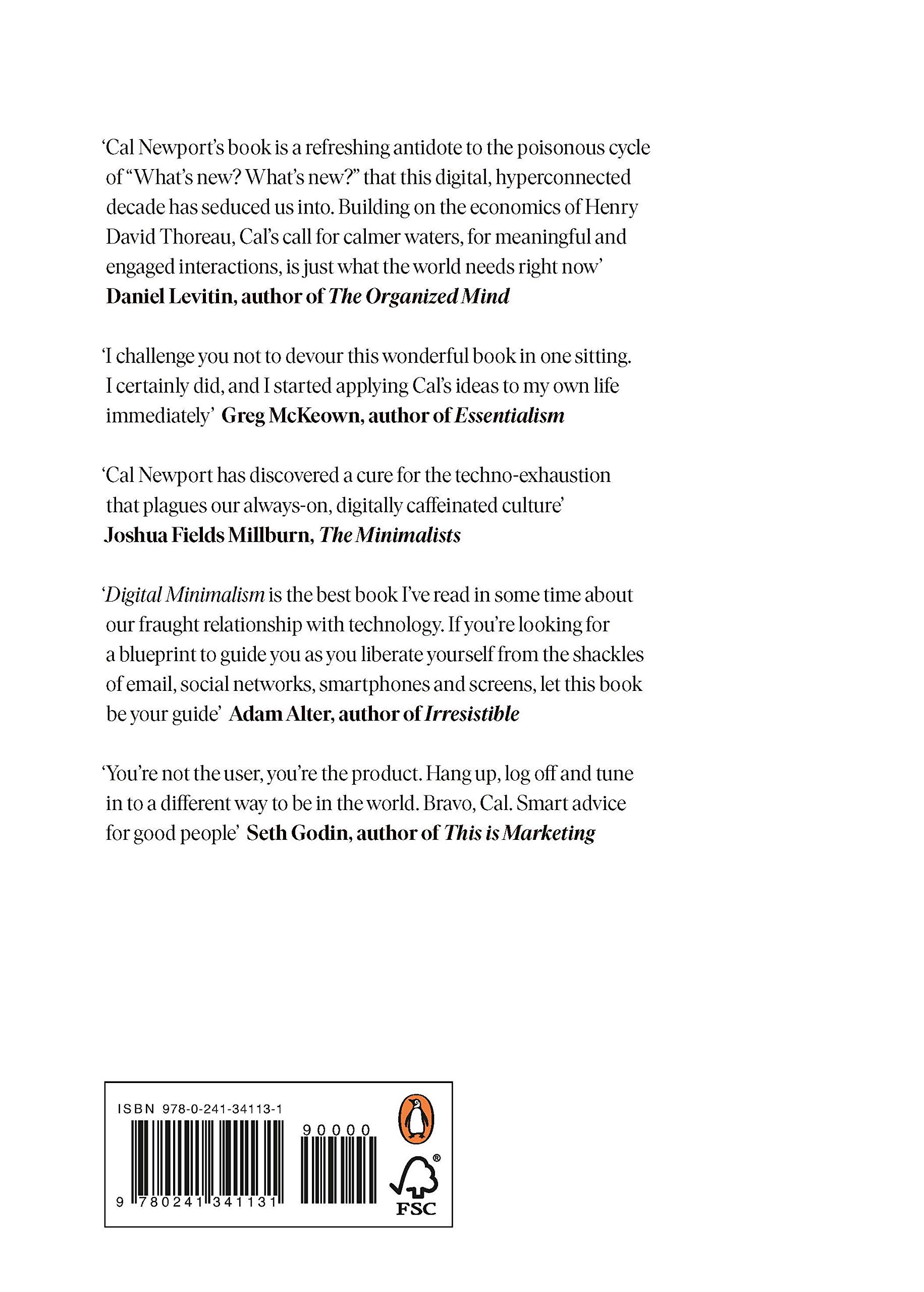

Digital Minimalism [Newport, Cal] on desertcart.com. *FREE* shipping on qualifying offers. Digital Minimalism Review: Serious reading for a meaningful digital relationship. - The reading is compelling, instructional, and practical. I couldn’t put Digital Minimalism down, and ended up "consuming” it in only 4 sits. Because of that, I feel compelled to share a review before you make any commitment. Let me divide this review into 3 parts. First I'll share reasons why I chose to read the book and some personal takeaways. Next, a summary of the book including short excerpts I highlighted while taking notes. Last, I'll suggest a few complementary readings. PERSONAL THOUGHTS I probably pre-ordered this book because I’ve been intrigued by how the overused of modern technologies—specially social networks and social media—have influenced our societies during the last 10 years. This latest wave is actually recent, and being in my early 30s I still remember clearly how life was during high school and early days in college before this explosion. We all acknowledge the wonders of technology, how the development of new tools has helped the prosperity of our societies in many dimensions. However, the opposite is equally important—consequences that deserve to be understood and evaluated. Besides the social, emotional and psychological aspects, which are the main focus of Digital Minimalism, I also care about the impacts on our physical health caused by technology overexposure. Not only how the devices shape our physical posture for worst over the years but also the detrimental effects of electromagnetic fields to our overall health. That said, I’ve been trying to be mindful about technology use during the last 4-5 years. I still have social network accounts, but I feel quite odd among my peers because I’ve been checking these accounts less often than ever—about once a month—but I rarely post pictures or comments. It brings a deep sense of freedom and calmness. In terms of smartphone use, I keep it on airplane mode for around 80% of the awake time, and I often try to go on adventures up in the mountains to be away from signal access for days or weeks at a time. This desire to be unreachable has grown over time and, although it makes me feel grounded and present, I admit that can be quite selfish of me towards loved ones. Reading this book helped me better understand the forces behind addictive technologies, exposed me to pragmatic ideas to implement the minimalism philosophy, and supported my previous thoughts on how we can better handle digital overexposure. SUMMARY [Intro] Digital minimalism, according to Cal Newport, is a philosophy where we focus our online time on a small number of carefully selected and optimized activities that support the things we value. We learn how the author got interested in the topic after receiving feedbacks from his previous book. [Chapter 1] Cal starts with a refresher—bringing back to the early and “potentially innocent" days of Facebook and the iPhone—then, he soon shows how these new technologies took the lead by dictating how we behave and how we feel by pushing us to overuse their products for as long as possible. Interesting story about how NYU professor Adam Alter shifted his research topic after getting “trapped” for 6 uninterrupted hours playing a game on his phone during a cross-country flight. Cal then explains 2 of the main forces used by technology companies to encourage behavior addiction: [1] Intermittent positive reinforcement. [2] The drive for social approval. [Chapter 2] Here is a primer on digital minimalism. We learn that "to reestablish control, we need to move beyond tweaks and instead rebuild our relationship with technology from scratch, using our deeply held values as a foundation.” Cal explains why digital minimalism works through 3 principles: [1] The first principle argues that, when we clutter our time and attention with many apps, social networks, and services, we create an overall negative cost compared to the benefits of each individual item in isolation. I was absolutely delighted to read his arguments by sharing Henry Thoreau’s decision to live for two years in a cabin near the Walden Pond. Thoreau's book, Walden, has actually impacted my life tremendously when I first read as a freshmen in college. [2] The second principle says that besides choosing a technology that supports our values, we should also think how we should use them to extract full benefits—optimizing, therefore, the returns. Here Cal shows how “the law of diminishing returns” can be directly correlated with potential negative effects when technology usage surpass the benefits they can generate. [3] The last principle shows that being more intentional about how we engage with new technologies is one way to become sincerely satisfied. For that, the author illustrates the Amish's approach toward technology: “they start with the things they value most, then work backward to ask whether a given new technology performs more harm than good with respect to their values.” [Chapter 3] In this chapter Cal shares a system for digital decluttering by transforming our relationship with technology. He encourages us to apply a rapid transformation: “something that occurs in a short period of time and is executed with enough conviction that the results are likely to stick.” He divides the process in 3 steps: [1] The first one is to establish which ones of the new “optional” technologies we can step away from without creating major problems in either our professional or personal life. [2] The second step is to take the leap and give ourselves a 30-day break while we rediscover the activities that generate real satisfaction without being attached to our devices. [3] The final step is the reintroduction, building it from the scratch, following the principles previously explained in chapter 2 by choosing carefully the apps/tools and using them with a deeper sense of purpose. [Chapter 4] This is most probably my favorite chapter, where we learn the value of solitude. Cal starts by sharing an interesting story of President Lincoln’s decision to reside in a cottage during months at time, communicating back and forth to the White House on horseback. The author then shares the benefits of solitude such as being a prerequisite for original and creative thoughts, as well as a deeper appreciation for interpersonal connections when they occur. He then shifts gears toward the impacts of solitude depravation, showing, for example, that the rise in anxiety-related problems among students coincide with the use of smartphones and social media. At the end of the chapter we learn 3 practices to foster more solitude moments in our daily lives: [1] To leave our phones and devices at home. [2] To go on long walks. [3] To spend time journaling. [Chapter 5] Now we jump to a chapter rich in social psychology lessons. We first learn how our brains evolved to desire social interactions, but differently than the rich face-to-face encounters, during the last decade or so we have been bombarded by digital communication tools, encouraging interactions through short, text-based messages and approval clicks. At the end Cal offers practices to develop meaningful “conversation-centric communication.” They range from avoiding clicking the “like” button all the way to holding more meaningful conversations during office hours. [Chapter 6] Now we jump to an empowering chapter. We learn to cultivate high-quality leisure time at the same time we declutter the low-quality digital distractions from our lives. They both, in fact, work together in order to create a more purposeful habit. This chapter is filled with real life examples of successful stories where helpful lessons are drawn at the end of each example. Like in the previous chapters, Cal doesn’t share only examples, but also practical ways to adopt his claims. My favorite suggestion is about scheduling in advance the time we'll be spending on low-quality leisure. [Chapter 7] The final chapter is about building a more resistant mindset to avoid the power of the attention economy—which is “business sector that makes money gathering consumers' attention and then repacking and selling it to advertisers." Practices are provided when further discipline is required to avoid exploitation: [1] Delete social media from our phone to remove the ability to access them at any time. If we're going to use social medial, we should access them through a web browser. [2] Turn our devices into purposeful tools, diminishing the number of things they enable us to do. In Cal's own words “I’m not talking about occasionally blocking some sites when working on a particularly hard project. I want you instead to think about these services as being blocked by default, and made available to you on an intentional schedule.” [3] To use social media like a social media professional does. [4] To embrace the slow media consumption by maximizing the quality of what we consume. [5] Making the hard choice to switch from smartphone to a “dumb” phone. COMPLEMENTARY READINGS Well, it doesn’t matter where in the spectrum we fall as long as we vow to move the needle towards a more meaningful and intentional technology use, diminishing our “natural” tendency to become dependent on digital devices. While reading Digital Minimalism I thought about book titles that could complement the content. [1] Essentialism, by Greg McKeown, is definitely the one that comes to mind first. It helped me focus on less but more important tasks, giving clarity to what matters most. [2] Originals, by Adam Grant, helped me see the world of creativity through a different angle by being more true to who I'm. [3] Atomic Habits, by James Clear, has already influenced me to build better and more meaningful habits during the last 3 months. It can be an extremely helpful source to apply the lessons suggested in Chapter 6. [4] Last, if you'd like to learn a bit more about electromagnetic fields and how we can minimize the dangers, look no further than The Non-Tinfoil Guide to EMFs, by Nicolas Pineault. Take good care, Haical Review: A Very Important Book on the Most Important Topic of Our Time - As is always the case, I really enjoyed Cal Newport's writing in his new work. I'm a bit biased in that I read his original yellow book (How to Win at College) almost ten years ago upon beginning college, and I know it played a big part in my success in college and in my professional life. I've kept up with Cal's writing via his blog ever since, but I hadn't pulled the trigger on any of his other books until now. I pre-ordered this book because I couldn't wait to read Cal's book-length treatise on the matter. Cal's philosophy on technology use has always been spot on, which is all the more surprising given his background as an MIT-educated computer science professor. Digital Minimalism was everything I expected it to be, and I can't recommend it enough. It is a book that everyone should read, as it really helps to put our current excessive technology use into perspective. Sadly, most of those reading Digital Minimalism are likely the choir; those who most need to hear Cal's advice will be so caught up in their digital distraction that they will never encounter the book. My favorite thing about the book is that Cal's advice is immensely practical. He is no Luddite, and he does not expect you to eliminate technology from your life. In fact, he urges you to embrace technology when it strongly supports the things you value most in life. He does not argue for or against any specific technology, but instead urges us to closely scrutinize any new technology before allowing it to enter our life. We should stop viewing new technology through the prism of what we are missing out on, and instead evaluate new technology based on how it supports our core goals and, specifically, whether the new technology is the BEST way to support our goals. If a new technology is deemed to be the best way to support our goals, Cal then recommends that we carefully tailor our use of the technology to get the most benefit while minimizing the concomitant distractions. This is where Cal's practical advice shines. For instance, instead of instituting a blanket ban on social media (like his detractors might expect him to do), Cal suggests that those who use social media limit their use to their computer or tablet (i.e., no iPhone social media unless absolutely necessary!) in order to eliminate boredom browsing, and also to tailor their settings for the social media application to ensure that the app is serving the user and not the other way around. Although I share Cal's disdain for social media and abstain from it entirely, I definitely understand that total abstinence may not be feasible for some people, and I feel that his advice is the most common sense approach that I have come across. I found myself agreeing with almost everything Cal says in the book, but I do have two minor critiques. First, toward the end of the book, Cal discusses the emergence of app-blocking software and "Dumb Phones", and seemingly recommends that we adopt these paternalistic mechanisms to prevent us from being trapped by the allure of new technology. Cal's praise for these things weakens the strength of his arguments for the Digital Minimalism philosophy, as it suggests that we are doomed to be sucked into the new technology vortex and that the only way to avoid this outcome is to take drastic measures that will literally not allow us the freedom to make our own choices about technology. I believe Cal's cheerleading of these app-blockers and "Dumb Phones" is short-sighted, as the practices outlined in Digital Minimalism should allow us the strong will to avoid these technological temptations. Also, it needs to be said that introducing these things into your technological mix could actually cause additional distraction; think of how much time you might waste trying to program your browser blocker to prevent yourself from visiting a certain mix of ever-changing sites at various points in the day and week. How much time will we waste researching the best "Dumb Phone" and constantly switching back and forth between it and our regular iPhone? Is it worth all the trouble? Tellingly, at the end of the section Cal seemingly admits that he just sticks with an iPhone, as it is not enough of a distraction for him to have to add the extra hassle of a "Dumb Phone." I think this should be the advice for all of us, as unless we put ourselves in some sort of bubble, there will always be unavoidable digital temptations out there that will require a strong backbone (and Digital Minimalist mindset) to resist. My second criticism is that Cal's advice on how to spend your free time is a bit muddled. On one hand, he strongly stresses the importance of ample amounts of solitude, which he describes as "a subjective state in which your mind is free from input from other minds." Yet he also stresses the importance of prioritizing demanding activities that often require strained mental effort. He references Arnold Bennett, who recommended reading difficult literature and poetry for leisure. To be fair, Cal does caution against taking Bennett's list of prescribed activities too literally, but he seems to endorse Bennett's philosophy of engaging in mentally demanding leisure pursuits that don't fit his definition of solitude. There seems to be a bit of conflict between the recommendation of Thoreau-esque solitude, whereby one might spend his/her time building a cabin or doing simple manual labor, and the recommendation of mentally demanding leisure activities such as reading dense writing. I think that it is likely that both of these types of activities are important, but Cal never really distinguishes between the two nor provides a discussion of how much of each we might need. These two critiques are minor, and really should be viewed more as topics that I hope Cal will address in his future writings as opposed to outright criticisms. I'm a huge fan of Cal and his writing, and I look forward to continuing to learn from him in the future. In conclusion, I strongly recommend that you pick up a copy of Digital Minimalism, and perhaps pick up an extra copy to gift to that person in your life who never looks up from their phone. Digital Minimalism is an important, timely work that we can all benefit from.
| Best Sellers Rank | #8,395,591 in Books ( See Top 100 in Books ) #358 in Business & Money (Books) |
| Customer Reviews | 4.5 4.5 out of 5 stars (9,238) |
| Dimensions | 6.02 x 0.87 x 8.43 inches |
| ISBN-10 | 0241341132 |
| ISBN-13 | 978-0241341131 |
| Item Weight | 12.6 ounces |
| Language | English |
| Print length | 286 pages |
| Publication date | February 7, 2019 |
| Publisher | Portfolio Penguin |
H**D
Serious reading for a meaningful digital relationship.
The reading is compelling, instructional, and practical. I couldn’t put Digital Minimalism down, and ended up "consuming” it in only 4 sits. Because of that, I feel compelled to share a review before you make any commitment. Let me divide this review into 3 parts. First I'll share reasons why I chose to read the book and some personal takeaways. Next, a summary of the book including short excerpts I highlighted while taking notes. Last, I'll suggest a few complementary readings. PERSONAL THOUGHTS I probably pre-ordered this book because I’ve been intrigued by how the overused of modern technologies—specially social networks and social media—have influenced our societies during the last 10 years. This latest wave is actually recent, and being in my early 30s I still remember clearly how life was during high school and early days in college before this explosion. We all acknowledge the wonders of technology, how the development of new tools has helped the prosperity of our societies in many dimensions. However, the opposite is equally important—consequences that deserve to be understood and evaluated. Besides the social, emotional and psychological aspects, which are the main focus of Digital Minimalism, I also care about the impacts on our physical health caused by technology overexposure. Not only how the devices shape our physical posture for worst over the years but also the detrimental effects of electromagnetic fields to our overall health. That said, I’ve been trying to be mindful about technology use during the last 4-5 years. I still have social network accounts, but I feel quite odd among my peers because I’ve been checking these accounts less often than ever—about once a month—but I rarely post pictures or comments. It brings a deep sense of freedom and calmness. In terms of smartphone use, I keep it on airplane mode for around 80% of the awake time, and I often try to go on adventures up in the mountains to be away from signal access for days or weeks at a time. This desire to be unreachable has grown over time and, although it makes me feel grounded and present, I admit that can be quite selfish of me towards loved ones. Reading this book helped me better understand the forces behind addictive technologies, exposed me to pragmatic ideas to implement the minimalism philosophy, and supported my previous thoughts on how we can better handle digital overexposure. SUMMARY [Intro] Digital minimalism, according to Cal Newport, is a philosophy where we focus our online time on a small number of carefully selected and optimized activities that support the things we value. We learn how the author got interested in the topic after receiving feedbacks from his previous book. [Chapter 1] Cal starts with a refresher—bringing back to the early and “potentially innocent" days of Facebook and the iPhone—then, he soon shows how these new technologies took the lead by dictating how we behave and how we feel by pushing us to overuse their products for as long as possible. Interesting story about how NYU professor Adam Alter shifted his research topic after getting “trapped” for 6 uninterrupted hours playing a game on his phone during a cross-country flight. Cal then explains 2 of the main forces used by technology companies to encourage behavior addiction: [1] Intermittent positive reinforcement. [2] The drive for social approval. [Chapter 2] Here is a primer on digital minimalism. We learn that "to reestablish control, we need to move beyond tweaks and instead rebuild our relationship with technology from scratch, using our deeply held values as a foundation.” Cal explains why digital minimalism works through 3 principles: [1] The first principle argues that, when we clutter our time and attention with many apps, social networks, and services, we create an overall negative cost compared to the benefits of each individual item in isolation. I was absolutely delighted to read his arguments by sharing Henry Thoreau’s decision to live for two years in a cabin near the Walden Pond. Thoreau's book, Walden, has actually impacted my life tremendously when I first read as a freshmen in college. [2] The second principle says that besides choosing a technology that supports our values, we should also think how we should use them to extract full benefits—optimizing, therefore, the returns. Here Cal shows how “the law of diminishing returns” can be directly correlated with potential negative effects when technology usage surpass the benefits they can generate. [3] The last principle shows that being more intentional about how we engage with new technologies is one way to become sincerely satisfied. For that, the author illustrates the Amish's approach toward technology: “they start with the things they value most, then work backward to ask whether a given new technology performs more harm than good with respect to their values.” [Chapter 3] In this chapter Cal shares a system for digital decluttering by transforming our relationship with technology. He encourages us to apply a rapid transformation: “something that occurs in a short period of time and is executed with enough conviction that the results are likely to stick.” He divides the process in 3 steps: [1] The first one is to establish which ones of the new “optional” technologies we can step away from without creating major problems in either our professional or personal life. [2] The second step is to take the leap and give ourselves a 30-day break while we rediscover the activities that generate real satisfaction without being attached to our devices. [3] The final step is the reintroduction, building it from the scratch, following the principles previously explained in chapter 2 by choosing carefully the apps/tools and using them with a deeper sense of purpose. [Chapter 4] This is most probably my favorite chapter, where we learn the value of solitude. Cal starts by sharing an interesting story of President Lincoln’s decision to reside in a cottage during months at time, communicating back and forth to the White House on horseback. The author then shares the benefits of solitude such as being a prerequisite for original and creative thoughts, as well as a deeper appreciation for interpersonal connections when they occur. He then shifts gears toward the impacts of solitude depravation, showing, for example, that the rise in anxiety-related problems among students coincide with the use of smartphones and social media. At the end of the chapter we learn 3 practices to foster more solitude moments in our daily lives: [1] To leave our phones and devices at home. [2] To go on long walks. [3] To spend time journaling. [Chapter 5] Now we jump to a chapter rich in social psychology lessons. We first learn how our brains evolved to desire social interactions, but differently than the rich face-to-face encounters, during the last decade or so we have been bombarded by digital communication tools, encouraging interactions through short, text-based messages and approval clicks. At the end Cal offers practices to develop meaningful “conversation-centric communication.” They range from avoiding clicking the “like” button all the way to holding more meaningful conversations during office hours. [Chapter 6] Now we jump to an empowering chapter. We learn to cultivate high-quality leisure time at the same time we declutter the low-quality digital distractions from our lives. They both, in fact, work together in order to create a more purposeful habit. This chapter is filled with real life examples of successful stories where helpful lessons are drawn at the end of each example. Like in the previous chapters, Cal doesn’t share only examples, but also practical ways to adopt his claims. My favorite suggestion is about scheduling in advance the time we'll be spending on low-quality leisure. [Chapter 7] The final chapter is about building a more resistant mindset to avoid the power of the attention economy—which is “business sector that makes money gathering consumers' attention and then repacking and selling it to advertisers." Practices are provided when further discipline is required to avoid exploitation: [1] Delete social media from our phone to remove the ability to access them at any time. If we're going to use social medial, we should access them through a web browser. [2] Turn our devices into purposeful tools, diminishing the number of things they enable us to do. In Cal's own words “I’m not talking about occasionally blocking some sites when working on a particularly hard project. I want you instead to think about these services as being blocked by default, and made available to you on an intentional schedule.” [3] To use social media like a social media professional does. [4] To embrace the slow media consumption by maximizing the quality of what we consume. [5] Making the hard choice to switch from smartphone to a “dumb” phone. COMPLEMENTARY READINGS Well, it doesn’t matter where in the spectrum we fall as long as we vow to move the needle towards a more meaningful and intentional technology use, diminishing our “natural” tendency to become dependent on digital devices. While reading Digital Minimalism I thought about book titles that could complement the content. [1] Essentialism, by Greg McKeown, is definitely the one that comes to mind first. It helped me focus on less but more important tasks, giving clarity to what matters most. [2] Originals, by Adam Grant, helped me see the world of creativity through a different angle by being more true to who I'm. [3] Atomic Habits, by James Clear, has already influenced me to build better and more meaningful habits during the last 3 months. It can be an extremely helpful source to apply the lessons suggested in Chapter 6. [4] Last, if you'd like to learn a bit more about electromagnetic fields and how we can minimize the dangers, look no further than The Non-Tinfoil Guide to EMFs, by Nicolas Pineault. Take good care, Haical
T**N
A Very Important Book on the Most Important Topic of Our Time
As is always the case, I really enjoyed Cal Newport's writing in his new work. I'm a bit biased in that I read his original yellow book (How to Win at College) almost ten years ago upon beginning college, and I know it played a big part in my success in college and in my professional life. I've kept up with Cal's writing via his blog ever since, but I hadn't pulled the trigger on any of his other books until now. I pre-ordered this book because I couldn't wait to read Cal's book-length treatise on the matter. Cal's philosophy on technology use has always been spot on, which is all the more surprising given his background as an MIT-educated computer science professor. Digital Minimalism was everything I expected it to be, and I can't recommend it enough. It is a book that everyone should read, as it really helps to put our current excessive technology use into perspective. Sadly, most of those reading Digital Minimalism are likely the choir; those who most need to hear Cal's advice will be so caught up in their digital distraction that they will never encounter the book. My favorite thing about the book is that Cal's advice is immensely practical. He is no Luddite, and he does not expect you to eliminate technology from your life. In fact, he urges you to embrace technology when it strongly supports the things you value most in life. He does not argue for or against any specific technology, but instead urges us to closely scrutinize any new technology before allowing it to enter our life. We should stop viewing new technology through the prism of what we are missing out on, and instead evaluate new technology based on how it supports our core goals and, specifically, whether the new technology is the BEST way to support our goals. If a new technology is deemed to be the best way to support our goals, Cal then recommends that we carefully tailor our use of the technology to get the most benefit while minimizing the concomitant distractions. This is where Cal's practical advice shines. For instance, instead of instituting a blanket ban on social media (like his detractors might expect him to do), Cal suggests that those who use social media limit their use to their computer or tablet (i.e., no iPhone social media unless absolutely necessary!) in order to eliminate boredom browsing, and also to tailor their settings for the social media application to ensure that the app is serving the user and not the other way around. Although I share Cal's disdain for social media and abstain from it entirely, I definitely understand that total abstinence may not be feasible for some people, and I feel that his advice is the most common sense approach that I have come across. I found myself agreeing with almost everything Cal says in the book, but I do have two minor critiques. First, toward the end of the book, Cal discusses the emergence of app-blocking software and "Dumb Phones", and seemingly recommends that we adopt these paternalistic mechanisms to prevent us from being trapped by the allure of new technology. Cal's praise for these things weakens the strength of his arguments for the Digital Minimalism philosophy, as it suggests that we are doomed to be sucked into the new technology vortex and that the only way to avoid this outcome is to take drastic measures that will literally not allow us the freedom to make our own choices about technology. I believe Cal's cheerleading of these app-blockers and "Dumb Phones" is short-sighted, as the practices outlined in Digital Minimalism should allow us the strong will to avoid these technological temptations. Also, it needs to be said that introducing these things into your technological mix could actually cause additional distraction; think of how much time you might waste trying to program your browser blocker to prevent yourself from visiting a certain mix of ever-changing sites at various points in the day and week. How much time will we waste researching the best "Dumb Phone" and constantly switching back and forth between it and our regular iPhone? Is it worth all the trouble? Tellingly, at the end of the section Cal seemingly admits that he just sticks with an iPhone, as it is not enough of a distraction for him to have to add the extra hassle of a "Dumb Phone." I think this should be the advice for all of us, as unless we put ourselves in some sort of bubble, there will always be unavoidable digital temptations out there that will require a strong backbone (and Digital Minimalist mindset) to resist. My second criticism is that Cal's advice on how to spend your free time is a bit muddled. On one hand, he strongly stresses the importance of ample amounts of solitude, which he describes as "a subjective state in which your mind is free from input from other minds." Yet he also stresses the importance of prioritizing demanding activities that often require strained mental effort. He references Arnold Bennett, who recommended reading difficult literature and poetry for leisure. To be fair, Cal does caution against taking Bennett's list of prescribed activities too literally, but he seems to endorse Bennett's philosophy of engaging in mentally demanding leisure pursuits that don't fit his definition of solitude. There seems to be a bit of conflict between the recommendation of Thoreau-esque solitude, whereby one might spend his/her time building a cabin or doing simple manual labor, and the recommendation of mentally demanding leisure activities such as reading dense writing. I think that it is likely that both of these types of activities are important, but Cal never really distinguishes between the two nor provides a discussion of how much of each we might need. These two critiques are minor, and really should be viewed more as topics that I hope Cal will address in his future writings as opposed to outright criticisms. I'm a huge fan of Cal and his writing, and I look forward to continuing to learn from him in the future. In conclusion, I strongly recommend that you pick up a copy of Digital Minimalism, and perhaps pick up an extra copy to gift to that person in your life who never looks up from their phone. Digital Minimalism is an important, timely work that we can all benefit from.
O**.
Çok güzel kitap, dijital dünya da kaybolduğumuzun farkındalığını anlatıyor. Ciltli bu fiyata olması da ayrı güzel
C**Z
Es un libro para aquellos que no quieren ser absorbidos por las #herramientas digitales y ver cómo se consume su tiempo en navegar sin sentido en las apps debido a la adicción a los dispositivos electrónicos. Yo siempre doy gracias a Dios que soy de otra generación 😂 Otra vez podemos ver ejemplos de hábitos valiosos en personajes de siglos pasados. Resulta irónico que tomemos ejemplos de cómo vivir bien no de nuestra época, sino de épocas pasadas, cuando se supone que debería ser al revés, debido al supuesto progreso. Me llamó la atención que es un libro de lectura fácil y rápida. Buen libro
T**S
Good insights and a practical guide for improving you leasure time!
I**I
Great book
S**A
this book was able to make me get away of the dependency of apple watch and notifications it really makes you think about how do you use social media and your phone
TrustPilot
vor 3 Wochen
vor 3 Wochen