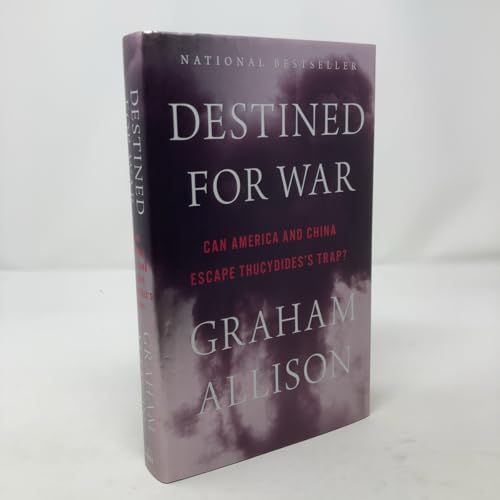
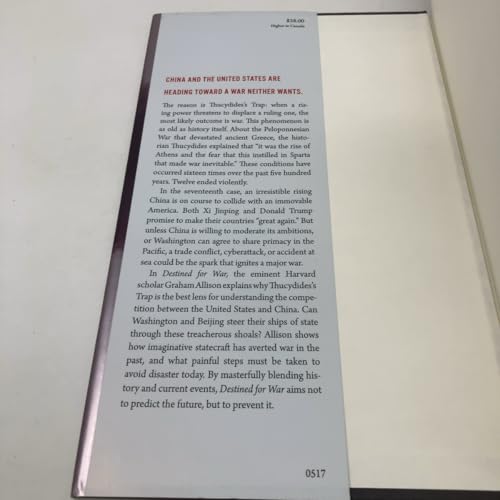

Destined for War: Can America and China Escape Thucydides’s Trap? [Allison, Graham] on desertcart.com. *FREE* shipping on qualifying offers. Destined for War: Can America and China Escape Thucydides’s Trap? Review: Must read to contextualize the growing frictions between the US and China - This book is excellent and the author could see the currently heightened frictions we are witnessing between China and the US miles away. The author describes the dynamics of great power struggles through history and refers us to Thucydides and the Peloponnesian Wars to frame an understanding of the inevitable conflict arising when there is a rising power facing an incumbent power. This book was written in 2017 but it was quite prophetic for the events of 2018 and the dynamics illustrated in the book are a valuable way to think about the current conflict we are witnessing. The author splits the book into four parts. He starts just by framing China's economic development over the past several decades and its current economic might as well as its different structure to the western idea of an ideal socio-economic system. China's growth has been remarkable and remains remarkable and it is important to take stock of its history to understand what form the national ambitions might take. The author then gets into the history of great power conflicts framing the discussion in terms of the Thucydides trap. He discusses the Peloponnesian War and the dynamics of how such conflicts arose benignly. The author details several similar conflicts including Spain and Portugal, US & Great Britain at the turn of the century, WW1 is discussed. The author then discusses China and the US. The author starts by discussing what China and Xi want, which is to restore China to its historic level of greatness. As the current world order was structured without China's influence. CHina legitimately can feel like rules need to be re-written to be more balanced. The author discusses Huntington and the message in the Clash of Civilizations and in particular discusses the deep intrinsic differences between the West and China and conception of right and wrong and the role of the state. The author also goes through the exercise of discussing various fictional states of the world where China and the US stumble into military conflict. They all seem highly plausible reminding the innocent reader that the world is a complex interconnected yet fragile place and we shouldn't trivialize what is required to keep it in balance. The author then gives his optimism about the ability to navigate away from conflict. Obviously the current state of military technology means war is potentially the end of humanity when it comes to nuclear powers. Nonetheless the author highlights that if national objectives are well thought out and the US starts to focus on what is in its vital interest rather than blindly want to hold on to the old status quo, a more honest assessment of mutual accommodation can be possible. The current frictions, manifesting themselves as a trade war, are strong evidence of a great power struggle that has many historical precedents and can be considered the Thucydides trap. Graham Allison writes a very clear overview of how to think about the current challenges faced and the ways to navigate them for mutual benefit. If only he were a current policy advisor instead of an academic as the current administration is in sore need of a clear mind and strategy. If one wants to view the current geopolitical climate in its context, read this book. Review: compelling analysis of Thucydides trap and power struggle - This book presents a compelling and thought-provoking analysis of the potential conflict between rising powers and established ones, a concept already known as Thucydides's Trap. I liked writer’s insightful exploration of historical events shows how tense relationship can be between emerging powers and existing ones. A good narrative gives historical lessons and geopolitical analysis. I think this book is an essential read for anyone interested in understanding the complexities of global power struggles and understanding of the strategic challenges changing our scary world today.
| Best Sellers Rank | #707,814 in Books ( See Top 100 in Books ) #29 in Asian Politics #438 in History & Theory of Politics #955 in Military History (Books) |
| Customer Reviews | 4.6 4.6 out of 5 stars (2,549) |
| Dimensions | 6.5 x 1.25 x 9.5 inches |
| Edition | First Edition |
| ISBN-10 | 0544935276 |
| ISBN-13 | 978-0544935273 |
| Item Weight | 1.28 pounds |
| Language | English |
| Print length | 364 pages |
| Publication date | January 1, 2014 |
| Publisher | Houghton Mifflin Harcourt |
A**N
Must read to contextualize the growing frictions between the US and China
This book is excellent and the author could see the currently heightened frictions we are witnessing between China and the US miles away. The author describes the dynamics of great power struggles through history and refers us to Thucydides and the Peloponnesian Wars to frame an understanding of the inevitable conflict arising when there is a rising power facing an incumbent power. This book was written in 2017 but it was quite prophetic for the events of 2018 and the dynamics illustrated in the book are a valuable way to think about the current conflict we are witnessing. The author splits the book into four parts. He starts just by framing China's economic development over the past several decades and its current economic might as well as its different structure to the western idea of an ideal socio-economic system. China's growth has been remarkable and remains remarkable and it is important to take stock of its history to understand what form the national ambitions might take. The author then gets into the history of great power conflicts framing the discussion in terms of the Thucydides trap. He discusses the Peloponnesian War and the dynamics of how such conflicts arose benignly. The author details several similar conflicts including Spain and Portugal, US & Great Britain at the turn of the century, WW1 is discussed. The author then discusses China and the US. The author starts by discussing what China and Xi want, which is to restore China to its historic level of greatness. As the current world order was structured without China's influence. CHina legitimately can feel like rules need to be re-written to be more balanced. The author discusses Huntington and the message in the Clash of Civilizations and in particular discusses the deep intrinsic differences between the West and China and conception of right and wrong and the role of the state. The author also goes through the exercise of discussing various fictional states of the world where China and the US stumble into military conflict. They all seem highly plausible reminding the innocent reader that the world is a complex interconnected yet fragile place and we shouldn't trivialize what is required to keep it in balance. The author then gives his optimism about the ability to navigate away from conflict. Obviously the current state of military technology means war is potentially the end of humanity when it comes to nuclear powers. Nonetheless the author highlights that if national objectives are well thought out and the US starts to focus on what is in its vital interest rather than blindly want to hold on to the old status quo, a more honest assessment of mutual accommodation can be possible. The current frictions, manifesting themselves as a trade war, are strong evidence of a great power struggle that has many historical precedents and can be considered the Thucydides trap. Graham Allison writes a very clear overview of how to think about the current challenges faced and the ways to navigate them for mutual benefit. If only he were a current policy advisor instead of an academic as the current administration is in sore need of a clear mind and strategy. If one wants to view the current geopolitical climate in its context, read this book.
S**O
compelling analysis of Thucydides trap and power struggle
This book presents a compelling and thought-provoking analysis of the potential conflict between rising powers and established ones, a concept already known as Thucydides's Trap. I liked writer’s insightful exploration of historical events shows how tense relationship can be between emerging powers and existing ones. A good narrative gives historical lessons and geopolitical analysis. I think this book is an essential read for anyone interested in understanding the complexities of global power struggles and understanding of the strategic challenges changing our scary world today.
J**N
"Destined for Critique?"
"Destined for War: Can America and China Escape Thucydides's Trap?" is a refreshing, timely-as-timely-can-get, powerful commentary on the bilateral relationship of America and China. And, yes, it is bashed online, mostly in The New Yorker's article and countless others which, ironically, follow exactly in the mold of the "sleepwalkers" mentioned in the book. These are the skeptics, who would rather sugarcoat the matter, no matter how grave and pressing the circumstances, like the U.S. and Japan in 1941 or pre-WWI Europe, than try to use their imagination to tackle the unpleasant, unimaginable scenario of war. One of the criticisms mentioned by the critics is the the author's alleged lack of knowledge about China and its realities. For one, it is true that dr. Allison got many facts, numbers, mostly, wrong in the book. Was it due to lack of proper preparation and other, more nuanced sources? Perhaps. One of these is his claim that over 20 million Chinese left the mainland for Taiwan in the aftermath of the 1949 communist victory, while it was between 1-2 million people, including roughly 600 thousand military, and most of them connected to to the Kuomintang. I understand this is factually wrong and should be pointed out, but it is essentially a sideline comment, having little or nothing to do with the thesis of the book, which is the titular "Thucydides's Trap." Next, there's the criticism that Graham Allison is too fixated on the idea that the Chinese actually like the CCP's reforms, however bloodthirsty and outsized they might seem to Washington pundits, and are more interested in China displacing the U.S. as the leader in Asia. Actually, both polls done by the CCP and outside parties, including even Harvard Kennedy School show a major support of the population for the central government, over 80%, mostly due to Xi's rejuvenation of the PLA and unprecedented crackdown on corruption. Most of the discontent is usually placed on local governments, which have much more autonomy in China than they do, for instance in Europe or even the U.S. Thus, the party is avoiding much of the criticism for everyday matters and gaining support for the overall direction in which the country is going. All in all, this review was not meant to be a praise of the book, really, because as I said, it seems to have a clear thesis and does its job neatly. Rather, I wanted to ask anyone who is considering reading it, but was discouraged by the harsh critiques online, to go ahead and focus on the important stuff.
J**A
Es un análisis ordenado y bien escrito sobre como China y EEUU están evolucionando hacia una previsible confrontación grave. Explica con lucidez cómo ven la realidad cada una de las partes. Hay posibilidades de evitar el conflicto, pero requiere que se progrese en cuestiones en las que no parece que estemos progresando. Muy recomendable
D**I
Chances are, you are probably aware of the worsening tension between the West and China and particularly between the United States and China. This book serves as a great reading for those who want to know why and how we got to this point in history as well as where we might head into the future. The author is unbiased and provides a fair assessment of both sides. The author does a good job criticizing and praising both sides when needed. I am no fan of the Chinese government but when China does something like lifting millions of people out of poverty, I do think it is a feat to be praised. Don't get me wrong, I don't like the Chinese government as demonstrated by their reckless and unbelievable behaviour in recent years but understanding the success of China is the key to understand their society and culture and how they were able to maintain their power. Graham also provides times and scenarios where both governments had acted arrogantly or let their ignorance get to them. I do think it is important to show how both countries aren't as perfect as they seem. But given the choice, America, despite all its problems is the beacon of hope, change and democracy. Graham Allison does an excellent examination of the cultural difference and nuance of both countries and how this plays in the bigger picture. To China, the US is an anomaly and it is only a matter of time before China ascends to its rightful place in what it believes as the leader of Asia if not the world. To the United States, China is a totalitarian state that is hell-bent on creating a new world order that will kill democracies and American ideals. China sees itself as the centre of the universe while the US sees itself as number one. However, this isn’t only the culture lesson as Graham also examines other cultural nuances, behaviour and thinking. Nationalism and constant reminders of the century of humiliation created a ticking time bomb and will cause trouble for the CCP if they were to ever back down. This was a huge topic that rarely gets explored and Graham does a good job exploring it in his scenarios of what might trigger the next conflict. Graham also explores this in other aspects and how China instills a sense of duty to everyone and even those living in the west who have Chinese ancestry to act in defence and improvement of the motherland. The book talks about History, economics, Domestic politics, International/geopolitics and so much more. The book also has extra pages of information for those who are interested. The book includes an index, is full of rich information, detailed citations, footnotes and sources. Really useful for any geopolitical buffs and for further digging on interesting statements such as Hillary Clinton saying how she doesn't want to live in a world dominated by the Chinese. Just be warned that the book does go a bit heavy on the history side but it is crucial in understanding the world we live in today. Although the book does provide a blueprint for peace, I believe that war may happen in the future. Given the information that Graham brought up shows that humans would always repeat the same mistakes and given enough time, it wouldn't be surprising if China and the US fought a war. Let this book serve as a warning or a preview of what might come in the future.
L**A
“A Caminho da Guerra” é um livro que nos faz refletir sobre a geopolítica atual. O argumento do autor é que, ao longo da história, sempre que uma potência emergente passava a ameaçar a hegemonia da potência dominante, o risco de um conflito se tornava iminente. Fenômeno que ele chamou de armadilha de Tucídides, em referência ao historiador grego que retratou os conflitos entre Atenas e Esparta na antiguidade. Ao longo dos anos, algumas dessas disputas se tornaram guerras concretas, como o caso ateniense, mas também a Alemanha e a Grã-Bretanha, no início do século XX. Outros conflitos foram latentes, mas não descambaram para a guerra direta, como os USA e a URSS, durante a Guerra Fria. Agora, a potência emergente é a China, que desafia a hegemonia que os USA desfrutam desde a queda do Muro de Berlim. A invasão da Ucrânia revela que a Rússia ainda não aceita seu papel nesse novo cenário. Suas ogivas nucleares garantem o seu lugar à mesa. A China tem sido o fiel da balança nesse conflito e sua resistência em condenar o regime de Putin demonstra que ela não está disposta a aceitar os “desígnios do ocidente”, garantindo sua influência na Eurásia. Não é possível prever o futuro, mas esse livro, com a ajuda da história, nos ajuda a entender o que pode vir por aí.
E**N
本書の主題はずばり”いかに戦争を回避するか”です。 著者は、学生の頃にキューバ危機を分析した『決定の本質』で政策的意思決定分野のパラダイムを築いたと言われ、 ハーバード大学のケネディ行政大学院初代学長を務めたグレアム・アリソン。つまり結構な重鎮だし、発言力もある人です。 そのアリソンが、過去500年の”ツキジデスの罠”を調べた研究結果をまとめたのが本書(のように見える)。 ツキジデスの罠と言うのは、古代ギリシャ時代、成長するアテネが覇権国家スパルタに挑戦し、ペロポネソス戦争に発展したのを受けて、ペロポネソス戦争を歴史的にまとめたツキジデスが提示した仮説「覇権国家が成長中の国家にその地位を脅かされたときに戦争が勃発する」のこと。 アリソンは過去500年の「覇権国家が成長国家に脅かされた」事例を16個特定、そのうち12個が戦争に発展、4個は戦争にはいたらかなった=回避ができたという。 そのことから、米国(派遣国家)と中国(成長国家)は、皆が想像している以上に、戦争に突入する可能性が高いだろうと論じている。 一方で、4例は回避できていることからも、回避は可能であると述べており、特に ①自国家(アメリカ)の絶対に譲れないラインの明確化 ②相手国家(中国)の絶対に譲れないラインの推定 ③外交戦略を立てること ④自国内で抱える政治問題にちゃんと向き合う事 の4点が、戦争回避のためには必要だとのことです。 ③は意外かもしれませんが、オバマも”今の時代にケナンの様な外交官は必要ない”というようなことを言っていたようですし、④に至っては、たしかに自国内の抱える問題・不満のはけ口を外交の舞台に求めているように見えることはあるような気がします。 また、①についは、アメリカにとって台湾やベトナムは絶対に譲れないラインではないとまで述べています。(絶対に譲れないのは”核戦争を回避すること”だとのこと) 自分は完全なる戦争反対派なので(だってベネディクト・アンダーソンが言ったように、”国家”などというものは想像上のものに過ぎないし、そんなもののために命を捨てたくはない)、戦争を避けるにはどうしたら良いか、という非常に重要な論点を抑えた本書は、少しでも戦争勃発のリスクを下げるために重要な作品だと思います。
C**H
It certainly is a great book. The best part has to do with conflict-escalation scenarios that might trigger a military confrontation between the US and China. I know the book was not about China's grand strategy, but that's perhaps the part that I missed the most.
TrustPilot
vor 2 Wochen
vor 1 Woche